wayground logo

Free Printable Worksheets

Font size

S
M
L
XL
Worksheets

Natural Selection

Total questions: 25

Worksheet time: 6hrs 15mins

Name
Class
Date
1.
Over time, the climate of an island became drier, which resulted in changes to the populations of various island finch species. Finch populations with a certain beak shape thrived, while those not having that beak shape decreased. Which of the following describes a necessary condition for these changes in the finch populations to occur?
a)
fewer mutations
b)
limited food resources
c)
limited beak variations
d)
overproduction of offspring
2.
Which of the following best illustrates natural selection?
a)
An organism with favorable genetic variations will tend to survive and breed successfully. 
b)
A population monopolizes all of the resources in its habitat, forcing other species to migrate.
c)
A community whose members work together utilizing all existing resources and migratory routes.
d)
The largest organisms in a species receive the only breeding opportunities.
3.
 According to fossil records, the horses that lived 50 million years ago were much smaller, weaker and slower than modern horses. Which process is most likely responsible for the changes that have led to the increased size, strength, and speed in horses?
a)
commensalism
b)
 inbreeding
c)
migration 
d)
evolution by natural selection
4.

Adaptations can be:

a)

camouflage

b)

ability to survive cold weather

c)

hunting skills

d)

all of the above

5.

Natural selection occurs during the lifetime of a single organism.

a)

True

b)

False

6.

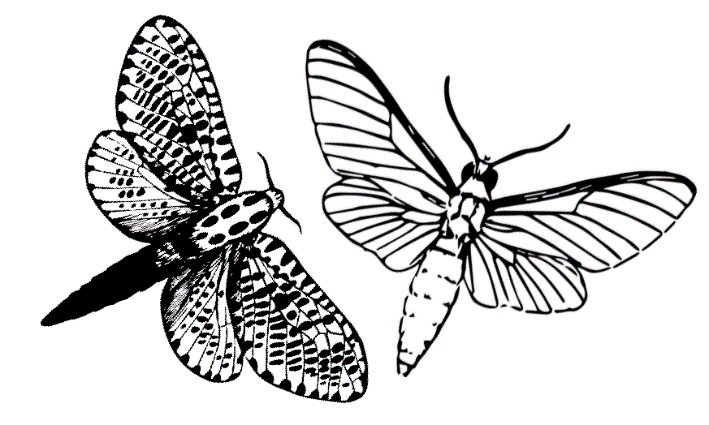
What is most likely to happen to moth populations in the picture shown?

a)

Light moths--hunted easily, dark moths--population increase

b)

Dark moths--hunted easily, dark moths--population increase

c)

Light moths--hunted easily, light moths--population increase

d)

Lights moths will change their color to match dark moths.

7.

TRUE or FALSE: Natural selection will still occur if individuals are exactly the same.

a)

TRUE

b)

FALSE

8.

How do you "win" at natural selection?

a)

survive

b)

go extinct

c)

survive & reproduce

9.

Due to pollution, a pond becomes darker over time. Which trait variation became more common?

a)

light fish

b)

dark fish

10.
Where the better adapted organisms survive to pass traits along to offspring.
a)
Evolution
b)
Natural Selection
c)
Extinction
d)
Artifical Selection
11.
Why are advantageous traits more likely to be passed onto offspring?
a)
Because they are more likely to survive and reproduce.
b)
Because they come from dominant alleles.
c)
Because they come from recessive alleles.
d)
Because the trait is an acquired phenotype.
12.

According to natural selection, light colored tree trunks would favor

a)

light colored moths

b)

dark colored moths

c)

red colored moths

d)

red and light colored moths

13.
Which organisms are most likely to survive?
a)
the best adapted
b)
the fastest
c)
the strongest
d)
the most domesticated (tamed)
14.
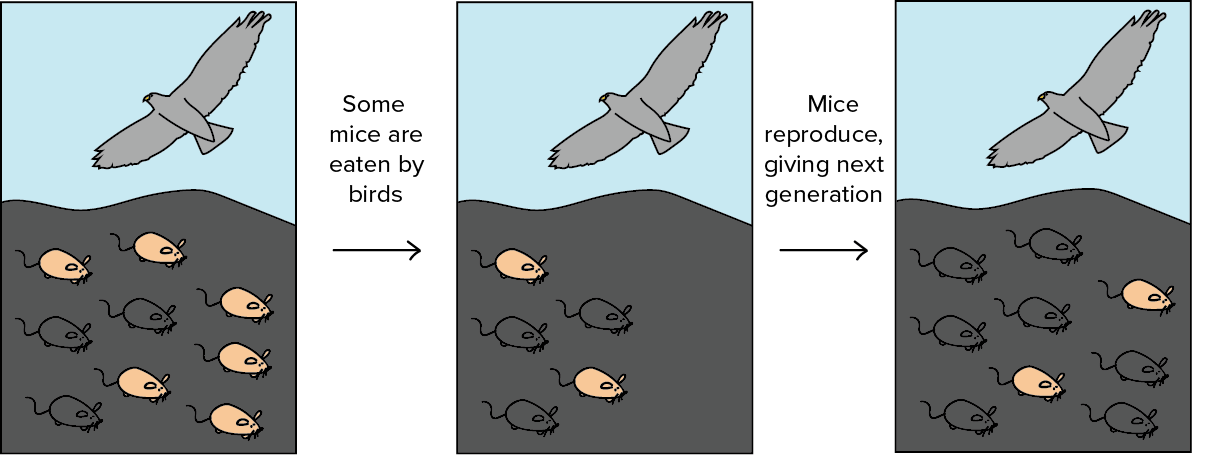
Why is the mouse population changing over time?
a)
The light mice can reproduce more successfully than the dark mice
b)
The hawks eat more dark mice than light mice because the dark mice taste better
c)
The hawks eat more light mice than dark mice because they can see the light mice more easily
d)
The hawks eat more dark mice than light mice because they can see the dark mice more easily
15.
Most organisms have more offspring than will survive 
a)
True
b)
False
16.
Definition: adaptation
a)
inherited characteristic that increases chances of survival
b)
organisms with traits well suited to their environment survive and reproduce at a greater rate
c)
a growing population causes a scarcity of resources
d)
differences in the DNA sequence
17.
Definition: natural selection
a)
inherited characteristic that increases chances of survival
b)
organisms with traits well suited to their environment survive and reproduce at a greater rate
c)
a growing population causes a scarcity of resources
d)
differences in the DNA sequence
18.
Definition: fitness
a)
ability to survive and reproduce in a specific environment
b)
organisms with traits well suited to their environment survive and reproduce at a greater rate
c)
a growing population causes a scarcity of resources
d)
differences in the DNA sequence
19.
The differences among a species, like different bird beaks, are called
a)
genes.
b)
variations.
c)
traits.
d)
theories.
20.
What process is being shown in this image?
a)
Variation
b)
Natural Selection
c)
Selective Breeding
d)
Homeostasis
21.
what gave Charles Darwin the idea of evolution?
a)
google
b)
wikipedia
c)
mans attempt to destroy mankind
d)
finches in the Galapagos island
22.
Which statement best describes the process of evolution?
a)
Populations can survive in different locations on earth
b)
Environmental conditions limit the number of species on Earth
c)
Populations grow when resources are abundant
d)
The traits of a species can change over time
23.
Charles Darwin’s observation that finches of different species on the Galápagos Islands have many similar physical characteristics supports the hypothesis that these finches 
 
a)
have the ability to interbreed.
b)
acquired traits through use and disuse.
c)
all eat the same type of food.
d)
descended from a common ancestor.
24.
The economist Thomas Malthus suggested that
a)
in the human population, people die faster than babies are born.
b)
without certain checks on population size, there would soon be insufficient food for the growing human population.
c)
in the 1700s, England needed more housing.
d)
the majority of a species’ offspring die.
25.
Darwin realized that the economist Malthus’s theory of population control 
a)
applied only to humans.
b)
 could be generalized to any population of organisms.
c)
could be generalized only when populations lived in crowded conditions.
d)
explained why the number of deaths exceeded that of births.