wayground logo

Free Printable Worksheets

Font size

S
M
L
XL
Worksheets

Evidence for Evolution Vocabulary

Total questions: 49

Worksheet time: 1hrs 2mins

Name
Class
Date
1.
A change in the inherited characteristics of an organism over time is ________
a)
evolution.
b)
development.
c)
growth.
d)
ancestry.
2.
In stage one (top row) of these embryos, most of the embryos________
a)
look very similar.
b)
have very different features.
c)
show different stages of development.
d)
have only a tail if they are non-human.
3.

Which scientist visited the Galapagos Islands and came up with the theory of natural selection?

a)

Theodor Schwann

b)

Gregor Mendel

c)

Charles Darwin

d)

Rudolf Virchow

4.

What type of evidence is represented in the picture above:

a)

Fossils

b)

Vestigial Structures

c)

DNA

d)

Homologous Structures

5.

What type of evidence is shown in the image above?

a)

Fossils

b)

Vestigial structures

c)

Homologous Structures

d)

DNA

6.

What type of evidence are shown in the picture above?

a)

Fossils

b)

Embryology

c)

Homologous Structures

d)

Vestigial Structures

7.
The similarities of the bones in the diagram provide evidence that---
a)
The organisms shown lived in the same natural envionrment
b)
The organisms shown may have developed from a common ancestor
c)
The organisms shown have the same genetic diseases
d)
All vertebrate species have identical forelimbs
8.
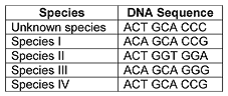
According to this data, the unknown bacterial species is most closely related to: 
a)
Species I
b)
Species II
c)
Species III
d)
Species IV
9.
The diagram shows fossils in different rock layers. Which of these statements about the age of these fossils is most likely correct?
a)
Fossil A and C are the same age
b)
Fossil B is older than fossil C
c)
Fossils A is older than fossil B
d)
Fossil D is older than fossil C
10.

Body parts similar in structure and origin

a)

evolution

b)

embryology

c)

homologous

d)

variation

11.
Changes in species that allow that species to survive changes in the environment are called:
a)
ecosystems
b)
adaptations
c)
biomes
d)
alleles
12.
A theory has significant evidence to support it.  True or False
a)
True
b)
False
13.
Whales are aquatic mammals that contain a pelvis bone.  Even though it does not aid in its movement, the function must have been used by a common ancestor of the whale.  Thus, the pelvis is referred to as a(n)
a)
vestigial structure
b)
analogous structure
c)
homologous structure
14.
In stage one (top row) of these embryos, most of the embryos________
a)
look very similar.
b)
have very different features.
c)
show different stages of development.
d)
have only a tail if they are non-human.
15.

The appendix, tailbone, and wisdom teeth are all examples of what type of structure in humans?

a)

Homologous

b)

Analogous

c)

Vestigial

d)

Modern

16.

What is the value of a transitional fossil?

a)

Transitional forms show the evolutionary steps between species.

b)

Transitional forms are evidence of punctuated equilibrium.

17.
Bird's beaks evolve mainly due to the type of ___________________ available.
a)
food
b)
water
c)
shrubs
d)
mates
18.
A slight difference in an inherited trait between individual members of the same species.
a)
variations
b)
adapatations
c)
homologous structures
d)
analogous structures
19.
When an organism of a species has an adaptation, it will compete for resources better, survive longer and pass that adaptation on to it's offspring. This process is called
a)
evolution by natural selection
b)
artificial selection
c)
inbreeding
d)
outbreeding
20.
The English naturalist that developed the theory of how evolution works.
a)
Charles Darwin
b)
Charles M. Schulz
c)
Charles Dickens
d)
Charles Norris
21.
Which of the following is a term for a group of similar organisms that can reproduce fertile offspring?
a)
individual
b)
population
c)
species
d)
fossil
22.
The ability of an organism to survive and reproduce in its specific environment 
a)
diversity.
b)
evolution
c)
adaptation
d)
 fitness
23.
Inherited trait that helps an organism survive is a(n) __________.
a)
Fossil
b)
Adaptation
c)
Ancestor
d)
Natural selection
24.
A remnant or trace of an organism from the past is called a _______.
a)
Ancestor
b)
Skeleton
c)
Fossil
d)
Imprints
25.
A fossil of an extinct dinosaur is found and the anatomy of the fossil shows similarities to that of a bird. What could this mean?
a)
This is purely by chance and isn't significant
b)
The extinct dinosaur and modern bird share a common ancestor
c)
All dinosaurs evolved into birds and that's why there aren't any dinosaurs alive today
d)
Dinosaurs choose to fly, and evolved into birds to escape predation and capture food
26.
Drawn observed several different types of finches.  Why are there so many different types?
a)
Finches live in different places, but eat the same food.
b)
Finches live in the same place, but eat different types of food.
c)
Finches live in different habitats and eat different types of food.
d)
Finches are found all over the world.
27.
In the graph shown, how many species of lizards seem to have beneficial adaptations?
a)
1
b)
2
c)
3
d)
4
28.

the system of classifying living things into categories

a)

Species

b)

Orginize

c)

Kingdom

d)

Taxonomy

29.

True or False: An organism's scientific name tells you the family in which the organism belongs.

A

a)

True

b)

False

30.

Organisms are classified based on ________.

a)

the number of them that exists in a species

b)

their Greek names

c)

similarities and evolutionary relationships

d)

the year their fossils are discovered

31.

An organism's scientific name identifies the ________ and the ________ in which the organism belongs.

a)

genus, species

b)

order, genus

c)

family, species

d)

class, order

32.

According to the diagram, what is the common ancestor of ALL organisms on the phylogenetic tree?

a)

B

b)

C

c)

D

d)

E

33.

Using the diagram, is organism 4 MORE closely related to organism 3 or 5?

a)

3

b)

5

34.

Which group on the cladogram arose FIRST?

a)

Theropods

b)

Allosaurus

c)

Robin

d)

Velociraptor

35.
The diagram shows layers of sedimentary rock and examples of the fossils each layer contains, Which layer contains the oldest fossils? 
a)
A. Layer 2
b)
B. Layer 4
c)
C. Layer 1
d)
D. Layer 3
36.
Which fossil layer is the youngest? 
a)
A. Layer A
b)
B. Layer B
c)
C. Layer C
d)
D. Layer D
37.
What prehistoric animal is this?  
a)
Archaeopteryx
b)
Tyrannosaurus rex
c)
Big Bird
d)
Stegosaurus
38.

Paleontologists found a fossil with feathers, now known as, Archaeopteryx, which lived approximately 150 million years ago. When comparing Archaeopteryx to other small dinosaurs and modern-day birds, the paleontologists learned that Archaeopteryx had more in common with dinosaurs. The Archaeopteryx were small and had broad wings which likely gave them the ability to fly or glide. How can the Archaeopteryx fossils be used to support the theory of evolution? 

a)

They give evidence to support the idea that organisms inherit the best traits from their parents. 

b)

They show how organisms today share characteristics with fossilized species. 

c)

They can demonstrate that animals from long ago are still alive today. 

d)

They indicate that evolution is a theory because scientists do not completely understand the fossil record. 

39.
What is the purpose of a dichotomous key?
a)
to find a common ancestor
b)
to show the evolution of organisms
c)
to show relationships between organisms
d)
to identify organisms
40.
From the table, which two animals are MOST CLOSELY related
a)
House Cate and Red Fox
b)
Red Fox and Dog
c)
Dog and Wolf
d)
Wolf and Gopher
41.
Term given to describe the 2 name naming system is:
a)
dichotmous key
b)
binomial nomenclature
c)
2 scientific names
d)
binomial key
42.
A dichotomous key for trees is provided. Hikers found a tree that has large brown cones and single sharp needles. What species of tree have the hikers found?
a)
Juniper
b)
Pine
c)
Spruce
d)
Fir
43.
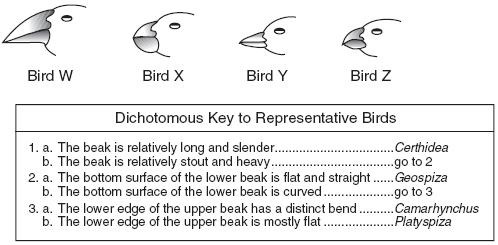
What is the name of bird Z?
a)
Certhidea
b)
Geospiza
c)
Camarhynchus
d)
Platyspiza
44.

Which of the following is NOT an adaptation?

a)

Quills

b)

Speed

c)

Camouflage

d)

Fish

45.

TRUE OR FALSE: All mutations are bad

a)

TRUE

b)

FALSE

46.

TRUE or FALSE: Mutations are random

a)

TRUE

b)

FALSE

47.

TRUE or FALSE: Mutations lead to variation.

a)

TRUE

b)

FALSE

48.

What is most likely to happen to moth populations in the picture shown?

a)

Light moths--hunted easily, dark moths--population increase

b)

Dark moths--hunted easily, dark moths--population increase

c)

Light moths--hunted easily, light moths--population increase

d)

Lights moths will change their color to match dark moths.

49.

Due to pollution, a pond becomes darker over time. Which trait variation became more common?

a)

light fish

b)

dark fish