wayground logo

Free Printable Worksheets

Font size

S
M
L
XL
Worksheets

Geometry Review

Total questions: 75

Worksheet time: 19hrs 45mins

Name
Class
Date
1.
What additional information is required for the 2 triangles to be congruent by SSS?
a)
A
b)
B
c)
C
d)
D
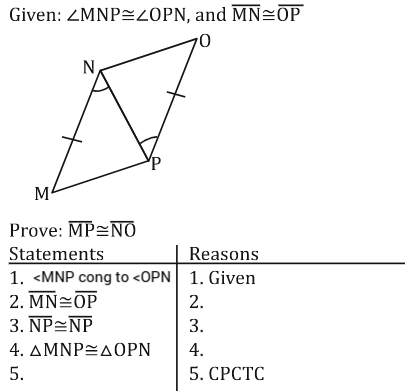
2.
Fill in the missing proofs.
a)
Transitive Property, SAS(Side-Angle-Side)
b)
Reflexive Property, SAS(Side-Angle-Side)
c)
Reflexive Property, Vertical Angles Thm.
d)
Transitive Property, SSS(Side-Side-Side)
3.

Given: <1 and <3 are vertical angles. What should you conclude by the vertical angles theorem?

a)

<1 and <2 are a linear pair

b)

<1 and <3 are right angles

c)

<2 and <4 are vertical angles

d)

<1<3<1\cong<3  

4.
Name the postulate, if possible, that makes the triangles congruent.
a)
SAS
b)
ASA
c)
AAS
d)
Not Possible
5.
Which transformation will result in being similar to the original figure but has a larger area?
a)
Dilation with scale factor of 2
b)
Dilation with scale factor of 1
c)
Dilation with scale factor of .5
d)
Translation 
6.

Which of the following describes the sequence of transformations shown?

a)

Reflect across the x-axis and then rotate 90º clockwise around the origin

b)

Rotate 90º degrees around the origin and then translate right.

c)

Reflect across the x-axis and then reflect across the y-axis.

d)

Translate up and then rotate 90º counter clockwise about the origin.

7.
What additional information is required for the 2 triangles to be congruent by SSS?
a)
A
b)
B
c)
C
d)
D
8.
What slope is perpendicular to:  
m = 5/8
a)
-5/8
b)
5/8
c)
-8/5
d)
8/5
9.
What slope is parallel to:  
m = 4
a)
4
b)
-1/4
c)
-4
d)
1/4
10.
What rule describes the translation?
a)
(x - 6, y + 2)
b)
(x - 2, y + 6)
c)
(x + 2, y - 6)
d)
(x + 6, y - 2)
11.
Solve for x.
a)
7
b)
-4
c)
8
d)
9
12.
Solve for x.
a)
9
b)
-7
c)
4
d)
6
13.
Solve for x.
a)
4
b)
11
c)
9
d)
7
14.
The point that is to be transformed is called the:
a)
Pre-Image
b)
Image
c)
Post-Image
d)
Triangle
15.
What is the angle of rotation for this counterclockwise rotation about the origin?
a)
90°
b)
180°
c)
270°
d)
360°
16.

Reflect (3,5) over the x-axis.

a)

(2,2)

b)

(3,-5)

c)

(-3,-5)

d)

(-3,5)

17.

When you translate, (x,y+6) will move _____.

a)

6 units right

b)

6 units left

c)

6 units up

d)

6 units down

18.
Identify the transformation from ABC to A'B'C'.
a)
90o clockwise rotation
b)
90o counter clockwise rotation
c)
Reflection across the y-axis
d)
Reflection across the x-axis
19.

Choose ALL the degrees of rotation that will map a regular hexagon onto itself.

a)

90

b)

120

c)

150

d)

240

e)

300

20.
Congruent by
a)
SSS
b)
SAS
c)
ASA
d)
AAS
21.
Slopes of perpendicular lines are...
a)
opposite reciprocals.
b)
opposites.
c)
identical.
d)
always 7.
22.

Which of the following is a correct statement and reason for the proof shown?

a)

JKJK\overline{JK}\cong\overline{JK} ; Reflexive

b)

ML\angle M\cong\angle L ; Reflexive

c)

MJLK\overline{MJ}\cong\overline{LK} ; Midpoint Theorem

d)

MKLJ\overline{MK}\cong\overline{LJ} ; Hypotenuse Congruence

23.

What is Reason B?

a)

Definition of Congruence

b)

Definition of Vertical Angles

c)

Reflexive Property

d)

Vertical Angle Theorem

24.
Fill in the blank.
a)
Given
b)
Reflexive Property
c)
Transitive Property
d)
They're the same side!!!!!! 
25.
What is this picture an example of? 
a)
An angle
b)
A cat vertex 
c)
Rotation 
d)
Dilation
26.

Which postulate can be used to prove ∆ABC ≅ ∆EDC?

a)

 AAA

b)

SSS

c)

SAS

d)

ASA

e)

SSA

27.
Fill in the missing proofs.
a)
Transitive Property, SAS(Side-Angle-Side)
b)
Reflexive Property, SAS(Side-Angle-Side)
c)
Reflexive Property, Vertical Angles Thm.
d)
Transitive Property, SSS(Side-Side-Side)
28.
Are the triangles congruent, if yes, why?
a)
SAS
b)
ASA
c)
AAS
d)
Not congruent
29.
What is the correct choice for Reason 2?
a)
Given
b)
Prove
c)
Reflexive Property
d)
Definition of Congruence
30.
Name the postulate, if possible, that makes the triangles congruent.
a)
SSS
b)
SAS
c)
ASA
d)
Not Possible
31.
Name the postulate, if possible, that makes the triangles congruent.
a)
SSS
b)
SAS
c)
AAS
d)
Not Possible
32.
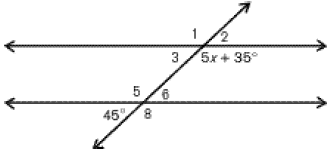
What type of angle pair is ∠1 and ∠5?
a)
alternate interior angles
b)
corresponding angles
c)
alternate exterior angles
d)
vertical angels. 
33.
Which rule would dilate shows a scale factor of 4
a)
(x, y) → (y, x)
b)
(x, y) → (x + 4, y + 4)
c)
(x, y) → (x, -y)
d)
(x, y) → (4x, 4y)
34.
Which of the following lines goes through the point        (-3, 4) and is perpendicular to  y = 3/2x + 6?
a)
y = 3/2x - 6
b)
y = 2/3x + 3
c)
y = -2/3x - 2
d)
y = -2/3x + 2
35.
Which of the following transformations creates a figure that is similar (but not congruent) to the original figure? (multiple choice)
l. Translation   ll. Rotation   lll. Dilation
a)
l only
b)
ll only
c)
lll only
d)
ll and lll
36.

What is the relationship of the two angles shown in the picture and what is the value of x.

a)

Complementary; x=3.4

b)

Complementary; x=45

c)

Supplementary; x=20

d)

Supplementary; x=175

e)

Vertical Angles x= -5

37.

WHAT IS THE CORRECT EQUATION AND THE VALUE OF X?

a)

X=12

b)

8X - 17 + 5X +19 = 180

c)

8X - 17 = 5X +19

d)

X= 2

e)

X= 2/3

38.

Identify the transformation from ABC to A'B'C'.

a)

90o clockwise rotation

b)

90o counter clockwise rotation

c)

Reflection across the y-axis

d)

Reflection across the x-axis

e)

Translation down 2 units

39.

What is the sequence of transformations?

a)

Reflect over the y then reflect over the x

b)

Reflect over the x then reflect over the y

c)

Translate 4 units then rotate 90˚

d)

Rotate 90˚ then reflect over the x

e)

Rotation of 180 degrees

40.

Choose the correct transformations

a)

rotate 90 degrees counter-clockwise around the origin, and then reflect over the x-axis

b)

right 1, down 4, and then reflection over the y-axis

c)

right 6, and then reflection over the x-axis

d)

reflection over the line y=x, and then translate up 4, right 2

e)

reflection of the x-axis, and then a translation to the left 6

41.

The rule for rotation of 90 degrees counterclockwise is

(x, y) --> _

a)

(y, -x)

b)

(-y, x)

c)

(x, -y)

d)

(-x, y)

e)

(-x,-y)

42.

Which of the following transformation will map the regular pentagon onto itself, choose ALL that apply?

a)

x axis reflection

b)

y axis reflection

c)

90 degree rotation

d)

180 degree rotation

e)

72 degree rotation around the orgin

43.

What are the angles of rotation for a square?

a)

multiples of 30

b)

multiples of 45

c)

multiples of 90

d)

multiples of 180

44.

How many lines of symmetry does this figure have?

a)

None

b)

Two

c)

One

45.
What is this transformation?
(x, y) ----> (-x, y) 
a)
Reflect over the x axis
b)
Reflect over the y-axis
c)
Slide down 1
d)
slide left 1
46.
Point C (-5, 4) is reflected over the x-axis. What are the coordinates of C'? 
a)
(5, 4)
b)
(-5, -4)
c)
(5, -4)
d)
(-5, 4) 
47.

What is this transformation?

(x, y) ----> (-x, y)

a)

Reflect over the x axis

b)

Reflect over the y-axis

c)

Slide down 1

d)

slide left 1

48.
What is this transformation?
(x, y) ----> (-x, y) 
a)
Reflect over the x axis
b)
Reflect over the y-axis
c)
Slide down 1
d)
slide left 1
49.
What is the Algebraic Notation for this Reflection?
a)
(x, y) → (y, x)
b)
(x, y) → (-x, y)
c)
(x, y) → (-y, -x)
d)
(x, y) → (x, -y)
50.
Reflect the point (2, -4) over the y-axis.
a)
(-4, 2)
b)
(-2, 4)
c)
(-2, -4)
d)
(2, 4)
51.
Point C (-5, 4) is reflected over the x-axis. What are the coordinates of C'? 
a)
(5, 4)
b)
(-5, -4)
c)
(5, -4)
d)
(-5, 4) 
52.

Reflections over the x-axis change the __________.

a)

y-coordinate

b)

x-coordinate

53.

Reflections over the y-axis change the ___________.

a)

y-coordinate

b)

x-coordinate

c)

y-axis

d)

x-axis

54.

Reflect the point (2, -4) over the y-axis.

a)

(-4, 2)

b)

(-2, 4)

c)

(-2, -4)

d)

(2, 4)

55.

What changes when an ordered pair, or point, is reflected across the y-axis?

a)

Neither the x-value nor the y-value

b)

y-value only

c)

x-value only

d)

Both the x-value and the y-value

56.

What is this transformation?

(x, y) ----> (-x, y)

a)

Reflect over the x axis

b)

Reflect over the y-axis

c)

Slide down 1

d)

slide left 1

57.
Is the picture being reflected in the y-axis or x-axis?
a)
y-axis
b)
x-axis
58.
Which answer shows a reflection across the x-axis?
a)
d
b)
c
c)
b
d)
a
59.
Reflect Point C over the y-axis:
a)
(-3, 2)
b)
(3,2)
c)
(-2,3)
d)
(3,0)
60.
Is the picture being reflected in the y-axis or x-axis?
a)
y-axis
b)
x-axis
61.
What is this transformation?
(x, y) ----> (-x, y) 
a)
Reflect over the x axis
b)
Reflect over the y-axis
c)
Slide down 1
d)
slide left 1
62.
What is a reflection?
a)
When you turn an object around a point.
b)
When you slide an object form one place to another.
c)
When you flip or mirror an object across a line.
d)
When you resize an object.
63.

What axis is the image reflected over?

a)

X-axis

b)

Y-axis

64.
State the line of reflection.
a)
Reflection across y-axis
b)
Reflection across x-axis
c)
Reflection across x = 1
d)
Reflection across y = 1
65.
∆QRS contains the points: Q(4, 2) R(5, 1) S(3,7). If the triangle is reflected across the y-axis, what will S' be?
a)
S'(3, 7)
b)
S'(-3, 7)
c)
S'(-3, -7)
d)
S'(3, 7)
66.
Another name for Reflection is...
a)
flip
b)
turn
c)
slide
d)
dilation
67.
∆BCD contains the points: B(2,3) C(2,1) D(5,1). If the triangle is reflected across the x-axis, what will B' be?
a)
B'(2, -3)
b)
B'(-2, 3)
c)
B'(-2, -3)
d)
B'(2, 3)
68.
Point P is graphed at (4,5) shown on the grid below.  Point P is 90⁰ counterclockwise to Point P'.  What are the coordinates of P'?
a)
(-5, 4)
b)
(-4, 5)
c)
(5, -4)
d)
(-4, -5)
69.

Relfect the image over the y-axis and then translate it 4 to the right and down 3. Which quadrants will the image be located in?

a)

Quadrant I and II

b)

Quadrant II and III

c)

Quadrant III and IV

d)

Quadrant I and IV

70.
What is Dilation?
a)
Dilation means to enlarge or reduce
b)
Dilation means to reflect on something
c)
Dilation means to like something
d)
Dilation means to make something different by making it smaller
71.
A triangle has vertices A(0,0), B(8,0), C(3,-2). Find the coordinates of the triangle after a dilation with a scale factor of  4. The dilation is (X,Y) --- (4x,4y)
a)
A(3,3), B(4,4), C(-3,-4)
b)
A(-4,8), B(6.5,8), C(7,7)
c)
A(0,0), B(32,0), C(12,-8)
72.

What is the rule for a 270 degree clockwise rotation?

a)

(x, y) --> (-y, x)

b)

(x, y) --> (y, -x)

c)

(x, y) --> (-x, -y)

73.
Choose the correct scale factor:
a)
2
b)
3
c)
1/3
d)
1/2
74.

The point A (8, 12) was dilated to become point A' (2, 3). What was the scale factor?

a)

½

b)

¼

c)

4

d)

2

75.
How do you write the algebraic notation when the scale factor is 3?
a)
(x, y) goes to (1/3x, 1/3y)
b)
(x, y) goes to (-3x, -3y)
c)
(x, y) goes to (x + 3, y + 3)
d)
(x, y) goes to (3x, 3y)