
 Worksheets
Algebra Essentials Review
Total questions: 90
Worksheet time: 3hrs 10mins

Find the value of y when x = 2
(a)
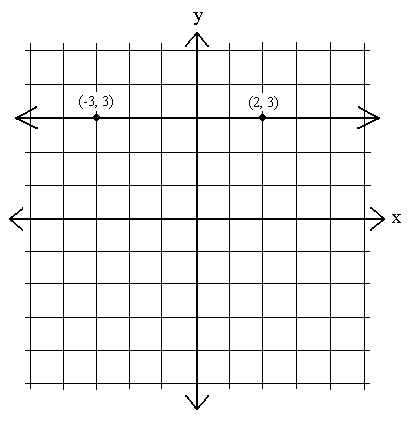

Are the following points a function?
(-2,-5), (-2,-1), (-2,1), (-2,3)
HINT
It's a function if EACH x-value is paired with only ONE y-value.
It's NOT a function if the SAME x-value REPEATS and is paired with TWO DIFFERENT y-values.
Yes
No
Are the following points a function?
(0,2), (1,1), (2,2), (4,3)
HINT
It's a function if EACH x-value is paired with only ONE y-value.
It's NOT a function if the SAME x-value REPEATS and is paired with TWO DIFFERENT y-values.
Yes
No

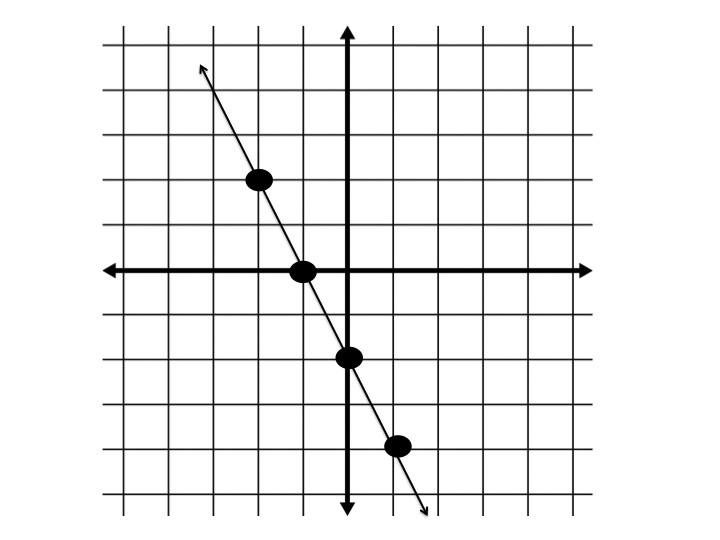
What is the y-intercept?
(a)

Is this graph a function or not a function?
HINT: Remember the VERTICAL LINE TEST!

Find the slope:
y = 2x - 10
(a)
The term "solutions" is the same as
y-intercept
roots
x-intercepts
vertex
zeros
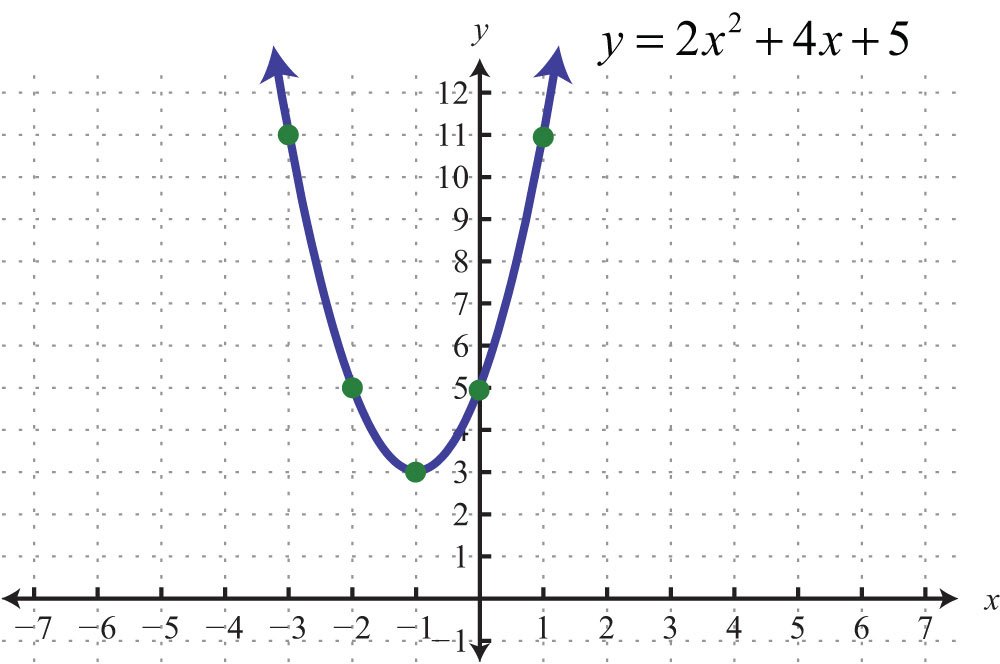
Where is the axis of symmetry for this parabola?
HINT: Remember that the axis of symmetry always passes through the VERTEX

one solution
two solutions
no real solutions
cannot be determined with the given information
x-intercept
Vertex
Solutions
Zeros

How many real solutions does the quadratic have?
No real solutions
One real solution
Two real solutions

What could the factored form of this function be?
y = x(x + 4)
y = x(x - 4)
y = x(4x)

Where is the axis of symmetry for this parabola?
HINT: Remember that the axis of symmetry always passes through the VERTEX

(0, 4)

What are the factors of the quadratic?
HINT: Think OPPOSITE
(x−2)(x+8)
(x+2)(x−8)
(x−6)(x+2)
(x+6)(x−2)
(53x2y4)0


Simplify the following expression:
14x6
14x3
9x3
9x6
Evaluate
35÷38
33
313
340
3−3
Evaluate
2624
22
2−2
210
224
Simplify the following expression. 7176
76
75
77
7−5
When we raise a power to another power, we _____________ the exponents.
add
subtract
multiply
divide
n⁴ ⋅ n⁵
n9
n20
n¹
n45
Write m5 in exponential form:
m25
m5
m52
m51
Given the radical expression 4x3 ,
what will the expression be in exponential form?
4x3
x34
x43
43x

For the expression, select the equivalent expression(s) using radicals.


What number fills the spot where the question mark (?) is located?
643=%6?
(a)
Given the radical expression 4x3 ,
what does the x3 represent?
Index
Radicand
Power
Base
Write the following expression in exponential form:
a5
a25
a5
5a2
a52
What number fills in the place where the percent sign (%) is placed?
10g2=g%?
(a)
Given the radical expression 4x3 ,
what does the 3 represent?
Index
Radicand
Power
Base


Write the following as a Rational Exponent
x52
x25
x51
x5
A collectible car has been going up in value by 10% each year. If the car is already worth $29,000, how much will the car be worth in 5 years?
NOTE: Write your answer WITHOUT a comma or $ sign. It will be a decimal value.
(a)
The attendance at the art museum at the New Year’s opening was 250 people. The attendance has been increasing at a rate of 3% each month. How many people will attend by the end of a year?
Round to the nearest whole number.
(a)
A population of fish starts at 8,000 and decreases by 6% per year. What is the population of fish after 10 years?
Round your answer to the nearest whole number.
(a)
Which of these functions is a growth function?
SELECT ALL THAT APPLY
f(x)=7(1.2)x
f(x)=5(0.8)x
f(x)=0.5(3)x
f(x)=3(34)x
The amount of ants in a colony, f, that is decaying can be modeled by f(x) = 800(.87)x, where x is the number of days since the decay started. Suppose f(20) = 49. Which of the following is true?
After 20 days, there are 49 ants in the colony.
After 49 days there are 20 ants in the colony.
The amount of ants times 20 is 49.
After 20 days the amount of ants remaining decreases by 49.
What is the value of 'b' in the function below?
y=45(1.09)x
(a)
A computer sells for $900 and loses 30% of its value per year. Which of the following equations can be represented to show the computer's value, V(t), t years after it is sold?
SELECT ALL THAT APPLY
(there are 2 correct solutions)
V(t) = 900(1 − .30)t
V(t) = 900(0.70)t
V(t) = 900(1.70)t
V(t) = 900(30)t
V(t) = 900(1 + .30)t

The initial amount of years

Does the table show exponential growth or decay?
Growth
Decay
What is the growth percent in the following function?
f(x)=803(1.02)x
NOTE: You do not need to type the % sign with your answer.
(a)
y = 3(x + 5)2 - 4,
what is the vertex of the parabola?
What is the parent function for a Quadratic equation?


y = x
y=a⋅bx
What transformations have happened to f(x) = 2x if the new equation is
g(x) = -2(x+3) - 6
SELECT ALL THAT APPLY
(three answers)
reflect x-axis
reflect y-axis
left 3
right 3
down 6
f(x)=3x and g(x)=0.2(3)x What transformation has taken place from the parent function to g(x)
Vertical Stretch (thinner)
Vertical Compression (wider)
Translation up 5 units
Reflection across the x-axis
For y=a(x−h)x+k , how does adding/subtracting a constant "h" transform the parent function?
Horizontal shift
Vertical Translation
Reflection over the x-axis
Reflection over the y-axis

Which equation represents this graph?
HINT: The coordinates of the vertex of the parabola will help
f(x) = (x - 4)2 - 3
f(x) = -(x - 4)2 + 3
f(x) = (x - 4)2 + 3
f(x) = -(x + 4)2 + 3

If the blue function is f(x)=√x, the red function must be...

The blue function is the original function f(x) = x3. Which of the following is the correct equation for the red function, g(x)?
HINT: Focus on the blue functions y-intercept and how far it moved to the right to make the red function.

f(x)=0.5x and g(x)=−3(0.5)x What transformations have taken place from the parent function to g(x)
HINT: There are two answers
Vertical Stretch
Vertical Compression
Translation down 3 units
Reflection across the x-axis

(x + 6)(x + 2)
(x + 3)(x + 4)
(x - 4)(x - 3)
(x - 2)(x - 6)

(x - 3)(x + 4)
(x - 2)(x + 6)
(x +3)(x - 4)
(x - 6 )(x + 2)
x2 + 81
x2 - 225
Factor x2+7x+6
(x + 6)(x + 1)
(x - 6)(x + 1)
(x + 6)(x - 1)
(x - 6)(x - 1)
x2 - 8x + 15
Factor completely: x2 - 12x + 20
(x - 2)(x - 10)
(x + 2)(x - 10)
(x - 2)(x + 10)
(x + 2)(x + 10)
x2 - 400
x2 +17x - 60
Factor out the GCF
3x3 + 9x
3x (x2 + 3)
3x ( x3 + 9)
x (3x2 + 9)
3x (x3 + 3x)
Factor using GCF or monomial factoring:
2n2 - 8n3
2n2(n - 4n2)
2n2(1 - 4n)
2n3(10 - 8n2)
3n(1 - 4n)
10x + 15
8n3 + 2n2
Factor:
7x(x+49)
7(x+7)
49(x+7)
x(7+49)
12c2−20a2
Factor:
2(6c2−10a2)
4(3c2−5a2)
2a2c2(6−10)
4(ca)2(3−5)
Factor out the GCF: 5x2+15x3
5x2(1+3x)
5x(x+3x2)
5(x2+3x3)
Factor out the GCF: 4x2+10x3
2x2(2+5x)
2x(2x+5x2)
2(2x2+5x3)
Factor out the GCF: 9x+36
9(x+4)
3(3x+12)
9(x+36)
Solve for x: (2x - 6)(x + 1)
-6, 1
3, -1
-3, 1
-3, -1

How many solutions are there?
0
1
2
3

What are the solutions to the given quadratic equation?
(0, -1), (0, 3)
(1, 4)
x = 1
(- 1, 0), (3, 0)
(h+8)(9h+7)=0
h=−8. h=−97
h=8, h=97
h=−8, h=97
h=8, h=−97
(2q+1)(q−9)=0
q=−21, q=9
q=21, q=−9
q=−21, q=−9
q=21, q=9
The solution, root, x-intercept, and zero of a problem are all the same thing?
(2x - 1)(x + 4) = 0
0=x(x - 6)
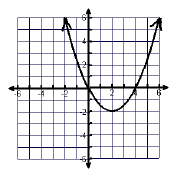
What is the vertex and axis of symmetry?
Vertex (2, -2)
AOS: x = 2
Vertex (-2, 2)
AOS: x = -2
Vertex (2, -2)
AOS: x = -2
Vertex (-2, 2)
AOS: x = 2
What are the solutions?
SELECT ALL THAT APPLY
f(x) = (x - 5)(x + 9)(x - 2)
2
5
-9
9
-5

