wayground logo

Free Printable Worksheets

Font size

S
M
L
XL
Worksheets

Days 5 - 12

Total questions: 90

Worksheet time: 3hrs 14mins

Name
Class
Date
1.

Which equation represents the following graph?

a)

y = 3x + 2

b)

y = -2x + 3

c)

y = 2x + 3

d)

y = -3x + 2

2.

What is the y-intercept in the equation?

y = 5x - 4

a)

(0,5)

b)

(0,-4)

c)

(-4,0)

d)

(5,0)

3.
What is the y-intercept?
a)
7
b)
0
c)
1
d)
2
4.
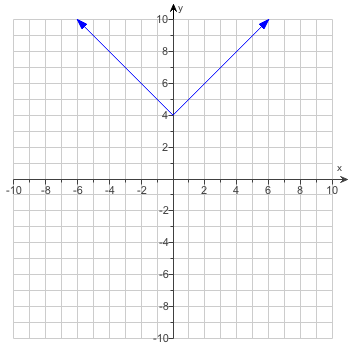
What is the vertex of the absolute value function?
a)
(4, 0)
b)
(0, 4)
c)
(-infinity, infinity)
d)
[4, infinity)
5.
What is the domain of the absolute value function?
a)
(4, 0)
b)
(0, 4)
c)
(-infinity, infinity)
d)
[4, infinity)
6.
What is the range?
a)
-7 ≤ y ≤ 5
b)
-9 ≤ y ≤ 3
c)
-5.5 ≤ y ≤ -0.5
d)
-∞ ≤ y ≤ 5
7.
Describe the transformation from the Absolute Value Parent Function.
a)
Shift up 4 units
b)
Shift down 4 units
c)
Shift left 4 units
d)
Shift right 4 units
8.
Identify the vertex and whether the graph opens up or down.
a)
(-1, 4); opens up
b)
(-1, 4); opens down
c)
(1, 4); opens up
d)
(1, 4); opens down
9.

Determine if the function graphed has a maximum or a minimum value and identify that value.

a)

maximum at -1

b)

minimum at -1

c)

maximum at 4

d)

minimum at 4

10.
What are the x- intercepts?
a)
x= 0 and x= -4
b)
x= 0 and x= 4
c)
y= 0
d)
x= 2
11.
Which parent function matches the graph?
a)
y = |x|
b)
y = ∛(x)
c)
y = x2
d)
y = a⋅bx
12.
What type of function is shown?
a)
absolute value
b)
quadratic
c)
linear
d)
exponential
13.
What type of function is shown?
a)
linear
b)
quadratic
c)
square root
d)
absolute value
14.

The graph represents a piecewise function. How many pieces make up the function?

a)

1

b)

2

c)

3

d)

4

15.
  . 
The blue graphs is the parent function f(x)=|x|, the red must be
a)
g(x)=|x+2|
b)
g(x)=|x|+2
c)
g(x)=|x-2|
d)
g(x)=|x|-2
16.
What is the range of the absolute value function?
a)
(-infinity, infinity)
b)
[3, infinity)
c)
[0, infinity)
d)
(-infinity, 3]
17.

Which of the following graphs is NOT a function?

a)
b)

y=2x+3

c)

f(x)=4

d)
18.

Which of the following functions is linear?

a)
b)
c)
d)
19.

Which of the following describes the translations of y=|x| to y=|x+7|-2?

a)

a. y=|x| translated 2 units to the left and 7 units down

b)

b. y=|x| translated 2 units to the right and 7 units up

c)

c. y=|x| translated 7 units to the left and 2 units down

d)

d. y=|x| translated 7 units to the right and 2 units up

20.
What is the name of this parent function?
a)
Quadratic Function
b)
Linear Function
c)
Cubic Function
d)
Square Root Function 
21.
2. What type of function is present? 
a)
Linear Inequality
b)
Linear Equation
c)
Exponential Growth
d)
Absolute Value
22.
What type of function is present? y=-2x+1
a)
Linear Inequality
b)
Linear Equation
c)
Exponential 
d)
Absolute Value
23.
What type of function is present? 
a)
Linear Inequality
b)
Exponential
c)
Linear Equation
d)
Absolute Value
24.
What is the y-intercept of the equation y=3x-5
a)
5
b)
3
c)
-5
d)
1
25.
What is the definition of slope? 
a)
starting value
b)
rapid decrease
c)
rate of change
d)
rapid increase
26.
Which parent function matches the graph?
a)
y = |x|
b)
y = ∛(x)
c)
y = x2
d)
y = a⋅bx
27.
What type of function is shown?
a)
Exponential 
b)
square root
c)
quadratic
d)
cube root
28.
Which parent function matches the graph?
a)
f(x) = √(x)
b)
f(x) = ∛(x)
c)
f(x) = |x|
d)
f(x) = a⋅bx
29.
Name the parent function. 
a)
constant
b)
quadratic
c)
linear
d)
exponential
30.
Name the parent function. 
a)
constant
b)
square root
c)
linear
d)
absolute value
31.
Name the parent function.
a)
linear
b)
exponential
c)
logarithmic
d)
cubic
32.
Name the parent function.
a)
constant
b)
linear
c)
quadratic
d)
cube root
33.
Name the parent function.
a)
cubic
b)
cube root
c)
exponential
d)
quadratic
34.
Name the parent function.
a)
cube root
b)
square root
c)
quadratic
d)
linear
35.
Name the parent function.
a)
cubic
b)
square root
c)
rational
d)
cube root
36.
Name the parent function.
a)
quadratic
b)
cubic
c)
square root
d)
logarithmic
37.
Domain is: 
a)
All x values, from left to right.
b)
All y values, from bottom to top.
c)
All x values from bottom to top. 
d)
All y values from left to right.
38.

Range is:

a)

All x values, from left to right.

b)

All y values, from bottom to top.

c)

All x values from bottom to top.

d)

All y values from left to right.

39.

What type of a function is this?

a)

Linear

b)

Absolute Value

c)

Quadratic

d)

Exponential

e)

None of the above

40.

What kind of function is this?

a)

Linear

b)

Absolute Value

c)

Quadratic

d)

Exponential

e)

None of the above

41.

What kind of function is this?

a)

Linear

b)

Absolute Value

c)

Quadratic

d)

Exponential

e)

None of the above

42.
Does this graph in the back have maximum or minimum value?
a)
maximum
b)
minimum
c)
neither
d)
both
43.
What is the range of this function?
a)
(- ∞,+∞)
b)
[0, +∞)
c)
[-2, +∞)
d)
[2, +∞)
44.
Which equation best represents the graph?
a)
y = 2(x - 4)2 + 5
b)
y = 2(x + 4)2 + 5
c)
y = -2(x - 4)2 + 5
d)
y = -2(x + 4)2 + 5
45.
Solve the equation
(x + 3)2 = 49.
a)
x = -7, 7
b)
x = 4, -10
c)
x = -4 +- √7
d)
x = 10, -4
46.
What are the x- intercepts?
a)
x= 0 and x= -4
b)
x= 0 and x= 4
c)
y= 0
d)
x= 2
47.
True or false:
The solution, root, x-intercept, and zero of a problem are all the same thing
a)
True
b)
False, because the solution and root are the same but the x-intercept and zero are different
c)
False, because the x-intercept and root are the same but the zero and solution are different
d)
False, they are all different
48.
.How many zeros does this parabola have? 
a)
3
b)
2
c)
0
d)
1
49.
How many solutions does this graph have?
a)
one
b)
two
c)
no solutions
d)
cannot be determined
50.
Is this a max or min?
a)
max
b)
min
c)
cannot be determined
51.
The lowest point one hits when using a swing would represent what?
a)
Maximum value
b)
Minimum value
c)
A root
d)
An x-intercept
52.
How many solutions does this graph have?
a)
one
b)
two
c)
no solutions
d)
cannot be determined
53.
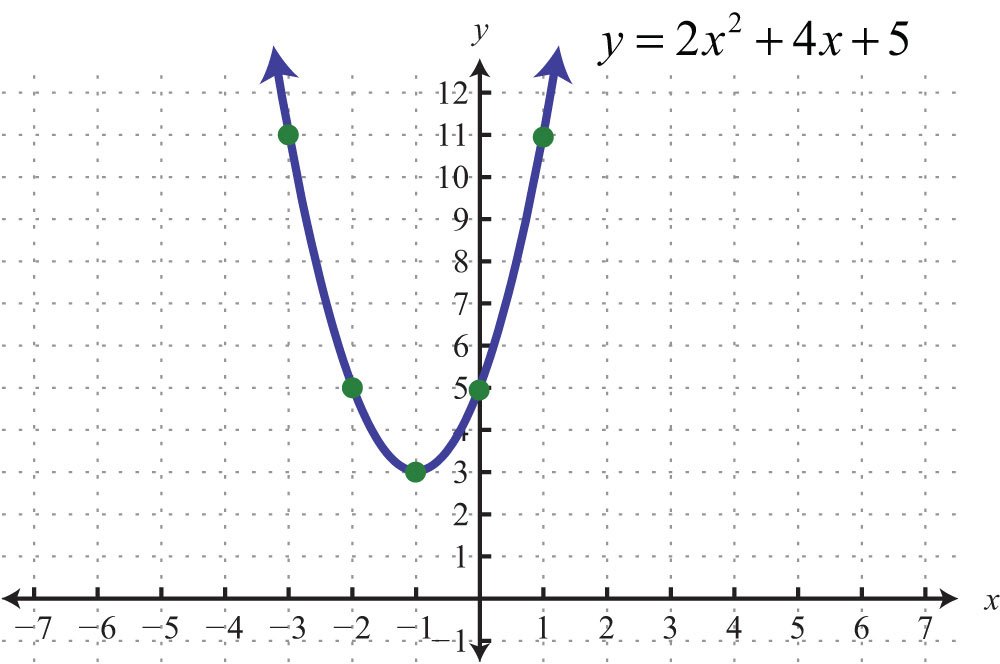
What is the vertex of the graph?
a)
(2, 4)
b)
(3, -1)
c)
(0, 8)
d)
(4, 2)
54.
What is the vertex of this parabola?
a)
(−1, 3)
b)
(−3, 11)
c)
(−2, 5)
d)
(0, 5)
55.
What is the y-intercept of this parabola?
a)
(−1, 3)
b)
(−3, 11)
c)
(−2, 5)
d)
(0, 5)
56.
Where is the axis of symmetry for this parabola?
a)
x = −1
b)
x = 0
c)
y = 3
d)
x = −3
57.
What are the zeros of the parabola? 
a)
1, 5
b)
3, -5 
c)
3, 0
d)
-6, 1
58.

What is the equation for axis of symmetry?

a)

y = 3

b)

x = 3

c)

x = 5

d)

x = 1

59.
What are the green dots called?
a)
axis of symmetry
b)
vertex
c)
parabola
d)
roots or x-intercepts
60.

How can you tell whether a parabola opens up or opens down by looking at the equation?

a)

The vertex tells you the direction of the opening

b)

The coefficient of the x squared term tells you the direction of the opening.

c)

All parabolas open upward

d)

All parabolas open downward

61.
Describe the transformation of y = f(x) for the new function
 y = f(x) - 5
a)
The graph of y = f(x) was shifted to the right 5 units. 
b)
The graph of y = f(x) was shifted to the left 5 units. 
c)
The graph of y = f(x) was shifted up 5 units. 
d)
The graph of y = f(x) was shifted down 5 units.
62.
Describe the transformation of y = f(x) for the new function
f(x) = 5x2 + 2
a)
Stretch of 5
Up 2
b)
Shrink of 5
Up 2
c)
Stretch of 5
Down 2
d)
Shrink of 5
Down 2
63.
If the blue graph is f(x) (the original function) and the red graph is the transformation, what is the equation of the red graph?
a)
-f(x)
b)
f(-x)
c)
f-1(x)
d)
f(2x)
64.
Describe the transformations of f(x) when compared to the parent function.
f(x)=x2+5
a)
horizontal shift right 5 units
b)
horizontal shift left 5 units
c)
vertical shift up 5 units
d)
vertical shift down 5 units
65.

Which of the following describes the transformations done to the quadratic parent function of f(x) = x2 to obtain g(x) = 2x2 + 4 ?

a)

Vertical Stretch by a factor of 2 and vertical shift up 4 units

b)

Vertical Compress by a factor 2 and vertical shift up 4

c)

Vertical Stretch by a factor of 2 and horizontal shift left 4 units

d)

Vertical Compress by a factor of 2 and horizontal shift right 4 units

66.
Describe the transformation of
f(x) = x2 -8 when compared to the parent function
a)
Vertical shift sp 8 units
b)
Vertical shift down 8 units
c)
Horizontal shift right 8 units
d)
Horizontal shift left 8 units
67.

What is the equation of the quadratic function obtained from vertically compressing the parent function by 3/5 and then shifted up 8 units?

a)

f(x)= 3/5(x-8)2

b)

f(x)=3/5x2+8

c)

f(x)=x2

d)

f(x)=3/5x2-8

68.
What is the equation of the quadratic function obtained from vertically stretching the parent function by a factor of 2 and then vertically shifting up 3 units?
a)
f(x)= 2(x-3)2
b)
f(x)= 2(x+3)2
c)
f(x)= 2x2+3
d)
f(x)= (x-2)2+3
69.
If the blue function is f(x)=x2, then the red function must be
a)
g(x)=x2-5
b)
g(x)=x2+5
c)
g(x)=(x-5)2
d)
g(x)=(x+5)2
70.
If the blue function is f(x)=√x, the red function must be
a)
g(x)=√(-x)
b)
g(x)=√(x-1)
c)
g(x)=√x-1
d)
g(x)=-√x
71.
g(x)=-f(x)
Describe the transformation to f(x) that results in g(x).
a)
f(x) has been reflected over the x-axis.
b)
f(x) has been reflected over the y-axis.
72.
DOMAIN?
a)
(-∞,∞)
b)
[0,∞)
c)
(-∞,0]
d)
-2, 2
73.
What is the RANGE?
a)
(-∞,∞)
b)
[0,∞)
c)
(-∞,0]
d)
[-∞,∞]
74.
Which transformation will occur if f(x) = x2 is replaced with 2⋅f(x)?
a)
Vertical Compression by a factor of 2
b)
Vertical Stretch by a factor of 2
c)
Vertical translation up by 2 units.
d)
Reflection across the x-axis.
75.
Which transformation will occur if f(x) = x2 is replaced with 1/2⋅f(x)?
a)
Vertical Compression by a factor of 1/2
b)
Vertical Stretch by a factor of 1/2
c)
Vertical translation up by 2 units.
d)
Reflection across the x-axis.
76.
Which transformation will occur if f(x) = x2 is replaced with f(x) + 2?
a)
Translation left 2 units
b)
Narrower
c)
Vertical translation up by 2 units.
d)
Reflection across the x-axis.
77.
Describe the transformation of y = f(x) for the new function
 y = f(x) + 5
a)
The graph of y = f(x) was shifted to the right 5 units. 
b)
The graph of y = f(x) was shifted to the left 5 units. 
c)
The graph of y = f(x) was shifted up 5 units. 
d)
The graph of y = f(x) was shifted down 5 units.
78.
Describe the transformation of y = f(x) for the new function
 y = f(x) - 5
a)
The graph of y = f(x) was shifted to the right 5 units. 
b)
The graph of y = f(x) was shifted to the left 5 units. 
c)
The graph of y = f(x) was shifted up 5 units. 
d)
The graph of y = f(x) was shifted down 5 units.
79.
Describe the transformation of y = f(x) for the new function
 y = 5f(x)
a)
The graph of y = f(x) compressed horizontally by a factor of 1/5
b)
The graph of y = f(x) was stretched horizontally by a factor of 5
c)
The graph of y = f(x) was compressed vertically by a factor of 1/5
d)
The graph of y = f(x) was stretched vertically by a factor of 5
80.
Describe the transformation of y = f(x) for the new function
 y = 1/5f(x)
a)
The graph of y = f(x) compressed horizontally by a factor of 1/5
b)
The graph of y = f(x) was stretched horizontally by a factor of 5
c)
The graph of y = f(x) was compressed vertically by a factor of 1/5
d)
The graph of y = f(x) was stretched vertically by a factor of 5
81.
Describe the transformation of y = f(x) for the new function
 y = - f(x)
a)
The graph of y = f(x) was flipped vertically across the x axis. 
b)
The graph of y = f(x) was flipped horizontally across the y axis.
c)
The graph of y = f(x) was shifted down.
d)
The graph of y = f(x) was shifted up
82.
Identify the transformation from the graph of f(x)=x2 to the graph g(x)= x2 - 5
a)
shifted up five units
b)
shifted down five units
c)
shifted left five units
d)
shifted right five units
83.
Identify the transformation from the graph of f(x)=x2 to the graph g(x)= x2 + 5
a)
shifted up five units
b)
shifted down five units
c)
shifted left five units
d)
shifted right five units
84.
Which equation describes the transformation of shifting f(x)=x3 seven units up?
a)
x3+7
b)
x3-7
c)
(x-7)3
d)
(x+7)3
85.
Which equation describes the transformation of shifting f(x)=x3 four units down?
a)
x3+ 4
b)
x3- 4
c)
(x - 4)3
d)
(x + 4)3
86.
Identify the transformation from the graph of f(x)=2x to the graph g(x)=2x-3
a)
shifted up three units
b)
shifted down three units
c)
shifted left three units
d)
shifted right four units
87.
How did we transform from f(x) =x
to
g(x) = -3x2
a)
reflection in x-axis and vertical shift down
b)
reflection x-axis and vertical stretch
c)
horizontal stretch
d)
reflection x-axis and vertical compression
88.
In the equation f(x)=5(x+3)2-10 what does the 5 do?
a)
Vertical stretch by 5
b)
Horizontal compress by 5
c)
Reflect
d)
Move up 5
89.
What is the vertical shift of this equation?
f(x) = -(x + 3)2 - 5
a)
left 5
b)
right 5
c)
up 5
d)
down 5
90.
Does the graph of this equation open up or down? 
f(x) = -(x + 3)2 - 5
a)
up
b)
down