Worksheets
Evolution
Total questions: 50
Worksheet time: 40mins
Male guppies found in areas without predators are more colorful than the ones found in locations with large predator populations. A population of adult guppies originating from an area with a large number of predators is transferred to a nearby area with few predators.
Which of these is most likely to happen over a few generations?
The mortality rate of the guppies will increase.
Offspring will stop competing for resources.
There will be an increase in mutations in the offspring.
There will be an increase in the number of colorful guppies.

The diagram shows light and dark colored beetles that live on a tree. Which result is most likely to occur to the beetle population due to predation over time?
The number of light-colored beetles in the population will increase.
There will be more dark-colored beetles than light-colored beetles.
The number of light-colored beetles will decrease.
The dark-colored beetles will move to a different type of tree.

The quiver tree grows in desert areas in southern Africa. In recent decades, average temperatures have been rising in southern Africa. Scientists predict that this warming trend will continue. Quiver trees in the hottest parts of their range near the equator are dying, but quiver trees at high elevations or in parts of the range that are farther from the equator are growing and reproducing.
Which of these best explains what is happening to the quiver tree population in southern Africa?
Individual quiver trees are unable to adjust to rising temperatures, and only those in cooler parts of the range will survive.
The quiver tree species is unable to survive rising temperatures throughout its range. The species is likely to undergo rapid extinction.
Individual quiver trees can quickly adapt to rising temperatures. Individual trees will change their method of seed dispersal in cooler parts of the range.
The quiver tree species will survive by producing offspring suited for warmer temperatures.
An experiment is run where 50 beige mice and 50 black mice are placed on dark volcanic rock. Over the next 25 years, which type of mouse do you expect to be the majority?
The beige mice because they have the adaptation to blend in and survive, and reproduce
The black mice because they have the adaptation to blend in and survive, and reproduce
The beige mice because they have an adaptation and can outlive the black mice
The dark mice because they have an adaptation and can outlive the black mice
Which term refers to the process by which individuals that are better suited to the environment survive and reproduce therefore passing down their genes to their offspring?
Evolution
Variation
Fitness (natural selection)
Competition

Scientists can determine relatedness among organisms by comparing partial amino acid sequences. The table shows four partial amino acid sequences from four organisms.
Which organism is the least related to the other three organisms?
organism 1
organism 2
organism 3
organism 4

The image shows part of the humerus bone in different genera of primates.
Which statement is best supported by the observable structures of the different humorous bones?
the primates lived in similar environments.
the primates shared a common ancestor.
the primates interbreed with similar organisms in a population.
the primates had diets that consisted of similar types of foods.

Cetaceans are whales and their relatives. The diagram shows some fossils of cetaceans.
Which statement provides the best evidence that Ambulecetus natans is an ancestor of Basilosaurus iris?
homologous structure occurs in each fossil.
similar nitrogenous bases are found in the DNA of each fossil.
the fossils were found in different locations
the youngest fossil is larger than the older fossils.
Bactrian camels, dromedaries, llamas, and alpacas are all members of the same taxonomic family, Camelidae. Members of this family all have two toes, no hooves, true canine teeth, and a split upper lip. the family Camelidae originated in North America. The physical features of animals in this family and the family's geographical origin provide evidence that all these animals -
live in the same type of ecosystem
have slowly evolved to become herbivores
have a common ancestor
exchanged DNA at some point in the past
A new predator of rabbits has been introduced within an ecosystem. This new predator runs faster than the native predator of rabbits.
Which statement describes what will most likely occur in the rabbit population due to the introduction of the predator?
The rabbits will mutate their genes and express genes that increase their speed.
Slower rabbits will develop stronger legs and pass this trait to their offspring.
Rabbits will mate and produce offspring with a different species that has faster runners.
Faster rabbits will survive and reproduce increasing the average speed of the rabbit population.

The aye-aye lemur is a mammal that fees mostly on insect larvae that live inside trees. The aye-aye lemur ha a specialized middle finger that is long and thin. The aye-aye lemur moves along a tree branch and taps the branch with its specialized finger. When the aye-aye lemur hears a difference in the echo, it will tear open the bark with its teeth until the insect tunnel is exposed. The aye-aye lemur then uses its specialized finger to reach the insect larvae and remove it.
Which selective pressure most likely resulted in the development of the aye-aye lemur's special adaptation ?
Limited availability of water
Competing for males
Large numbers of natural predators
Food sources that are hard to find
The white tail cattail is a hybrid species of plant that is a result of the cross between broad-leaved cattail and the narrow-leaved cattail. Over time, the white cattail has established itself in the wetlands of Midwestern states.
Which of these explains the success of the white cattail ?
Favorable genes form parental generations provide advantageous characteristics to the hybrid species.
Hybridization produces offspring traits that allow different species to survive in extreme environments
Inherited traits passed on from parental generations make hybrid species more susceptible to disease.
Hybrid species display more adaptations due to their reduced genetic diversity
Adaptations that result from natural selection are expected to increase the fitness of an organism. In terms of natural selection, which of the following best describes fitness ?
Being able to escape from predators
Being among the strongest organisms in a population
Being able to survive, find a mate, and produce offspring
Being able to survive long enough to reach the adult stage
In the 1040s, the scientist J. B. S. Haldane linked may human red blood cell disorders with the tropical regions where malaria occurs. Haldane hypothesized that the widespread presence of these red blood cell disorders as well as traits that protect individuals from malaria were the result of natural selection. Haldane's hypothesis was later confirmed by the research of A. C. Allison.
The resistance to malaria carried by individuals in areas where malaria is widespread is the result of --
a vaccine against malaria
the individuals' genetic composition
antibiotic medications
the individuals' behavior in avoiding those with the infection
Conservation biologists studying cheetah populations have determined that the lack of genetic diversity among the cheetahs is due to genetic drift.
Which statement explains the most likely consequence of having a low genetic diversity on the cheetah population?
The chances of a mutation occurring in the cheetah population are decreased, increasing the cheetah survival rate.
The gene pool remains in equilibrium and future generations of cheetah offspring are stronger and better adapted to their environments.
The cheetah population becomes less likely to survive an outbreak of a disease or an environmental change, increasing the chance of species extinction.
Genetic variability is maintained from older cheetah populations that have survived and endured environmental stressors.
Common baboons live on the savanna in breeding groups called troops. While females tend to stay with the troop, younger or less dominant males may leave to join a neighboring troop. Which of these is a likely outcome of movement by young males ?
Gene flow occurs between populations.
Allele frequencies suddenly change.
Relative genotypic frequencies reach a constant state.
Intermediate phenotypes increase in the species.
Two populations of mice living in the same forest are separated by a large water-filled ditch. After a rainstorm, flooding brings several mice from one population to the other population. When the mice from the first population reproduce with members of the second population, which of the following will likely occur?
All the offspring will die as a result of reproductive mutations.
The offspring will be forced to leave the second population.
The offspring will be genetically identical to their parent from the first population.
The offspring in the second population will have greater genetic variety.
Lord Howe Island is a volcanic island in the Tasman Sea that is about 11 km long and 2.8 km wide. The island has two species of palm trees, Howea forsteriana, and the more abundant Howea belmoreana. The two species do not interbreed even when they grow very close to each other. Which evolutionary process fails to occur ?
Genetic drift of Howea forsteriana
Natural selection of adaptive traits in both species
Gene flow between the two species
Mutations in Howea belmoreana
The concept of gene flow is demonstrated when a cow is driven off from its hers, joins another herd, and reproduces. When the cow contributes to the gene pool of the new herd, which of these most likely increases?
Natural selection
Genetic variation
Environmental fitness
Reproductive mutations

White-tailed deer are seasonal breeders. female white-tailed deer begin their reproductive cycle in the fall. Rising testosterone levels in male white-tailed deer cause them to start their breeding season around the same time. Offspring are born the following spring and summer.
What is the most likely explanation for white-tailed deer having a seasonal breeding cycle instead of a monthly breeding cycle like many domesticated animals?
Male and female deer come into contact with each other only in the fall.
Large predators are not found in deer habitats during the spring and summer months.
Giving birth only in the spring and summer ensures that offspring are born when food is most available.
Deer give birth in the spring and summer in order to avoid being pregnant during the hot summer months.

The green frog (Liithobathes clamitans clamitans) is found in many parts of the United States. The table contains some information about this frog.
Why does the ability to lay 1,000 to 5, 000 eggs increase the fitness of the species L. clamitans clamitans?
It increases opportunities for offspring to compete for limited resources.
It increases the probability that some offspring will survive long enough to reproduce.
It increases the probability that moving water will promote gene flow from one population to another.
It increases the chance of the recombination of alleles, leading to genetic drift in the population.
What condition is essential for natural selection to result in a new species ?
Unlimited resources
An inherited variation
A static environment
A long life span
The giant octopus lays 20,000 to 100,000 fertilized eggs. After hatching, most octopuses become prey to larger marine organisms, and less than 5% will reach adulthood to reproduce.
One benefit of the giant octopus laying many eggs is to —
increase the average body size for surviving individuals to avoid predation
decrease competition between different octopus species to maintain resources in the population
increase the chance that more individuals will survive to maintain the population
decrease the likelihood of offspring being consumed by predators

The diagram shows data on the evolution of horses.
The date in the diagram is evidence that -
a new species of horse suddenly appeared
horses slowly developed over time
Horses have similar stages of rapid embryological development
horses have a common ancestry with other hovved animals
Niles Eldredge and Stephen Jay Gould researched the lenses of the eyes of fossil trilobites of different species. In 1972 they published a paper in which they described the tendency of a species to remain the same un5il a sudden change in the environment causes a new related species to appear.
Which hypothesis was most challenged by the work of Eldredge and Gould?
Redi's hypothesis that spontaneous generation does not occur
Haeckel's hypothesis that embryological development mimics the evolution of species
Wallace's hypothesis that geography affects the distribution of species
Darwin's hypothesis that the development of species is a slow, gradual process

The graph shows the number of taxa of reptiles whose fossilized tracks have been found.
Which statement is best supported by this data?
Competition for food and shelter among reptile species was very low during the Triassic period.
A great extinction occurred during the Jurassic period.
Environmental conditions for speciation were most favorable for reptiles during the Permian period.
Reptiles adapted to a terrestrial environment during the Cretaceous period.l

This diagram of the fossil record represents changes in mollusks over millions of years.
How can the pattern of changes in the fossil record best be explained?
the mollusks were well adapted to their stable environment. A large sudden change occurred in their environment. After the changes, the mollusk with the bigger shells was better adapted to the new environment.
the mollusks were well adapted to their stable environment. the mollusks hybridized with a smaller species of mollusk. A new species of mollusk with a bigger shell resulted.
the mollusks were not well adapted to their environment. the length of the mollusk's shells changed gradually over time. The mollusks in the original population that has small shells died over a period of many years.
the mollusks were well adapted to their environment. humans introduced a new species of mollusk that was not adapted to this environment. the introduced mollusk outcompeted the native mollusk species.

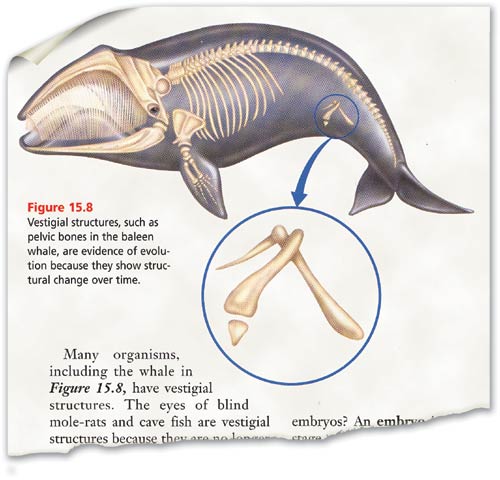

What do we call a change in a species over time?
Adaptation
Evolution
Extinction
Environmental influences
Ostriches are large flightless birds. Their wings are examples of a/an___
analogous structure
During the Industrial Revolution, the environment around Manchester, England, changed. Birch trees, which were previously lightly covered, became dark due to air pollution. How did this change affect peppered moths living in the area?