
Font size
S
M
L
XL
 Worksheets
Short Review Game: 2.3, Cycles of Matter
Total questions: 18
Worksheet time: 10mins
Name
Class
Date
1.
How do living organisms return carbon to the atmosphere in the carbon cycle?
a)
respiration and photosynthesis
b)
decomposition and respiration
2.
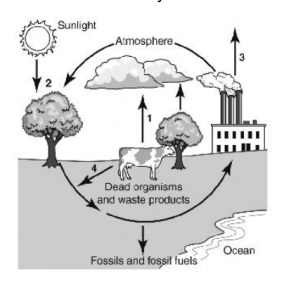
What is happening at 1?
a)
respiration: releasing CO2
b)
decomposing CO2 in the soil
c)
photosynthesis: absorbing CO2
d)
turning CO2 from the atmosphere into organic molecules
3.
Organisms that need nitrogen to survive
a)
only plants
b)
only animals
c)
only bacteria
d)
all living organisms
4.
When nitrogen gas is turned in to a form that plants and animals can use is called
a)
Combustion
b)
Photosynthesis
c)
Decomposition
d)
Nitrogen Fixation
5.
How do animals get nitrogen?
a)
the atmosphere
b)
eating other organisms
c)
bacteria
d)
lightning
6.
What converts nitrogen into a useable form for plants and animals?
a)
bacteria
b)
fungi
c)
rain
7.

Identify the cycle pictured.
a)
The Water cycle
b)
The Carbon cycle
c)
The Nitrogen cycle
d)
The Phosphorus cycle
8.

Identify the cycle pictured.
a)
The Water cycle
b)
The Carbon cycle
c)
The Nitrogen cycle
d)
The Phosphorus cycle
9.
What is the most abundant gas in the atmosphere?
a)
hydrogen
b)
oxygen
c)
helium
d)
nitrogen
10.
Where is carbon stored in the environment?
a)
Fossil fuels
b)
Wood of trees
c)
Calcium carbonate (shells and bones)
d)
All of the above
11.

The step in the nitrogen cycle where plants take up nitrate and use it to make biological molecules is:
a)
nitrification
b)
ammonification
c)
nitrogen fixation
d)
assimilation
12.
Biogeochemical cycles:
a)
only include processes conducted by or within living organisms.
b)
describe the movement of water and other materials throughout the abiotic and biotic environment.
c)
only pertain to exchanges and interactions that occur within the atmosphere.
d)
are used to describe the attempts of humans to recycle various pollutants.
13.

What process is shown at # 6?
a)
dentirification
b)
ammonification
c)
assimilation
d)
fixation
14.

This figure shows water storages and flows. Label flow D.
a)
Precipitation
b)
Run-Off
c)
Percolation
d)
Condensation
e)
Transpiration
15.
Which of these options are considered "Transformations" and not "Transfers" in the hydrological cycle? (choose more than 1!)
a)
Evaporation
b)
Advection
c)
Transpiration
d)
Precipitation
e)
Freezing
16.

Which type of feedback system can deforestation lead to?
a)
Positive
b)
Negative
17.
FILL IN THE BLANKS: Plants _______ water through their roots and _______ it from their leaves.
a)
absorb, evaporate
b)
absorb, transpire
c)
assimilate, respire
d)
assimilate, transpire
18.
When water vapor changes to liquid water, we call it -
a)
Evaporation
b)
Condensation
c)
Freezing
d)
Melting
e)
Deposition
Reset

