Wayground logo

Free Printable Worksheets

Font size

S
M
L
XL
Worksheets

Thermal Energy

Total questions: 37

Worksheet time: 28mins

Name
Class
Date
1.

Energy is defined as

a)

power

b)

food

c)

ability to produce heat

d)

ability to do work or cause change

2.
Conduction can only occur between two objects when –
a)
one object is less dense than the other.
b)
both objects are in physical contact with each other.
c)
one of the objects is made of a metal.
d)
both objects are exactly the same temperature.
3.
In the situation illustrated, how will heat energy move? Heat energy will be transferred from –
a)
the water to the hot plate by convection.
b)
the water to the hot plate by conduction.
c)
the hot plate to the water by convection.
d)
the hot plate to the water by conduction.
4.
Radiation is a method of thermal energy transfer that moves -
a)
through empty space.
b)
when objects touch.
c)
only through solids.
d)
in the motion of fluids.
5.
An example of a situation in which an egg is receiving thermal energy through convection -
a)
The egg is kept warm by its mother in the nest.
b)
An egg cracked on a hot sidewalk starts to cook.
c)
The egg is hard boiled in a pot of water.
d)
A metal pan on the stove fries the egg.
6.
What two kinds of heat transfer are represented?
a)
stove→pot=radiation pot→egg=conduction
b)
stove→pot=conduction pot→egg=radiation
c)
stove→pot=convection pot→egg=conduction
d)
stove→pot=conduction pot→egg=convection
7.
What was the change in temperature resulting from this heat transfer in degrees Celsius?
a)
4.5
b)
6.0
c)
5.5
d)
7
8.

Thermal energy is associated with

a)

kinetic and potential energy of particles

b)

position or shape

c)

chemical reactions

d)

chemical bonds

9.

The three scales used to measure temperature are

a)

metric, American and wrong

b)

Celsius, Fahrenheit, and Calvin

c)

Celsius, Fahrenheit, and Kelvin

10.

This phase of matter has the most thermal energy

a)

gas

b)

liquid

c)

solid

11.

Heat always moves

a)

in convection currents

b)

by radiation

c)

from hot to cold

d)

from cold to hot

12.

The diagram above shows a Bunsen burner heating a beaker of water on a beaker stand. The arrows represent the transfer of heat energy in the water. Which process is primarily responsible for the transfer of heat in the beaker as indicated by the arrows in the diagram?

a)

conduction

b)

radiation

c)

convection

d)

condensation

13.

Water’s specific heat is 4,180 and iron’s is 450. Which will heat up faster?

a)

water

b)

iron

c)

oil

d)

air

14.

The measure of the average kinetic energy of particles in an object is its

a)

temperature

b)

heat

c)

thermal energy

d)

hotness

15.

The energy needed to heat up 1kg of a substance by 1K, is its

a)

temperature

b)

heat

c)

specific heat

d)

thermal heat

16.

Temperature scale starting with absolute zero at 0 is the

a)

coldness scale

b)

Farenheit scale

c)

Celcius scale

d)

Kelvin scale

17.

When heat is passed on by direct contact of particles, this occurs

a)

conduction

b)

condensation

c)

convection

d)

radiation

18.

Transfer of energy by electromagnetic waves is called

a)

conduction

b)

convection

c)

radiation

d)

infrared proton rays (sounds cool, but I made it up so don't pick this one)

19.

A material that doesn’t allow heat to pass through it easily is a/an

a)

conductor

b)

insulator

c)

metal

d)

rock

20.

energy of motion

a)

thermal energy

b)

sondensation

c)

water vapor

d)

kinetic enetgy

21.

matter in which atoms are closely spaced and vibrate in a fixed position.

a)

solid

b)

liquid

c)

gas

d)

water vapor

22.

Matter in which atoms are constantly moving around and bumping into each other.

a)

mass

b)

gas

c)

liquid

d)

solid

23.

Matter in which atoms vibrate so much that they are far apart.

a)

liquid

b)

solid

c)

gas

d)

thermal energy

24.

Water in gas form

a)

water vapor

b)

solid

c)

kinetic energy

d)

heat

25.

The process when matter loses thermal energy and changes from a gas to a liquid.

a)

thermal energy

b)

kinetic energy

c)

temperature

d)

condensation

26.

The transfer of thermal energy from a hotter area to a colder area.

a)

liquid

b)

heat

c)

kinetic energy

d)

water vapor

27.
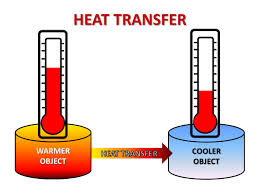
Heat transfer in the image.
a)
conduction
b)
convection
c)
radiation
28.
Heat transfer in boiling water.
a)
Conduction
b)
Convection
c)
Radiation
29.
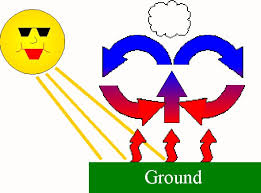
The heat transfer in the image is by
a)
convection
b)
conduction
c)
radiation
30.
On a cold rainy day a baby is touching a cold window.  It feels so cold. Which way is the heat moving moving? 
a)
Cold is moving from the window to the hand.
b)
Heat is moving from the hand to the window.
c)
Heat doesn't move.
d)
It moves in currents
31.
Heat transfer in wind.
a)
conduction
b)
convection
c)
radiation
32.
Which ice cube will melt first?
a)
The large cube
b)
The small cube
c)
They will melt at the same rate
33.
The Gulf Stream is a current that brings warm ocean water from the south to the north. What type of heat transfer is this?
a)
conduction
b)
convection
c)
radiation
d)
insulation 
34.
Heat transfers from an area of ____temperature to an area of ___ temperature.
a)
high to low
b)
low to high
c)
high to high
d)
It can travel high to low and low to high. 
35.
The baby chickens are kept warm from the heat lamps demonstrates this type of heat transfer. 
a)
conduction
b)
convection
c)
radiation
36.
Warm air rises and the cool air sinks demonstrates this type of heat transfer. 
a)
conduction
b)
convection
c)
radiation
d)
Insolation 
37.
Heat transfer occurs
a)
in many directions
b)
both from warm objects to colder ones and from cold objects to warmer ones.
c)
only from warm objects to colder ones.
d)
only from cold objects to warmer ones.