wayground logo

Free Printable Worksheets

NEW

Font size

S
M
L
XL
Worksheets

Parallel and Series Circuits

Total questions: 15

Worksheet time: 16mins

Name
Class
Date
1.
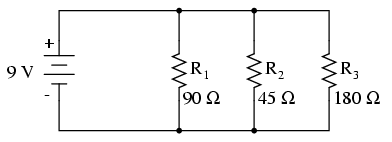
This is an example of a _______ circuit
a)
open
b)
series
c)
parallel
d)
square
2.
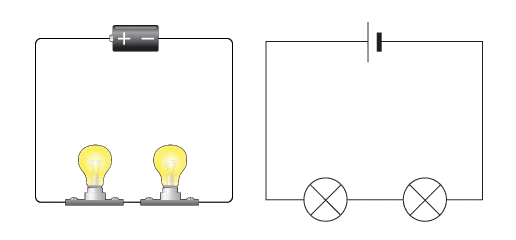
This is an example of a ______ circuit
a)
Series
b)
Parallel
c)
Open
d)
Dihexihedral
3.
What kind of circuit is this?
a)
Series
b)
Consecutive
c)
Parallel
d)
Training
4.
What kind of circuit is this?
a)
Series
b)
Consecutive
c)
Parallel
d)
Training
5.
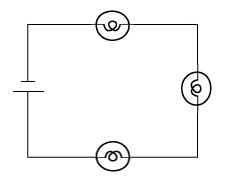
The picture shows an electrical circuit. This circuit is a series circuit because: 
a)
It has 3 light bulbs.
b)
The same current flows through all three light bulbs.
c)
It uses a single battery.
d)
The electrical current is divided between the three light bulbs.
6.

Wood is a _____?

a)

conductor

b)

insulator

7.

A material in which electrons are able to move easily is a(n)

a)

Circuit

b)

Insulator

c)

Resistance

d)

Conductor

8.
This circuit has more than one loop. When one light goes out, the others stay on. 
a)
closed circuit
b)
series circuit
c)
parallel circuit
d)
open circuit
9.
What 'flows' in a wire?
a)
Protons
b)
Neutrons
c)
Atoms
d)
Electrons
10.
In a parallel circuit, if one connection is broken, all of the connections stop working.
a)
True
b)
False
11.
A series circuit has ____ path(s) that the electric current can take. 
a)
One
b)
Two 
c)
Three 
d)
Four
12.

CIrcuit elements connected in series have the same

a)

voltage drop across them.

b)

current through them.

c)

power dissipation by them.

d)

None of the above.

13.

The brightness of a lightbulb is most closely related to

a)

its resistance.

b)

the voltage drop across it.

c)

the current through it.

d)

the power dissipated by it.

14.

Four unequal resistors are connected in series with each other. Which one of the following statements is correct about this combination?

a)

The equivalent resistance is equal to that of any one of the resistors.

b)

The equivalent resistance is equal to average of the four resistances.

c)

The equivalent resistance is less than that of the smallest resistor.

d)

The equivalent resistance is less than that of the largest resistor.

e)

The equivalent resistance is more than the largest resistance.

15.

As more resistors are added in series to a constant voltage source, the power supplied by the source

a)

increases.

b)

decreases.

c)

does not change.

d)

increases for a time and then starts to decrease.