wayground logo

Free Printable Worksheets

NEW

Font size

S
M
L
XL
Worksheets

Final Review 21/22

Total questions: 46

Worksheet time: 33mins

Name
Class
Date
1.

The Camp David Accords was-

a)

peace treaty to end the Cold war

b)

agreement between the U.S and Middle eastern nations to lift the oil embargo by OPEC.

c)

peace agreement negotiated by Carter between Israel & Egypt

d)

agreement to protect Middle Eastern countries from Soviet rule

2.
Many people lost their jobs during the Great Depression.  The national government responded with President Franklin Roosevelt's "New Deal," which
a)
provided programs to help people make money to provide for their needs. 
b)
helped reduce the national debt, providing more capital for businesses
c)
forced people to join the military forces to make money for their needs. 
d)
forced people to use charities to help them provide for their needs. 
3.
One difference between the administrations of President Roosevelt and President Hoover was that Roosevelt was-
a)
more willing to use government intervention to solve economic problems
b)
unwilling to allow government agencies to establish jobs
c)
able to ignore economic issues for most of his first term in office
d)
opposed to any type of government regulation of financial institutions
4.
What problem were both the Civilian Conservation Corps and the Works Progress Administration developed to address?
a)
Excessive stock market speculation
b)
High unemployment
c)
Increased use of credit
d)
Overproduction of goods
5.
A major reason for creating the Tennessee Valley Authority in 1933 was to-
a)
Provide health care benefits to southerners
b)
Encourage African-Americans to settle in the valley
c)
Improve economic conditions in a poor rural region
d)
Evacuate farmers from the impoverished region
6.
What was created to protect bank deposits up to $5,000?
a)
WPA
b)
CCC
c)
TVA
d)
FDIC
7.

What legislation is this cartoon referring to?

a)

30 day waiting period for immigration

b)

Deportation after completion of Transcontinental Railroad

c)

Immigration Reduction Act

d)

Chinese Exclusion Act

8.
A movement concerned with helping the poor -- according to biblical principles
a)
Social Gospel
b)
Gospel of Wealth
c)
Social Darwinism
9.

Which president wanted to control businesses and conserve the environment?

a)

William McKinley

b)

Abraham Lincoln

c)

Theodore Roosevelt

d)

Franklin D. Roosevelt

10.

During the early 1900s, the term "muckrakers" was used to describe-

a)

pacifists who demonstrated against war

b)

Politicians who criticized Progressive Era presidents

c)

Writers who exposed the evil in American society

d)

Newspaper columnists who reported in celebrities

11.
Which of the following is not an effect of the Dawes Act.
a)
Native Americans forced to Americanize
b)
Forced them to become farmers
c)
Native Americans became wealthy landowners
d)
Abolished Native American Tribes
12.

__________warned against the establishment of any additional European colonies in Latin America.

a)

Roosevelt Corollary

b)

Monroe Doctrine

c)

Woodrow Wilson

d)

William H. Taft

13.

What was NOT a factor in the annexation of Hawaii?

a)

Tariffs on sugar imports

b)

American settlers' economic interests

c)

Queen limiting American's political power

d)

The Hawaiian people agreeing to be annexed

14.

Why is WWI important to history?

a)

It showed that the US was a strong military power.

b)

It served as a break in US isolationism.

c)

It led to shift of more African Americans and women in northern factories.

d)

All of the above.

15.

The Treaty of Versailles forced Germany to...

a)

pay large reparations

b)

cut their military

c)

give back all of their colonies

d)

All of the above

16.

The Munich Pact incorporated this policy

a)

Isolationism

b)

Neurality

c)

Appeasement

17.
All of the following are reasons why groups such as CORE and the SCLC were effective EXCEPT:
a)
They used extreme measures such as forcefully taking over businesses to get on the news regularly.
b)
They had nationally well-known and respected leaders.
c)
They were well organized.
d)
They conducted many non-violent protests.
18.
Court case that created "Separate-but-equal" doctrine.
a)
Sweatt v. Painter
b)
Brown v. Board of Education
c)
Plessy v. Ferguson
d)
Mendez v. Kirby ISD
19.

During the Cold War, what bill did the U.S. Congress pass to provide financial assistance to western European countries?

a)

Truman Doctrine

b)

Open Door Policy

c)

Marshall Plan

d)

Domino Theory

20.

In what year did the Russians launch the satellite Sputnik?

a)

1941

b)

1957

c)

1969

d)

1991

21.

This established that employment discrimination is illegal

a)

Voting Rights Act 1965

b)

Civil Rights Act 1964

c)

94th Amendment

d)

Equal Opportunity Act 1962

22.

This Great Society program provided health insurance for senior citizens

a)

Medicare

b)

HUD

c)

Head Start

d)

Job Corps

23.

Nixon visited the Peoples Republic of China to establish __________ relations.

a)

foreign

b)

domestic

c)

diplomatic

d)

allies

24.

Nixon and the Soviet Union singed SALT (Strategic Arms Limitation Treaty) to

a)

make the United States military stronger

b)

establish diplomatic relations

c)

limit the race for oil production

d)

limit the arms race

25.

Why did the Arab members of OPEC (Organization of Petroleum Exporting Countries) raise their oil prices leading to a gas shortage?

a)

the United States and other countries were trading with Israel during the Arab-Israeli War of 1973

b)

the United States and other countries were trading with Palestine during the Israeli-Palestinian conflict

c)

the United States was facing high unemployment rates

d)

the United States planned on boycotting the purchasing of oil from the Middle East

26.
President Bush and the United Nations sent in troops in January 1991, their goal was the restore peace in Kuwait. What was the name of this conflict, which lasted six weeks?
a)
World War II
b)
Vietnam War
c)
Persian Gulf War
d)
This means war
27.
The Cold War ended in 1991, when which country broke apart?
a)
China
b)
Kuwait
c)
Soviet Union
d)
Cuba
28.
How was the Iran Hostage Crisis resolved?
a)
the hostages were all killed
b)
the hostages were released as part of the agreement ending the Vietnam War
c)
the hostages were freed upon Reagan's inauguration
d)
the Camp David Accords led Israel to release the hostages
29.
A trade agreement that removed restrictions between the US, Canada, and Mexico. 
a)
Palestinian Liberation Organization (PLO)
b)
North American Free Trade Agreement (NAFTA)
c)
Oil Crisis of 1979
d)
North Atlantic Treaty Organization (NATO)
30.
What did the events of the Persian Gulf War and the Balkan Crisis in the 1990s indicate about the foreign policy goals of American Leaders?
a)
They desire greater economic stability in the Middle East
b)
They wish to expand trade and eliminate all tariffs with the Middle Eastern nations
c)
They want to help maintain peace and stop oppression around the world
d)
They only act where American access to scarce resources is at stake
31.
This was one of the first things that Clinton worked on in office…
a)
Healthcare
b)
Guns
c)
Taxes
d)
Drugs
32.
Bill Clinton's affordable healthcare plan never passed and was attacked for being "big government".  
a)
True 
b)
False 
33.

Who did W. Bush identify as the attackers on 9/11/2001?

a)

al-Qaeda

b)

the Taliban

c)

Saddam Hussein

d)

Hamid Karzai

34.
What is the nickname often used in the press for the Affordable Healthcare Act?
a)
Clintoncare
b)
Obamacare
c)
Barackcare
d)
Barrycare
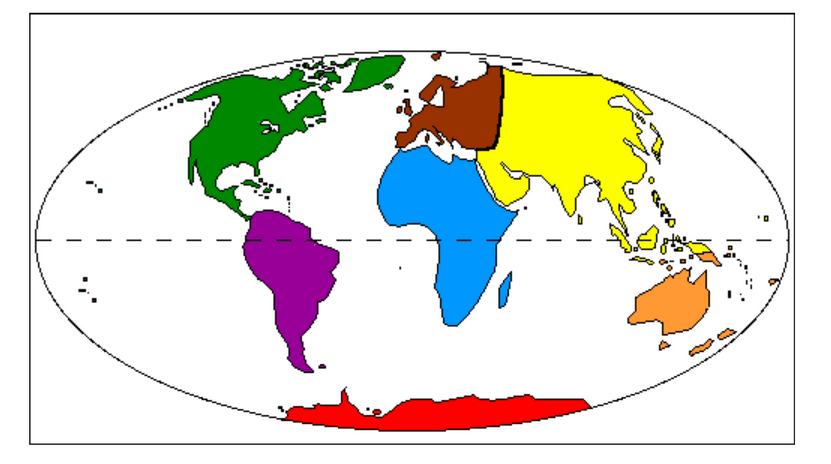
35.

What is the name of the purple continent?

a)

North America

b)

South America

c)

Africa

d)

Europe

36.

Which continent was the Transcontinental Rail Road built on?

a)

South America

b)

North America

c)

Australia

d)

Europe

37.

On which Continent did D-Day occur?

a)

Antarctica

b)

Europe

c)

Africa

d)

South America

38.

Which continent did most immigrants processed through Angel Island come from?

a)

Africa

b)

Europe

c)

Australia

d)

Asia

39.

What is the name of the blue continent?

a)

Asia

b)

Africa

c)

Antarctica

d)

Australia

40.

What is the name of the red continent?

a)

South America

b)

Australia

c)

Antarctica

d)

Asia

41.

What is the name of the orange continent?

a)

Australia

b)

Antarctica

c)

Africa

d)

North America

42.

What is the name of the ocean labeled with a letter A?

a)

Indian Ocean

b)

Arctic Ocean

c)

Atlantic Ocean

d)

Pacific Ocean

43.

In which ocean did most submarines attack and sink Allied ships during WWI & WWII?

a)

Arctic Ocean

b)

Southern Ocean

c)

Indian Ocean

d)

Atlantic Ocean

44.

What is the name of the ocean in which Island Hopping happened in WWII?

a)

Pacific Ocean

b)

Indian Ocean

c)

Arctic Ocean

d)

Atlantic Ocean

45.

What is the name of the ocean labeled with a letter E?

a)

Indian Ocean

b)

Arctic Ocean

c)

Southern Ocean

d)

Pacific Ocean

46.

How many continents and oceans are there in the world?

a)

7 continents and 4 oceans

b)

8 continents and 4 oceans

c)

7 continents and 5 oceans

d)

8 contents and 5 oceans