wayground logo

Free Printable Worksheets

Font size

S
M
L
XL
Worksheets

Scientific method & Metrics SOL Review

Total questions: 62

Worksheet time: 58mins

Name
Class
Date
1.

The graph below shows atmospheric carbon dioxide levels since the year 1880. Which of the following conclusions can be drawn from this graph

a)
 Atmospheric carbon dioxide levels are responsible for global temperature change.
b)
 Atmospheric carbon dioxide levels have been rising at about the same rate for the past century.
c)
Atmospheric carbon dioxide levels have remained the same over the past century.
d)
 Atmospheric carbon dioxide levels have been rising at an increasingly higher rate as the past century has progressed.
2.
In order to be accepted, a scientific theory must be
a)
 widely tested and supported by extensive data
b)
 based on the results of a single experiment
c)
 controversial and cause debate
d)
 in line with all previous historical ideas
3.
In an appropriately designed experiment, a scientist is able to test the effect of
a)
 a single variable
b)
 multiple variables
c)
 the hypothesis
d)
 scientific observations
4.
Which statement best expresses a basic scientific assumption?
a)
Interpretation of experimental results has provided explanations for all natural phenomena.
b)
If a conclusion is valid, similar investigations by other scientists should result in the same conclusion.
c)
For any conclusion to be valid, the design of the experiment requires that only two groups be compared.
d)
After a scientist formulates a conclusion based on an experiment, no further investigation is necessary.
5.
Conclusions based on an experiment are most likely to be accepted when
a)
they are consistent with experimental data and observations
b)
 they are derived from investigations having many experimental variables
c)
 scientists agree that only one hypothesis has been tested
d)
 hypotheses are based on one experimental design
6.
An experiment was carried out to determine whether drinking caffeinated soda increases pulse rate. The pulse rates of two groups of people at rest were measured. Group A was then given caffeinated soda and group B was given caffeine-free soda. One hour after drinking the soda, the pulse rates were measured. The participants in the experiment were all the same age, and they were all given the same amount of soda. The dependent variable in this experiment is the
a)
type of soda given to each group
b)
amount of soda given to each group
c)
 pulse rate of each group
d)
age of participants in each group
7.
Which of these contains steps in the right order?
a)
Ask a question, state your hypothesis, research, experiment, analyze, make a conclusion
b)
State your hypothesis, ask a question, research, experiment, analyze, make a conclusion
c)
Ask a question, research, state your hypothesis, experiment, analyze, make a conclusion
d)
State your hypothesis, ask a question, research, make a conclusion, experiment, analyze
8.

Performing a test or experiment allows you to test your ___________.

a)

draw conclusions

b)

hypothesis

c)

senses

d)

battery

9.
All factors that can change in an experiment.
a)
variable
b)
data
c)
conclusion
d)
result
10.
If you are testing the buoyancy of a cotton ball and you leave one plain, cover one half in oil, and cover the third in oil completely then place each in water, what is the variable?
a)
water
b)
cotton ball
c)
amount of oil
d)
time
11.

The clouds are grey and ground is wet.

a)

qualitative

b)

quantitative

12.

Your teacher has asked you to explain the difference between quantitative and qualitative observations. Which statement is correct?

a)

Quantitative observations use numbers, qualitative uses the senses.

b)

Quantitative observations use the senses, qualitative uses numbers.

c)

Quantitative observations use measurement, qualitative uses numbers.

d)

Quantitative observations use colors, qualitative uses the senses.

13.
Read each statement. Then choose whether the statement is an observation, inference, or prediction.
In 6 months, it will be too hot to go outside. 
a)
Observation
b)
Inference
c)
Prediction
14.

Read each statement. Then choose whether the statement is an observation, inference, or prediction.


The container is filled to the 350 mL mark.

a)

Observation

b)

Inference

c)

Prediction

15.
Which observation is quantitative?
a)
It is 5 cm long
b)
It is smooth
c)
It looks red
d)
It is dry
16.
What does Inference mean?
a)
finding details in a story
b)
Use clues and what you already know to come up with an idea
c)
Giving a reason for your answer
d)
Using what I know
17.

What inference could be made about this picture?

a)

The child is wearing mostly red

b)

The child is cold

c)

The child will play in the snow

18.

Which units below are NOT part of the metric system? Check all that apply.

a)

Inches

b)

Feet

c)

Meters

d)

Grams

19.

Which units are the BASE units in the metric system? Check all that apply.

a)

Meters

b)

Liters

c)

Grams

d)

Inches

e)

Miles

20.

The Metric System is based on powers of:

a)

5's

b)

10's

c)

20's

d)

50's

21.
The metric unit of measurement for length is ____________________. 
a)
Liter
b)
Meter
c)
gram
d)
inch
22.
The metric unit of measurement for weight or mass is ________________.
a)
Gram
b)
Liter
c)
Pound
d)
Meter
23.
The metric unit of measurement for capacity or volume is ________________.
a)
Gram
b)
Meter
c)
Liter
d)
Ounce
24.

42 L = ? mL

a)

4,200

b)

.0042

c)

4.20

d)

42,000

25.
40 mL =  ? cL
a)
400
b)
4000
c)
4
d)
0.4
26.

3 cm = ? mm

a)

30

b)

300

c)

3000

d)

0.3

27.
400 cg = ? g
a)
4
b)
40
c)
50
d)
400
28.

What is the correct order from smallest to largest?

a)

milliliter, liter, kiloliter

b)

liter, milliliter, kiloliter

c)

kiloliter, milliliter, liter

d)

liter, kiloliter, milliliter

29.

A student states that plants grow taller when grown in natural light than they do in artificial light. Which method is the BEST way to determine if the statement is fact or opinion? (BIO.1.c)

a)

conduct a controlled experiment

b)

discuss the statement with other students

c)

ask several teachers their thoughts

d)

propose a scientific conclusion

30.
Plant material that accumulates and hardens on the floor of a swamp is known as peat. If a layer of sediments accumulates on top of the peat, its weight, after thousands of years, can compress the peat to form coal. Which of the following types of coal probably formed from the greatest pressure?
a)
Anthracite (the hardest coal)
b)
Bituminous coal (softer than anthracite)
c)
Subbituminous coal (softer than bituminous)
d)
Lignite (the softest coal)
31.

The temperature in …………… is the highest of all.

a)

February

b)

April

c)

June

d)

July

32.

Which layers show an increasing temperature as height increases?

a)

A & B

b)

B & C

c)

B & D

d)

A & C

33.

As Depth (km) into Earth increases, interior temperature _____

a)

increases

b)

decreases

c)

stays the same

34.

During which month is the greatest amount of runoff?

a)

May

b)

December

c)

June

d)

March

35.

During which month is the amount of water gained from precipitation greater than the amount of water lost to evaporation?

a)

September

b)

December

c)

November

d)

February

36.

What is the interval on the Y axis of this graph.

a)

1000 *C

b)

500 *C

c)

100 *C

37.

What is the interval on the X axis of this graph?

a)

20*C

b)

10 *C

c)

30 *C

d)

50 *C

38.
What does Reasoning mean?
a)
A solid and reasonable argument
b)
A written response to a claim
c)
An explanation that connects your evidence back to the claim
d)
An opinion you believe in 
39.

What does Evidence mean?

a)

Facts or data that support your claim

b)

An opinion

c)

Statement you believe to be true

d)

A statement of an opposing argument

40.

The type of variable that responds to the experiment and is what you measure to determine if your hypothesis is true.

a)

Independent

b)

Dependent

c)

Control

d)

Constant

41.
The type of variable that you change or manipulate in an experiment.  It is what you are testing.
a)
Independent
b)
Dependent
c)
Control
42.
The parts of the experiment that must be kept the same.
a)
Constants
b)
independent
c)
Dependent
43.

Maya designed an experiment to answer the following question: How does the amount of water given to a lima

bean seed affect how tall it grows?


Multiple answer!!!! Which things does Maya need to keep the same in her experiment?

a)

the amount of water each plant gets

b)

the amount of soil

c)

the type of plant

d)

the amount of sunlight each plant gets

44.

Maya designed an experiment to answer the following question: How does the amount of water given to a lima

bean seed affect how tall it grows?


In this experiment, what variable should Maya CHANGE?

a)

the amount of water

b)

the kind of plant

c)

the type of soil

d)

the amount of sunlight it gets

45.

Xavier’s team designed an experiment to answer the following question. How does the surface of a ramp affect how far a toy car rolls?


Which factor should Xavier change in the experiment?

a)

the kind of car

b)

the height of the ramp

c)

the surface of the ramp

46.
In August, how many metric tons did Clark's Paper Mill and Tyler Paper Mill produce all together?
a)
10
b)
70
c)
80
d)
90
47.

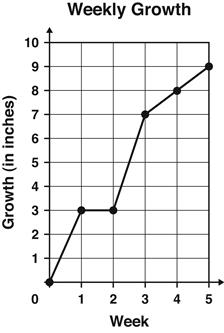
The graph shows the number of inches a plant grew each week.

Between which 2 weeks did the plant grow the MOST?

a)

Week 1 and Week 2

b)

Week 2 and Week 3

c)

Week 3 and Week 4

d)

Week 4 and Week 5

48.

This chart shows the composition of lunar soil. Which element is third most abundant?

a)

Silicon

b)

Magensium

c)

Iron

d)

Impossible to tell

49.
The amount of space something takes up
a)
density
b)
volume
c)
mass
d)
matter
50.

A crayon has a mass of 10.0 g and volume of 5.0 mL. What is the density?

a)

30 g/mL

b)

15 g/mL

c)

1.0 g/mL

d)

2.o g/mL

51.
True or False:  The density of a specific type of material never changes.  
a)
True
b)
False
52.
You can measure ______ with grams.
a)
mass
b)
volume
c)
conductivity
d)
melting point
53.
What is the formula for density?
a)
density = mass x volume
b)
density = mass / volume
c)
density = mass + volume
d)
density = mass - volume
54.
What is the density of water?
a)
0 g/ml
b)
1 g/ml
c)
10 g/ml
d)
100 g/ml
55.
What is the volume of the fish?
a)
18.0 cm3
b)
6.0 cm
c)
38.0 cm3
d)
32.0 mL
56.

A block of aluminum occupies a volume of 15 mL and has a mass of 40.5 g. What is its density?

a)

.37 g/mL

b)

605.5 g/mL

c)

2.7 g/mL

d)

25.5 g/mL

57.
Density is...
a)
the amount of mass in an object
b)
the amount of space an object takes up
c)
the amount of mass in a given space
d)
the weight of an object
58.
Which box has a higher density?  
a)
Box A
b)
Box B
c)
cannot be determined
d)
they are the same
59.

As part of a classifying elements lab Joe was finding the density of different samples. One sample had a mass of 26.4 and a volume of 12 mL. What element is it?

a)

Sulfur

b)

Carbon

c)

Boron

d)

Krypton

60.

when an object is compressed so that its mass is packed into a smaller space, its density

a)

increases

b)

decreases

c)

remains constant

61.
Calculate the density of the cube.
a)
2 g/cm3
b)
4 g/cm3
c)
6 g/cm3
d)
8 g/cm3
62.

A. gasoline 0.7 g/ cm3

B. lead 11.3 g/ cm3

C. mercury 13.6 g/ cm3

D. Paraffin(wax) 0.87 g/ cm3

E. platinum 21.4 g/ cm3

Which will not sink in water?

a)

A & B

b)

C & E

c)

B & C

d)

A & D