
 Worksheets
Covalent Bond
Total questions: 32
Worksheet time: 59mins
Name
Class
Date
1.
How do covalent bonds form?
a)
Donating & receiving valence e- between atoms.
b)
Opposite slight charges attract each other between compounds.
c)
Scientists are still not sure how they form.
d)
Sharing valence e- between atoms.
2.
Which of the following is NOT formed by a covalent bond?
a)
K2S
b)
H2O
c)
I2
d)
CO2
3.
Covalent bonds are between...
a)
Metal and Non-metal
b)
Non-metal and Non-metal
c)
Metal and Metal
4.
Is hydrogen considered a metal or a non-metal?
a)
A metal
b)
Nonmetal
c)
Metalloid
5.
What is a valence electron?
a)
The sum of neutrons and protons.
b)
The # of electrons in the last shell.
c)
A type of bond.
d)
A popular compound.
6.
How is covalent bonding represented?
a)
by writing its valence electrons
b)
by writing its Lewis structure
c)
by writing its number of bonds
d)
by writing its number of protons
7.

Which of the following is the correct Lewis dot structure for the molecule fluorine (F2)?
a)
A
b)
B
c)
C
d)
D
8.
Number of covalent bonds can form in group 16
a)
three
b)
two
c)
four
9.
The number of covalent bonds form in group 17
a)
One
b)
Two
c)
Three
10.
The number of pairs of electrons shared in triple covalent bond
a)
Two
b)
Three
c)
One
11.
A Nitrogen molecule (N2) has one triple bond. How many electrons do the nitrogen atoms share?
a)
1
1
1
b)
3
c)
4
d)
6
12.
In an electron dot diagram, two pairs of shared electrons represents a ...
a)
single bond
b)
double bond
c)
triple bond
d)
quadruple bond
13.

How many are shared in a single bond?
a)
2 pairs
b)
4
c)
2
d)
1
14.

Name the following compound:
CO2
CO2
a)
monocarbon dioxide
b)
carbon oxide
c)
carbon dioxide
d)
oxygen carbonide
15.

What is the correct formula for this molecule?
a)
NH
b)
N3H
c)
NH3
d)
NH4
16.

How many valence electrons does hydrogen have?
a)
4
b)
3
c)
2
d)
1
17.

How many bonds does carbon have to create in order to satisfy the octet rule
a)
1
b)
2
c)
3
d)
4
18.

Which element is most likely to form a covalent bond?
a)
Nitrogen
b)
Lithium
c)
Sodium
d)
Potassium
19.
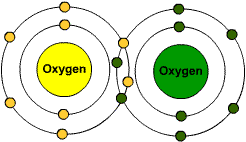
Is this image an example of covalent bonding?
a)
Yes
b)
No
20.

Atoms want
a)
A full outer shell of electrons
b)
One electron short of a full shell
c)
kit kats
21.

Outer shell electrons are called
a)
outer electrons
b)
valence electrons
c)
negatives
22.
What is the correct name for C4H6?
a)
Carbon Hexahydride
b)
Pentacarbon Pentahydride
c)
Hexacarbon Tetrahydride
d)
Tetracarbon Hexahydride
23.
What is the correct name for NO?
a)
Mononitrogen Monoxide
b)
Nitrogen Monoxide
c)
Mononitrogen Dioxide
d)
Nitrogen Oxide
24.
What is the formula for Tricarbon Octahydride?
a)
Ca3O
b)
C2H8
c)
C3H8
d)
Ca3H8
25.
A covalent compound made of one sulfur and two oxygen atoms would be named
a)
sulfur dioxide.
b)
sulfur oxide.
c)
disulfur oxide.
d)
sulfide oxygen.
26.
Bromine monofluoride
a)
Br1F1
b)
BrF
c)
Br2F
d)
BrF2
27.
What is the correct term for "atom with a full valence shell"?
a)
positive ion (cation)
b)
negative ion (anion)
c)
neutral atom
d)
stable atom
28.

Protons are positively charges, electrons are negatively charged, and neutrons are neutral. Using the diagram, determine the overall charge.
a)
positive
b)
negative
c)
neutral
d)
static
29.
P₄S₁₀
a)
tetrapotassium decasulfide
b)
phosphorus decasulfide
c)
tetraphosphorus decasulfide
d)
phosphorus (X) sulfide
30.
a representation of the valence electrons in an atom, using dots
a)
electron schematic
b)
electron dot diagram
c)
valence diagram
d)
covalent diagram
31.
a number in a chemical formula that tells the number of atoms in a molecule or the ratio of elements in a compound
a)
superscript
b)
subscript
c)
coefficient
d)
exponent
32.
an atom or group of atoms that has become electrically charged
a)
eon
b)
ion
c)
photon
d)
electricity
100 %

