wayground logo

Free Printable Worksheets

Font size

S
M
L
XL
Worksheets

Unit 4: Waves & Light

Total questions: 197

Worksheet time: 4hrs 50mins
Name
Class
Date
1.
Energy stored in chemical bonds is called
a)
elastic PE
b)
chemical PE
c)
gravitational PE
d)
kinetic energy
2.
Sounds that have a high pitch also have a high
a)
frequency
b)
rhythm
c)
volume
d)
crest
3.
Disturbances that transfer energy from one point to another are called
a)
bolts
b)
mediums
c)
thunder
d)
waves
4.
The high point of a transverse wave
a)
cap
b)
crest
c)
top
d)
trough
5.
What type of wave is a sound wave?
a)
transverse
b)
light
c)
compressional
d)
electromagnetic
6.
Which object has kinetic energy?
a)
a roller coaster stuck on top of a hill
b)
a bowling ball rolling down an alley
c)
a lion sleeping under a tree
d)
a bucket of water sitting on the floor
7.
The loudness of a sound wave depends on
a)
amplitude
b)
frequency
c)
pitch
d)
wavelength
8.
As wavelength increases, its
a)
frequency decreases
b)
frequency stays the same
c)
frequency increases
d)
volume increases
9.
Where would a book have the most potential energy?
a)
on the floor
b)
on top of a bookshelf
c)
on a table
d)
on a chair
10.
Monica turned down the volume on her ipod. In physics terms, she decreased the sound waves'
a)
frequency
b)
pitch
c)
amplitude
d)
wavelength
11.
In a flashlight, what is the energy transformation?
a)
elastic to mechanical
b)
mechanical to gravitational
c)
mechanical to light to thermal
d)
chemical to electrical to thermal to light
12.
As a lawnmower burns gas to turn the blade, which energy transformation is taking place?
a)
nuclear to mechanical
b)
thermal to mechanical
c)
chemical to mechanical
d)
mechanical to thermal
13.
In every energy transformation, which kind of energy is created?
a)
light
b)
electrical
c)
potential
d)
thermal
14.
Which is a form of energy an object has due to its motion?
a)
kinetic
b)
elastic PE
c)
potential 
d)
gravitational PE
15.
The kinetic energy of an object depends on 
a)
distance and time
b)
gravity and velocity
c)
position and acceleration
d)
mass and speed
16.
If you rode a bike past someone who was blowing a whistle at a constant pitch, which would happen?
a)
the pitch would not seem to change
b)
the pitch would seem to get higher as you approached and lower as you went by
c)
the pitch would seem to get lower as you approached and higher as you went by
d)
the pitch would seem to get higher as you approached and even higher as you went by
17.
Which is an example of the Law of Conservation of Energy?
a)
energy released from a tank of gas is converted to mechanical energy & heat
b)
a fire is put out and the energy disappeared
c)
people are required to turn off electrical appliances when not using them
d)
when 10g of paper is burned, 10g of product is formed
18.
The distance between waves is the
a)
frequency
b)
amplitude
c)
wavelength
d)
pitch
19.
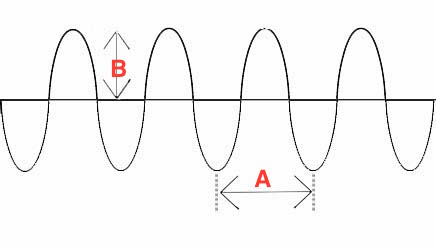
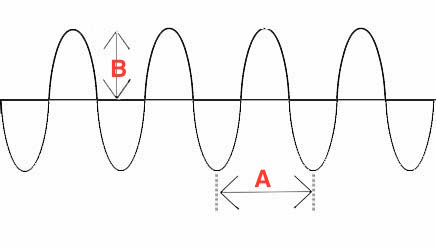
What property of this wave is represented by the letter "A"
a)
amplitude
b)
crest
c)
trough
d)
wavelength
20.
What property of the wave is represented by the letter "B"?
a)
amplitude
b)
crest
c)
trough
d)
wavelength
21.
The highest point on a wave is:
a)
the crest
b)
the trough
c)
the top
d)
the coast 
22.
The lowest point on a wave is the:
a)
Amplitude
b)
Crest
c)
Trough
d)
Wavelength
23.
The number of wavelengths that pass a point each per second is:
a)
frequency
b)
period
c)
longitudinal 
d)
transverse wave 
24.
The type of waves that require medium to pass:
a)
Mechanical Waves
b)
Electromagnetic Waves
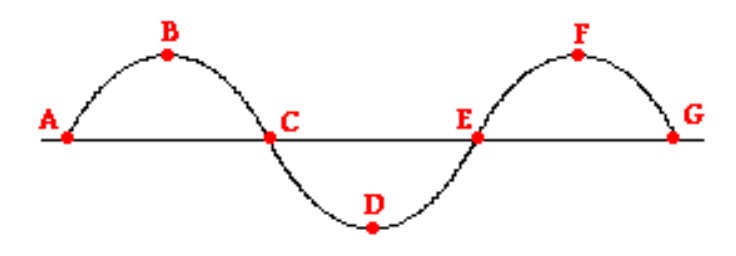
25.
Which vocabulary term is used to identify the distance between points C & G?
a)
Amplitude
b)
Crest
c)
Frequency
d)
Wavelength
26.
When the frequency of a wave increases, what happens to the wavelength?
a)
The wavelength is not directly affected by the frequency of a wave.
b)
The wavelength increases.
c)
The wavelength decreases.
d)
More specific information is needed to form a conclusion about the wavelength.
27.
A mechanical wave cannot travel through...
a)
a vacuum(empty space).
b)
water.
c)
air. 
d)
glass.
28.
Which letter(s) represent the trough of the wave?
a)
A
b)
B & D
c)
D
d)
C & G
29.
Which letter(s) represent the crest of the wave?
a)
A
b)
B & D
c)
B & F
d)
F
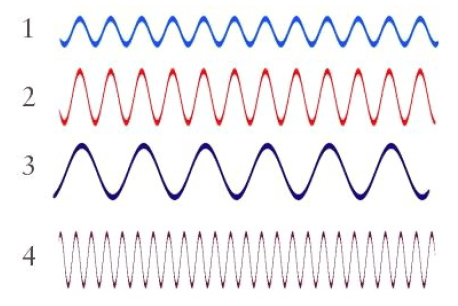
30.
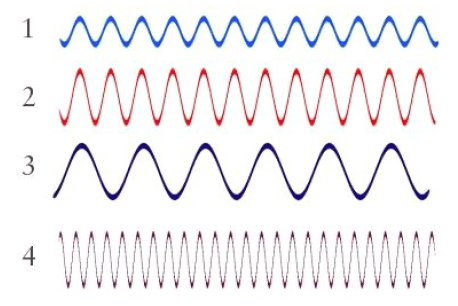
Which wave in the diagram has the greatest frequency?
a)
1
b)
2
c)
3
d)
4
31.
Which wave in the diagram has the greatest wavelength?
a)
1
b)
2
c)
3
d)
4
32.
Which of the following can sound travel through?
a)
solid
b)
liquid
c)
gas
d)
all of the above
33.
crest to crest or trough to trough
a)
crest
b)
trough
c)
amplitude
d)
wavelength
34.
Electromagnetic waves include the following except
a)
radio waves
b)
X-rays
c)
doing the wave at a football game
d)
microwaves
35.
regular disturbances that carry energy through matter or space
a)
crest
b)
energy
c)
wave
d)
trough
36.
which material does sound travel the fastest?
a)
solid 
b)
liquid 
c)
gases
37.
When a wave strikes and object and bounces off. (example echo)
a)
medium
b)
refraction
c)
reflection
d)
interference
38.
When a wave bends as it passes through at an angle from one medium to another.(example: pencil in a glass of water-)
a)
medium
b)
refraction
c)
reflection
d)
interference
39.
A disturbance that transfers energy from one place to another without transferring energy
a)
wave
b)
trough
c)
pitch
d)
sound
40.
A reflected sound wave
a)
frequency
b)
pitch
c)
echo
d)
rarefaction
41.
You and your father inspect an empty house with the hopes of buying it. You walk through the rooms talking to one another, and you notice that your voices and footsteps are echoing in the big, empty house. What causes the echo?
a)
sound waves reflecting off smooth, flat surfaces throughout the house
b)
sound waves moving around the large rooms
c)
sound waves moving slowly through air
d)
sound waves refracting around corners in the empty rooms
42.
Cletus wants to make ear protectors for people who work around loud jet engines at Hartsfield Airport in Atlanta. Which of the following materials should he experiment with for the best results?
a)
a material that produces sound
b)
a material that absorbs sound
c)
a material that transmits sound
d)
a material that amplifies sound
43.
As the fire truck approached Mary, the pitch of the siren got higher. Once the fire truck passed and moved away, the siren's pitch got lower. This change in pitch is because of a change in the sound wave's
a)
concussion. 
b)
amplitude. 
c)
reflection.
d)
frequency. 
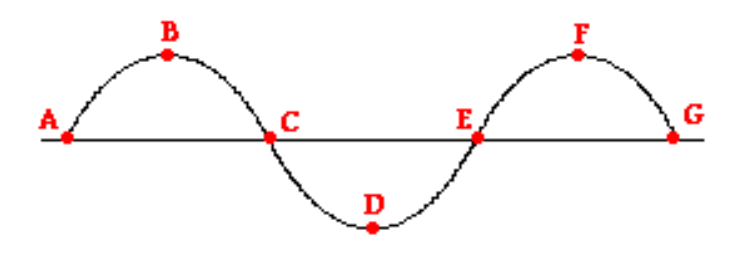
44.
After the train passed, the pitch of the train whistle became lower. This change in sound would be represented by what change in the diagram above? 
a)
The distance represented by C would increase. 
b)
The distance represented by C would decrease. 
c)
The distance represented by D would increase. 
d)
The distance represented by D would decrease. 
45.
Which of the following would you hear as a low pitched sound? 
a)
sound wave with a frequency of 50 Hz
b)
sound wave with frequency of 10,000 Hz
c)
sound wave with an intensity of 10 dB
d)
sound wave with an intensity of 100 dB
46.
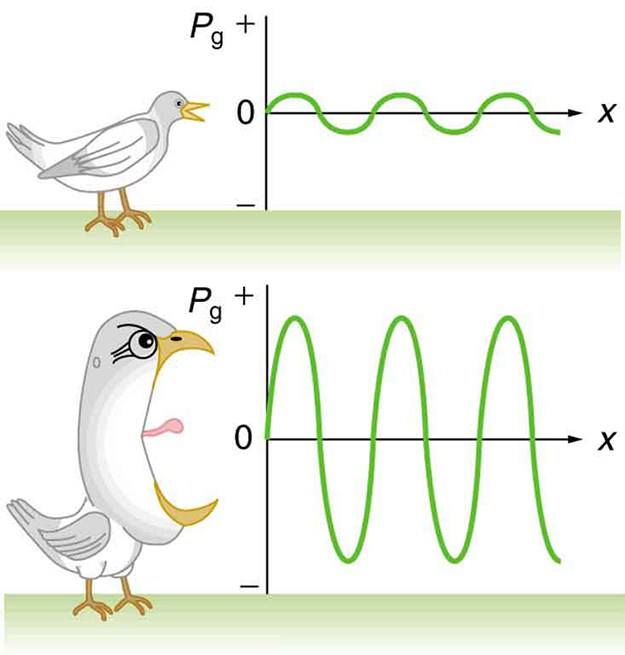
When a sound is louder what measurement gets bigger?
a)
Frequency 
b)
Amplitude 
c)
Wavelength 
d)
Crest
47.
Why is the school library covered with carpet?
a)
So everyone can make a lot of noise
b)
to help absorb sounds to keep it quiet
c)
because it looks good
d)
to help absorb sounds so it can stay noisy
48.

The speed of sound depends on these two things:

a)

The type of medium and the temperature of the medium

b)

Speed of the medium and temperature of the medium

c)

Temperature of the medium and sound of the medium

d)

None of the above

49.

Sound waves travel the fastest through ---

a)

Liquids

b)

Gases

c)

Solids

50.

Sonar and echolocation use ----- to detect objects under water.

a)

Refraction

b)

Reflection

51.

Sound waves that are beyond the range of human ear are known as ----

a)

Infrasonic waves

b)

Ultrasonic waves

52.
A disturbance that travels through a medium as a longitudinal wave
a)
sound
b)
wavelength
c)
pitch
d)
frequency
53.
Bending of waves around an object (such as through a doorway)
a)
sound
b)
diffract
c)
pitch
d)
volume
54.
travels through solids fastest because the molecules are closer together
a)
speed of sound
b)
wavelength
c)
frequency
d)
amplitude
55.
The number of wavelengths that pass a point each second
a)
frequency
b)
wavelength
c)
pitch
d)
amplitude
56.
Material (matter) through which a wave travels
a)
medium
b)
Doppler Effect
c)
sound
d)
pitch
57.
How high or low a sound is; depends on the frequency (greater frequency= higher pitch)
a)
pitch
b)
frequency
c)
sound
d)
medium
58.
A wave in which the vibration is in the same direction as that in which the wave is traveling; sound waves
a)
longitudinal wave
b)
ocean wave
c)
transverse wave
d)
mechanical wave
59.
The part of a longitudinal wave where the particles of the medium are close together.
a)
rarefaction
b)
compression
c)
crest
d)
trough
60.
A part in a longitudinal wave where the particles are spread apart
a)
compression
b)
rarefaction
c)
crest
d)
trough
61.
A disturbance that transfers energy from one place to another without transferring energy
a)
wave
b)
trough
c)
pitch
d)
sound
62.
A reflected sound wave
a)
frequency
b)
pitch
c)
echo
d)
rarefaction
63.
A wave that requires a medium through which to travel
a)
mechanical wave
b)
chemical wave
c)
electromagnetic wave
d)
pitch
64.
You and your father inspect an empty house with the hopes of buying it. You walk through the rooms talking to one another, and you notice that your voices and footsteps are echoing in the big, empty house. What causes the echo?
a)
sound waves reflecting off smooth, flat surfaces throughout the house
b)
sound waves moving around the large rooms
c)
sound waves moving slowly through air
d)
sound waves refracting around corners in the empty rooms
65.
Cletus wants to make ear protectors for people who work around loud jet engines at Hartsfield Airport in Atlanta. Which of the following materials should he experiment with for the best results?
a)
a material that produces sound
b)
a material that absorbs sound
c)
a material that transmits sound
d)
a material that amplifies sound
66.
As the fire truck approached Mary, the pitch of the siren got higher. Once the fire truck passed and moved away, the siren's pitch got lower. This change in pitch is because of a change in the sound wave's
a)
concussion. 
b)
amplitude. 
c)
reflection.
d)
frequency. 
67.
After the train passed, the pitch of the train whistle became lower. This change in sound would be represented by what change in the diagram above? 
a)
The distance represented by C would increase. 
b)
The distance represented by C would decrease. 
c)
The distance represented by D would increase. 
d)
The distance represented by D would decrease. 
68.
Which of the following would you hear as a low pitched sound? 
a)
sound wave with a frequency of 50 Hz
b)
sound wave with frequency of 10,000 Hz
c)
sound wave with an intensity of 10 dB
d)
sound wave with an intensity of 100 dB
69.

What is the Doppler Effect

a)

Where the wavelength of a wave is shifted due to the source moving

b)

When a wave is shifted when a body pushes the wave

c)

Where the apparent wavelength of a wave is shifted due to the source moving

70.

An observer moves towards a source of sound at a speed of 30 ms-1

If the frequency of the sound to a stationary observer is 500 Hz the frequency to the moving observer is

a)

456 Hz

b)

544 Hz

c)

460 Hz

d)

548 Hz

71.
If a wave is traveling at 260 m/s and has a wavelength of 0.8 m/s, what is its frequency?
a)
208 Hz
b)
325 Hz
c)
430 Hz
d)
160 Hz
72.
What particles make up light?
a)
Photons
b)
Neutrons
c)
Protons
73.
Light behaves like both a particle and a ______.
a)
Mass
b)
Wave
c)
Current
74.
What is the speed of light in air?
a)
140,000 miles/sec
b)
186,000 miles/sec
c)
60 miles/hour
d)
120 miles/hour
75.
A light year is...
a)
The speed light travels
b)
How long it takes light to get to you from the sun
c)
The distance light can travel in a year
d)
How many years it takes light to be emitted
76.
What color has the shortest wavelength, or the highest frequency?
a)
yellow
b)
blue
c)
red
d)
violet
77.
What does reflection mean?
a)
bending light
b)
bouncing light
78.
What does refraction mean?
a)
bending light
b)
bouncing light
79.
What type of waves does light travel in?
a)
transverse
b)
compression
c)
high and low waves
d)
waves like the ocean
80.
What is this a picture of?
a)
reflection
b)
refraction
81.

Why does light refract?

a)

speeds up

b)

gets hot

c)

slows down

d)

gains energy

82.

Light travels through an object during

a)

absorption

b)

reflection

c)

transmission

d)

diffraction

83.
The full spectrum of light energy is called the__________
a)
broad spectrum
b)
electromagnetic spectrum
c)
helium spectrum 
d)
natural light spectrum
84.
Electric and magnetic fields produce
a)
electricity
b)
magnets
c)
longitudinal waves
d)
light
85.

What is the earth's primary source of light energy?

a)

moon

b)

sun

c)

waves

d)

fire

86.

The height of the sound waves

a)

Frequency

b)

Amplitude

c)

Wavelength

87.
4 is 
a)
radio
b)
UV 
c)
Visible Light
d)
X-ray
88.
EM waves have the same speed but different:
a)
frequency & medium 
b)
wavelength & frequency
c)
medium & wavelength
d)
color & medium
89.
When the surface of a mirror curves inward, like the inside of a bowl, it is called a
a)
Plane Mirror
b)
Convex Mirror
c)
Concave Mirror
d)
Diffuse Mirror
90.
Which wavelength of visible light has the lowest energy?
a)
Red
b)
Yellow
c)
Orange
d)
Blue
91.
Which of the following types of radiation has the shortest wavelength and the highest frequency?
a)
Radio Waves
b)
Infrared
c)
Visible
d)
X-Rays
92.

A student placed a pencil in a cup of water. The pencil appears broken because light-

a)

light travelling from water to air bends away from the normal making the pencil under water look closer to the surface

b)

light travelling from water to air bends towards the normal making the pencil under water look further away

c)

light travelling from air to water bends towards the normal making the pencil under water look higher up

d)

light travelling from air to water bends away from the normal making the pencil under water look closer to the surface

93.

In comparison to air glass has _____________ index of refraction.

a)

the same

b)

a higher

c)

a lower

d)

an unknown

94.

Refraction occurs due to _____________

a)

the change in the wave's speed when it enters a new medium

b)

the wave bouncing off a boundary

c)

the change in the wave's frequency when it enters a new medium

d)

the wave bending around a barrier

95.

Light has the lowest velocity in which medium?

flint glass n=1.70

air n=1.0001

water n=1.33

diamond n=2.45

a)

diamond

b)

water

c)

flint glass

d)

air

96.

Calculate the refractive index of the mystery material.

a)

0.55

b)

1.5

c)

1.81

d)

2.05

97.

If the refractive index of water is 1.33, at what angle will the light shone by the diver exit the water.

a)

14.6

b)

49.7

c)

28.6

d)

55

98.

If the refractive index of glass is 1.5 and the refractive index of water is 1.33, which ray A or B correctly shows how light is refracted travelling from glass to water?

a)

A

b)

B

99.

The refractive index of a medium is the ratio of the speed of light in a vacuum to the speed of light in that medium 

a)

True

b)

False

100.

When light travels from a slow to a fast medium & the incident angle is gradually increased

a)

the angle θr\theta_r increases until it reaches a fixed value

b)

the angle undefined decreases until it reaches 0

c)

the angle 90o90^o increases until it reaches

d)

the angle θi\theta_i approaches the incident angle

101.

A laser was shone on a glass prism and the angle of refraction was measured for a range of incident angles. The sine of both angles were plotted on a graph and a trend line determined. What is the refractive index of the glass?

a)

0.63

b)

1.59

c)

0.7

d)

1.43

102.

The power output of a green laser is 5 mW. If the laser beam is a circle 1 mm in diameter, what is the intensity of the beam.

a)

1.6 Wm-2

b)

6.4 m-2

c)

1.6 kWm-2

d)

6.4 kWm-2

103.

The law of reflection states that

a)

the angle of reflection is equal to the angle of incidence

b)

the angle of reflection is greater than the angle of incidence

c)

the image is laterally inverted

d)

the image must be upright and the same size as the object

104.

A ray of light hits a plane mirror. Using the diagram determine the angle of reflection.

a)

40

b)

50

c)

90

d)

Don't know

105.

When light hits an area and bounces back it is called:

a)

echo

b)

refraction

c)

reflection

d)

absorbing

106.

When light goes from one material(medium) to another it becomes bent, what term means bent?

a)

reflected

b)

refracted

c)

absorbed

d)

turned

107.

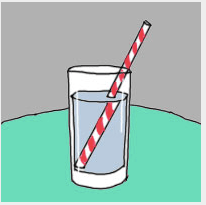
Why does the straw appear to be bent?

a)

light is reflected

b)

light is absorbed

c)

light is turned

d)

light is refracted

108.

When light passes from air to water, what happens to the speed of the light?

a)

speeds up

b)

slows down

c)

stays the same

109.

What is the best explanation for Mickey seeing himself in the mirror?

a)

refraction

b)

absorbed

c)

reflection

d)

flipped

110.

What is happening in this picture?

a)

Reflection

b)

Refraction

111.
The velocity of light in vacuum is _______ m/s
a)
3x10⁸
b)
3x10¹²
c)
3x10⁶
d)
3x10¹⁰
112.

What is the angle of reflection (θr) in the image?

a)

56o

b)

90o

c)

124o

d)

34o

113.
A student placed a pencil in a cup of water.  The pencil appears broken because light-
a)
always travels in a straight line
b)
bends when it passes through water
c)
makes the water in the glass evaporate
d)
reflects the pencil on the water's surface
114.

Which of the following characteristics are correct for the image formed in a plane mirror?


I. Upright

II. Inverted

III. Real

IV. Same size as the object

V. Virtual

a)

I, II, III

b)

I, III, IV

c)

I, IV, V

d)

III, IV, V

115.

Which of the following factors contributes to the bending of light?

a)

Change of speed of light

b)

Change of density of light

c)

Change of colour of light

d)

Change of energy of light

116.
Light has the lowest velocity in which medium?
flint glass n=1.70
barium glass n=1.60
crown glass n=1.523
water n=1.33
diamond n=2.45
a)
diamond
b)
water
c)
flint glass
d)
barium glass
117.

When the light passes out of the glass, back into the air

a)

It bends away from the normal

b)

It does not bend

c)

It bends towards the normal

d)

It continues to be the normal

118.

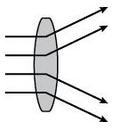
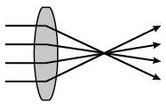
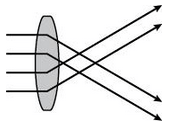
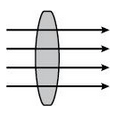
Which figure represents the path light takes through a converging lens?
a)
b)
c)
d)
119.

The type of mirror used in reflector in automobile lights is

a)

Plane mirror

b)

Concave mirror

c)

Convex mirror

d)

None of the above

120.

Why does the straw appear to be bent?

a)

light is reflected

b)

light is absorbed

c)

light is turned

d)

light is refracted

121.

When light passes from air to water, what happens to the speed of the light?

a)

speeds up

b)

slows down

c)

stays the same

122.
The velocity of light in vacuum is _______ m/s
a)
3x10⁸
b)
3x10¹²
c)
3x10⁶
d)
3x10¹⁰
123.

What is the angle of reflection (θr) in the image?

a)

56o

b)

90o

c)

124o

d)

34o

124.
A student placed a pencil in a cup of water.  The pencil appears broken because light-
a)
always travels in a straight line
b)
bends when it passes through water
c)
makes the water in the glass evaporate
d)
reflects the pencil on the water's surface
125.
Light has the lowest velocity in which medium?
flint glass n=1.70
barium glass n=1.60
crown glass n=1.523
water n=1.33
diamond n=2.45
a)
diamond
b)
water
c)
flint glass
d)
barium glass
126.
What do we call this tool that separates white light into the colors of the Visible Spectrum?
a)
tuning fork
b)
prism
c)
microscope
d)
graduated cylinder
127.
According to the Law of reflection, a light ray striking a mirror
a)
continues moving through the mirror in the same direction
b)
moves into the mirror at a slightly different angle
c)
bounces off the mirror toward the direction it came from
d)
bounces off the mirror at the same angle it hits.
128.

What color has the longest wavelength?

a)

Black

b)

Green

c)

Purple

d)

Red

129.
The bouncing off of light rays from the surface of an object such as a mirror or other shiny surface is called:
a)
mirror
b)
laser
c)
reflection
d)
refraction
130.

Which one of these describes a lens that causes light to come to together at a single point?

a)

concave

b)

opaque

c)

convex

d)

translucent

131.

A mirror having focal length –15 cm is _________________

a)

Plane mirror

b)

Concave mirror

c)

Convex mirror

d)

None of these

132.

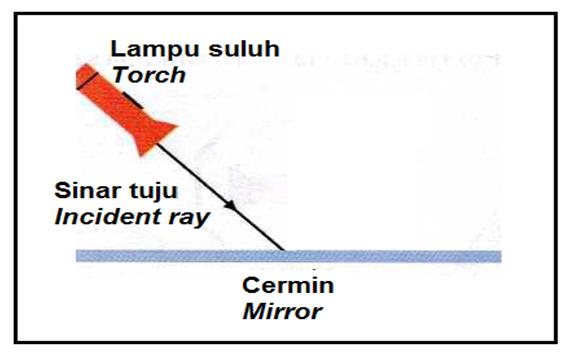
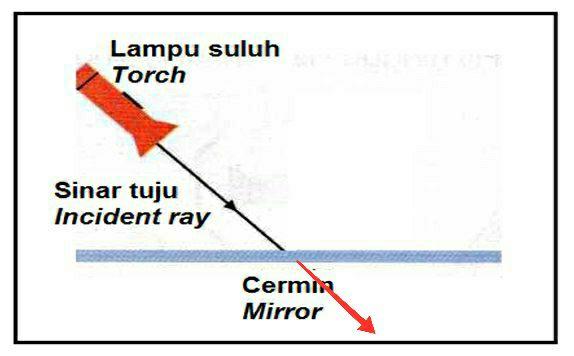
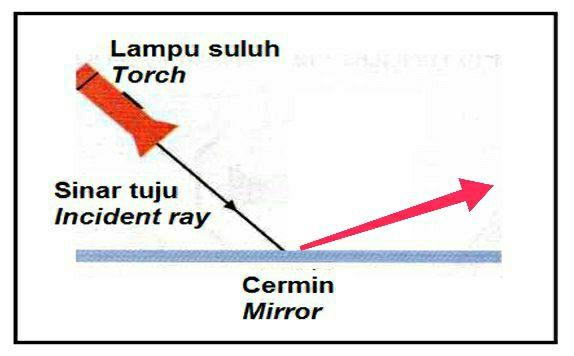
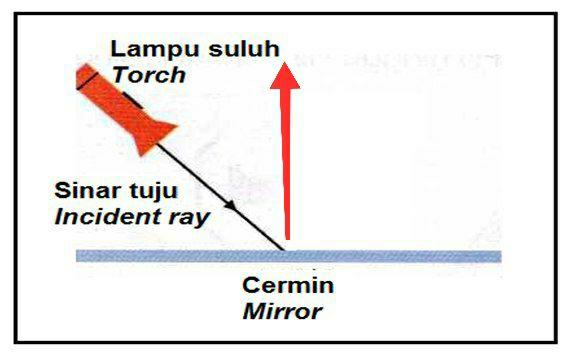
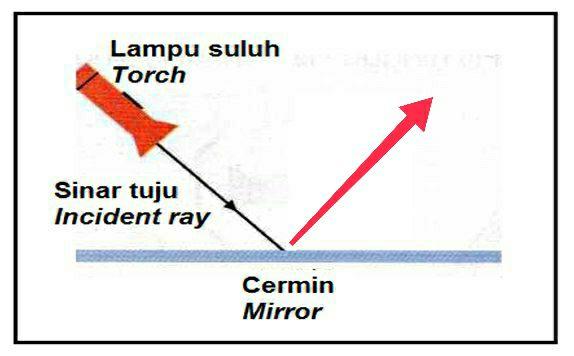
The following diagram shows the ray diagram when a torch light is torched towards a mirror. Which of the following is the correct reflected ray?
a)
b)
c)
d)
133.
Law of reflection state that - The angle of incidence is .................. to the angle of reflection.
a)
equal
b)
double
c)
half
134.
If the angle of incidence increases, the angle of refraction ________.
a)
Increases
b)
Decreases
135.

No matter how far you stand from a spherical mirror, your image appears erect. The mirror may be

a)

only plane

b)

only concave

c)

either plane or convex

d)

only convex

136.

A positive sign in the value of magnification indicates that the image is

a)

real

b)

virtual

c)

enlarged

d)

near

137.

A ray of light coming parallel to the principal axis after passing through a convex lens, has passed through its

a)

optical centre

b)

focus

c)

center of curvature

d)

mid point

138.

When light passes through a convex lens, it does this.....

a)

Diverge, or spread apart

b)

Converge, or come together

c)

Reflect, or bounce off

d)

Create a rainbow

139.

The thicker the convex lens, the ___________________ its focal length.

a)

Shorter

b)

Longer

c)

Thicker

d)

Thinner

140.

Two waves E and G are shown. The waves have the same speed.

Which statement is correct?

a)

Wave E has a greater amplitude than wave G.

b)

Wave E has a greater intensity than wave G.

c)

Wave E has a smaller frequency than wave G.

d)

Wave E has a smaller wavelength than wave G.

141.

The diagram shows a displacement-time graph for a progressive wave.

a)

Amplitude: 5 mm; Frequency: 40 Hz

b)

Amplitude: 5 mm; Frequency: 50 Hz

c)

Amplitude: 10 mm; Frequency: 40 Hz

d)

Amplitude: 10 mm; Frequency: 50 Hz

142.

Which observation indicates that sound waves are longitudinal?

a)

Sound can be reflected from a solid surface.

b)

Sound cannot be polarised.

c)

Sound is diffracted around corners.

d)

Sound is refracted as it passes from hot air to cold air.

143.

A diffraction grating is used to measure the wavelength of monochromatic light, as shown in the diagram.

The spacing of the slits in the grating is 1.00 x10⁻⁶ m. The angle between the first order diffraction maxima is 70.0o.

What is the wavelength of the light?

a)

287 nm

b)

470 nm

c)

574 nm

d)

940 nm

144.

Interference of light is evidence that:

a)

the speed of light is very large

b)

light is a transverse wave

c)

light is electromagnetic in character

d)

light is a wave phenomenon

145.

In a Young's double-slit experiment the centre of a bright fringe occurs wherever waves from the slits differ in the distance they travel by a multiple of:

a)

quarter of a wavelength.

b)

half a wavelength.

c)

a wavelength.

d)

three-fourths of a wavelength.

146.

In a Young's double-slit experiment, the slit separation is doubled. To maintain the same fringe spacing on the screen, the screen-to-slit distance D must be changed to:

a)

D/2

b)

D 2\sqrt{2}

c)

2D

d)

4D

147.

For destructive interference, the path difference is:

a)

odd number of half wavelengths

b)

even number of half wavelengths

c)

whole number of wavelengths

d)

even whole number of wavelengths

148.

Constructive interference happens when two waves are:

a)

out of phase.

b)

zero amplitude.

c)

in phase.

149.

Two waves with phase difference 180° have resultant of amplitude

a)

one.

b)

zero.

c)

same as the single wave.

d)

doubles the single wave.

150.

Extra distance travelled by one of waves compared with other is called

a)

path.

b)

displacement.

c)

phase difference.

d)

path difference.

151.

What principle is responsible for light spreading as it passes through a narrow slit?

a)

refraction

b)

polarization

c)

diffraction

d)

interference

152.

What principle is responsible for alternating light and dark bands when light passes through two or more narrow slits?

a)

refraction

b)

polarization

c)

diffraction

d)

interference

153.

When a light wave enters into a medium of different optical density,

a)

its speed and frequency change.

b)

its speed and wavelength change.

c)

its frequency and wavelength change.

d)

its speed, frequency, and wavelength change.

154.

Light of wavelength 575 nm falls on a double-slit and the third order bright fringe is seen at an angle of 6.5o. What is the separation between the double slits?

a)

5.0 micro-m

b)

10 micro-m

c)

15 micro-m

d)

20 micro-m

155.

Two light sources are said to be coherent if they

a)

are of the same frequency.

b)

are of the same frequency, and maintain a constant phase difference.

c)

are of the same amplitude, and maintain a constant phase difference.

d)

are of the same frequency and amplitude.

156.

One beam of coherent light travels path P1 in arriving at point Q and another coherent beam travels path P2 in arriving at the same point. If these two beams are to interfere destructively, the path difference P1 - P2 must be equal to

a)

an odd number of half-wavelengths.

b)

zero.

c)

a whole number of wavelengths.

d)

a whole number of half-wavelengths.

157.

Interference of light is evidence that ___________.

a)

the speed of light is very large

b)

light is a transverse wave

c)

light is electromagnetic in character

d)

light is a wave phenomenon

158.

All of the following are evidence that light is a wave EXCEPT:

a)

refraction

b)

reflection

c)

interference

d)

diffraction

159.

These two waves are _________.

a)

monochromatic and in phase

b)

monochromatic and out of phase

c)

multichromatic and in phase

d)

multichromatic and out of phase

160.

These two waves will ________ interfere and result in a _________ amplitude.

a)

constructively, increased

b)

constructively, decreased

c)

destructively, increased

d)

destructively, decreased

161.

The path difference between these two waves is ________.

a)

0 waves

b)

1 wave

c)

2 waves

d)

3 waves

162.

These two waves would ______ interfere and cause the brightness to be at a _____.

a)

constructively, minima

b)

constructively, maxima

c)

destructively, minima

d)

destructively, maxima

163.

The path difference between these two waves is ______ and would result in a _____-order bright spot.

a)

6 wavelengths, sixth

b)

3 wavelengths, sixth

c)

6 wavelengths, third

d)

3 wavelengths, third

164.

Two beams of coherent light travel different paths, arriving such that they destructively interfere on the screen. The two beams must

a)

arrive in phase

b)

arrive 45-degrees out of phase

c)

arrive 90-degrees out of phase

d)

arrive 180-degrees out of phase

165.

In a Young's double-slit experiment, the center of a bright fringe occurs wherever waves from the slits differ in path length by:

a)

a quarter of a wave

b)

half of a wave

c)

any integer number of waves

d)

multiples of four waves

166.

In Young's Double slit experiment, two adjacent bright fringes are 0.5 cm apart. The distance between two dark fringes ______.

a)

is less than 0.5 cm

b)

is greater than 0.5 cm

c)

is exactly 0.5 cm

d)

is dependent on which order is observed.

167.

In Young's double slit experiment, which diffraction grating would result in the largest spacing of bright spots?

a)

d = 0.0125 m

b)

d = 0.0100 m

c)

d = 1 mm

d)

d = 1 micron

168.

A slide with three diffraction gratings on it is used for an experiment. Which has the largest value of slit spacing, d?

a)

50 lines per mm

b)

100 lines per mm

c)

200 lines per mm

169.

In Young's double slit experiment, which laser would result in the closest together bright spots?

a)

violet (410 nm)

b)

blue (450 nm)

c)

green (550 nm)

d)

red (650 nm)

170.

A student holds a laser and diffraction grating such that they are projecting a series of bright and dark fringes onto the whiteboard. As the student walks toward the board, the bright spots ______.

a)

become closer together

b)

moves farther apart

c)

maintain the same spacing

171.

Which would have the widest-spaced fringe pattern for light traveling through a diffraction grating?

a)

large wavelength and a small slit spacing

b)

small wavelength and small slit spacing

c)

large wavelength and a large slit spacing

d)

small wavelength and a large slit spacing

172.

A photoelectric cell is used as a light sensor in a YDS experiment. If the fourth maxima were found at a position of y = 12 cm, where would the third maxima be found?

a)

depends on the wavelength

b)

6 cm

c)

8 cm

d)

9 cm

173.
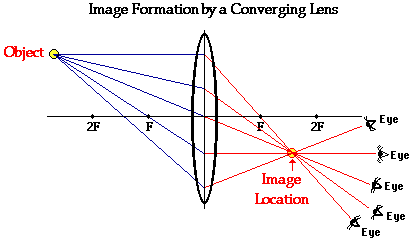
Compared to the object in front the lens, its image is.....
a)
inverted and smaller
b)
inverted and larger
c)
not inverted and smaller
d)
not inverted and larger
174.
What type of image is formed when rays of light actually intersect?
a)
real
b)
virtual
c)
projected
d)
curved
175.
An image that you can see , but does not really exist is called which of the following?
a)
Real Image
b)
Fake Image
c)
Virtual Image
d)
Digital Image
176.
A real image...
a)
is produced by virtual rays and can be projected on a screen
b)
is produced by real rays and cannot be projected on a screen
c)
is produced by virtual images and cannot be projected on a screen
d)
is produced by real rays and can be projected on a screen
177.
Which one is a convex lens?
a)
A
b)
B
178.
What type of image is formed in a plane mirror?
a)
Real
b)
Virtual
c)
Enlarged
d)
Small
179.
If an image formed by a convex lens is inverted, it is most likely what type of image?
a)
Real
b)
Virtual
c)
None of the above
180.
As you move an object further away from a convex lens, its image would become which of the following?
a)
Larger and virtual
b)
Larger, only
c)
Smaller, only
d)
Smaller and virtual
181.
Which of the following does not refract light?
a)
prism
b)
convex lens
c)
concave lens
d)
mirror
182.
What kind of image will you get if you put an object right at F, the focal point of this lens?
a)
Virtual, larger
b)
Real, smaller
c)
Real, larger
d)
No image
183.

The process of light bouncing off a surface

a)

refraction

b)

reflection

c)

diffraction

d)

diffusion

184.
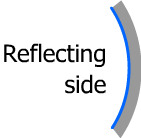
The following is a picture of what type of mirror? 
a)
Convex Mirror
b)
Concave Mirror
c)
Plane Mirror
d)
Flat Mirror
185.
The following is a picture of what type of mirror? 
a)
Convex Mirror
b)
Concave Mirror
c)
Plane Mirror
d)
Flat Mirror
186.
Which type of mirror magnifies a close up image, like a make-up mirror.
a)
Concave
b)
Convex
c)
Specular
d)
Plane
187.
Which type of mirror is shown.
a)
Concave
b)
Convex
c)
Specular
d)
Plane
188.
Individuals that are farsighted need to have prescription lenses that are _________. 
a)
convex
b)
concave
c)
plane
d)
flat
189.
Individuals that are nearsighted need to have prescription lenses that are ___________. 
a)
convex
b)
concave
c)
plane 
d)
flat
190.
Concave lenses, like the ones found in the peepholes of a door, always produce images that are .....
a)
Virtual, upright, smaller
b)
Real, inverted, larger
c)
Real, inverted, smaller
d)
Virtual, upright, larger
191.
Convex mirrors, like those found on the side of a car, produce images that are always _________________. 
a)
Real, larger and inverted
b)
Virtual, larger, and inverted
c)
Virtual, smaller and upright
d)
Of equal size and position as the original object
192.
The point where the rays meet is known as....
a)
Fire
b)
the focal point
c)
refraction
d)
Plane of the lens
193.
This image is...
a)
Inverted and smaller
b)
Inverted and larger
c)
not inverted and smaller
d)
not inverted and larger
194.
What is Nearsightedness? 
a)
condition that has difficulty seeing things that are close 
b)
condition that has difficulty seeing things that are far away
195.
What is an Astigmatism?
a)
a very contagious condition caused by a bacterial infection 
b)
a substance that hardens your teeth 
c)
 a hard substance that gives nails their strength 
d)
persons vision is distorted due to a irregular shaped eye 
196.
A real image having a size of 10 cm is formed by a concave mirror. The size of the object is 5 cm.The magnification of the object is
a)
-5
b)
5
c)
2
d)
-2
197.
An object is placed 10 cm from a convex mirror. Its image is formed 5 cm behind the mirror.The focal length of the given convex mirror is
a)
-5 cm
b)
5 cm
c)
10 cm
d)
-10cm