
 Worksheets
IGCSE Physics 1,2,3,5,6
Total questions: 199
Worksheet time: 4hrs 3mins

A
B
C
D
A tunnel has a length of 50 km. A car takes 20 min to travel between the two ends of the tunnel. What is the average speed of the car?
2.5 km / h
16.6 km / h
150 km / h
1000 km / h

pole 1 and pole 2.
pole 2 and pole 3.
pole 3 and pole 4.
pole 4 and pole 5.

A
B
C
D

A
B
C
D
A small steel ball is dropped from a low balcony. Ignoring air resistance, which statement describes its motion?
It falls with decreasing acceleration.
It falls with constant acceleration.
It falls with decreasing speed.
It falls with constant speed.

Which speed/ time graph applies to an object at rest?
A
B
C
D

A
B
C
D

10 m
20 m
100 m
200 m

150 m
300 m
600 m
1200 m

4.0 s
6.0 s
10 s
16 s

A
B
C
D

A
B
C
D

A
B
C
D

A
B
C
D

A
B
C
D

A
B
C
D

A
B
C
D

A
B
C
D

A
B
C
D
Which force acts on an object when it is placed on a flat surface?
a) Frictional force
b) Tension force
c) Gravitational force
d) Electrostatic force
What happens to the spring constant when the spring is stretched?
a) The spring constant remains the same
b) The spring constant increases
c) The spring constant decreases
d) The spring constant becomes zero
What is the limit of proportionality?
a) The maximum force that a spring can withstand without breaking
b) The point at which the spring stops obeying Hooke's law
c) The point at which the spring constant changes
d) The point at which the spring reaches its maximum length
What is the SI unit of pressure?
a) Newton
b) Pascal
c) Joule
d) Watt
A force of 20 N is applied to an object with an area of 2 m2. What is the pressure exerted on the object?
a) 10 Pa
b) 20 Pa
c) 40 Pa
d) 60 Pa
When a force of 10 N is applied to an object, the object moves with a constant velocity. What can you say about the forces acting on the object?
a) There is no net force acting on the object
b) The object is accelerating
c) The force is unbalanced
d) The object is moving in a circular path
A spring has a spring constant of 5 N/m. What is the extension of the spring when a force of 20 N is applied to it?
a) 4 m
b) 5 m
c) 10 m
d) 25 m
Which of the following is not an application of pressure in everyday life?
a) Using a nail to hang a picture on a wall
b) Using a pen to write on paper
c) Using a knife to cut vegetables
d) Using a syringe to inject medicine
What is the pressure exerted by a force of 50 N on an area of 5 m2?
a) 10 Pa
b) 25 Pa
c) 50 Pa
d) 250 Pa
A spring has a spring constant of 100 N/m. What is the extension of the spring when a force of 20 N is applied to it?
a) 0.2 m
b) 0.5 m
c) 2 m
d) 5 m
Which of the following is not an example of a fluid?
a) Water
b) Air
c) Glass
d) Oil
Which of the following statements is true regarding the stretching of a spring?
a) The spring constant decreases as the spring is stretched
b) The spring constant increases as the spring is stretched
c) The spring constant remains constant as the spring is stretched
d) The spring constant depends on the direction of the force applied to the spring
Which of the following is the formula for calculating pressure due to a fluid?
a) Pressure = density × gravity × depth
b) Pressure = density × volume × gravity
c) Pressure = force ÷ area
d) Pressure = mass ÷ volume
Which of the following is true regarding the pressure at the bottom of a container filled with a liquid?
a) The pressure is equal to the pressure at the top of the container
b) The pressure is equal to the weight and depth of the liquid
c) The pressure is equal to the weight of the container
d) The pressure is equal to the sum of the weight of the liquid and the weight of the container
Which of the following is the formula for calculating the weight of a fluid?
a) Weight = density × volume × gravity
b) Weight = mass × gravity
c) Weight = force ÷ area
d) Weight = pressure ÷ area
Which of the following is true regarding the weight of an object submerged in a fluid?
a) The weight of the object is equal to the weight of the fluid displaced by the object
b) The weight of the object is equal to the buoyant force acting on the object
c) The weight of the object is equal to the difference between the weight of the fluid displaced by the object and the weight of the object
d) The weight of the object is independent of the density of the fluid
A diver is at a depth of 20 meters in seawater, which has a density of 1025 kg/m³. What is the pressure the diver experiences due to the seawater?
a) 196,000 Pa
b) 205,000 Pa
c) 215,000 Pa
d) 225,000 Pa
In a hydraulic system, which of the following is true regarding the pressure exerted on the larger piston compared to the pressure exerted on the smaller piston?
a) The pressure is greater on the larger piston
b) The pressure is greater on the smaller piston
c) The pressure is equal on both pistons
d) It depends on the force applied to each piston
In a hydraulic system, if the area of the smaller piston is 5 cm² and the area of the larger piston is 20 cm², what force is required to apply a pressure of 2.5 Pa to the larger piston?
a) 50 N
b) 100 N
c) 200 N
d) 500 N
Which of the following is true regarding Pascal's law?
a) It states that pressure is directly proportional to volume
b) It states that pressure is inversely proportional to volume
c) It states that pressure is transmitted equally in all directions in a fluid
d) It states that pressure is transmitted more efficiently in a gas than in a liquid
Calculate the impulse on the ball.


When a diver swims down from the surface of the water to a depth of 10m, the pressure experienced increases from 100 000 N / m2 to 200 000 N / m2.
Which statement explains this increase in pressure?
The density of the water increases with depth.
The gravitational field strength increases with depth.
The weight of water above the diver increases with depth.
Water cannot be compressed.

Tractors have large tyres. These help to prevent the wheels from sinking into soft ground.
Which statement explains this?
Larger tyres exert a greater force on the ground.
Larger tyres exert a greater pressure on the ground.
Larger tyres exert a smaller force on the ground.
Larger tyres exert a smaller pressure on the ground.
Why is it easier to push a sharp nail, rather than a blunt nail, into a piece of wood?
The sharp nail exerts a larger force on the wood.
The sharp nail exerts a smaller force on the wood.
The sharp nail exerts a larger pressure on the wood.
The sharp nail exerts a smaller pressure on the wood.
Which graph shows the relationship between the pressure exerted by the water and the depth water in the pool?
(Assume the density of water is constant.)


An object is a depth h below the surface of a liquid. The pressure due to the liquid at this depth is ρ. The gravitational field strength is g.
What is the density ρ of the liquid?
ρ = pgh
ρ = pg / h
ρ = ph / g
ρ = p / hg
An object is immersed in a liquid of density ρ. The pressure at this depth due to the liquid is p.
The gravitational field strength is g.
What is the equation for the depth h of the object beneath the surface?
h = pρg
h = ρg / p
h = p / ρg
h = pg / ρ


Waves on the surface of water travel from deep to shallow water. Which diagram shows the correct path of the waves in the shallow water?


Which change will increase the diffraction of a wave as it passes through a gap?
What is ultrasound?
sound waves that are so loud that they damage human hearing
sound waves that are too high-pitched for humans to hear
sound waves that are too low-pitched for humans to hear
sound waves that are too quiet for humans to hear

In the diagram, the mountaineer can hear the stream although he cannot see it. When he is closer to the gully, he can both hear and see the stream. When he is further from the gully, he can neither hear nor see the stream.
Which statement is NOT correct?
As he approaches the gully edge, the sound becomes louder.
As he approaches the gully edge, he hears first the short wavelength, higher frequencies and then the long wavelength, lower frequencies.
He hears the stream because some of the sound is diffracted.
He hears the stream because some of the sound is reflected from the opposite wall of the gully.

The diagrams show examples of wave motion. Which waves are longitudinal?
1 only
2 and 3 only
2, 3, and 4
2, and 4 only

The diagram shows compressions and rarefactions in air as a sound wave moves from left to right. A quieter sound of the same frequency is made.
What will happen to the number of particles in a region of rarefaction and in a region of compression?
Rarefaction: Decrease | Compression: Decrease
Rarefaction: Decrease | Compression: Increase
Rarefaction: Increase | Compression: Decrease
Rarefaction: Increase | Compression: Increase
A fire alarm is not loud enough and the pitch is too low. An engineer adjusts the alarm so that it produces a louder note of a higher pitch.
What effect does this have on the amplitude A and on the frequency F of the sound?
A: larger | F: greater
A: larger | F: smaller
A: smaller | F: greater
A: smaller | F: smaller
Two beams of light are both the same colour of red. One beam is travelling through air. The other beam is travelling through water. Each beam has a different brightness.
Which quantity is the same for both sets of waves?
Amplitude
Frequency
Speed
Wavelength

The diagram shows a ray of light in air incident on a glass block. Some of the light is refracted and some of the light is reflected. Two angles, p and q, are marked on the diagram.
Which answer gives the angle of incidence (p or q) and states whether total internal reflection occurs (yes/no)?
p, no
p, yes
q, no
q, yes

The diagram shows a ray of light in glass incident on the surface between the glass and air.
What happens if the angle of incidence is made larger than the critical angle for the glass?
The angle of refraction becomes equal to 90 degrees
There is a refracted ray, and a ray inside the glass.
There is a refracted ray only.
There is only a ray reflected inside the glass.

The diagram shows how a ray of light refracts when going from air to Perspex. The critical angle of Perspex is c. Which expression is correct?
sin x / sin z = sin c
sin z / sin x = sin c
sin w / sin y = sin c
sin y / sin w = sin c

The letter F is reflected in a mirror. What does the optical image look like?


In the diagram, the mountaineer can hear the stream although he cannot see it. When he is closer to the gully, he can both hear and see the stream. When he is further from the gully, he can neither hear nor see the stream.
Which statement is NOT correct?
As he approaches the gully edge, he hears first the short wavelength, higher frequencies and then the long wavelength, lower frequencies.
As he approaches the gully edge, the sound becomes louder.
He hears the stream because some of the sound is diffracted.
He hears the stream because some of the sound is reflected from the opposite wall of the gully.
Which diagram shows what happens when a ray of white light passes through a prism?


Light travels in a vacuum and then enters a glass block. The speed of the light in the glass block is 2.0 x 10^8 m/s.
Which statement about the speed of light is correct?
The speed in a vacuum is 1.5 times the speed in the glass.
The speed in the glass is the same as the speed in a vacuum.
The speed in the glass is 1.5 times the speed in a vacuum.
The speed in the glass is 1.0 x 10^8 times the speed in a vacuum.
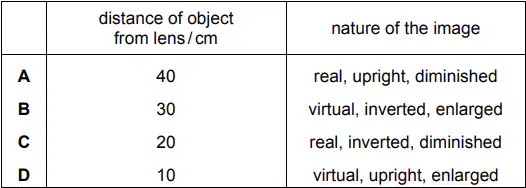

The speed of light in air is 3.0 x 10^8 m/s. The critical angle for light in a transparent plastic material placed in air is 37°. What is the speed of light in the plastic material?
A sound wave travels from air into water. Which row describes what happens to the frequency and the wavelength of the wave?
Frequency: decreases; Wavelength: increases
Frequency: decreases; Wavelength: stays the same
Frequency: stays the same; Wavelength: decreases
Frequency: stays the same; Wavelength: increases
The horn of a ship makes a sound. The captain on the ship hears an echo from a cliff 4.0 s later. When the speed of sound is 340m/s, what's the distance between the cliff and the ship?
170 m
340 m
680 m
1360 m
The diagrams represent water waves in a tank. Which diagram represents a wave that changes speed?

A

C

D

A tank contains water. Ripples are produced on the surface of the water. Refraction is observed. What causes the ripples to refract?
The cold water in the tank is replaced by warm water
The ripples change speed as they move from deep to shallow water
The ripples hit the wall of the tank
The ripples pass through a narrow gap
Infrared radiation from the Sun disappears before visible light and ultraviolet radiation.
Ultraviolet radiation from the Sun disappears before visible light and infrared radiation.
Visible light from the Sun disappears before ultraviolet radiation and infrared radiation
Infrared radiation, ultraviolet radiation and visible light from the Sun all disappear at the same moment.
light waves, radio waves, gamma-rays
light waves, sound waves, gamma-rays
radio waves, sound waves, alpha-particles
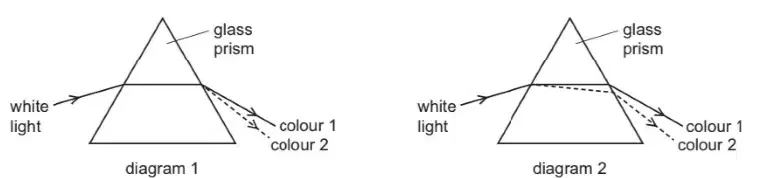
Path taken by the light: diagram 1; Color 1: red; Color 2: violet
Path taken by the light: diagram 1; Color 1: violet; Color 2: red
Path taken by the light: diagram 2; Color 1: red; Color 2: violet
Path taken by the light: diagram 2; Color 1: violet; Color 2: red
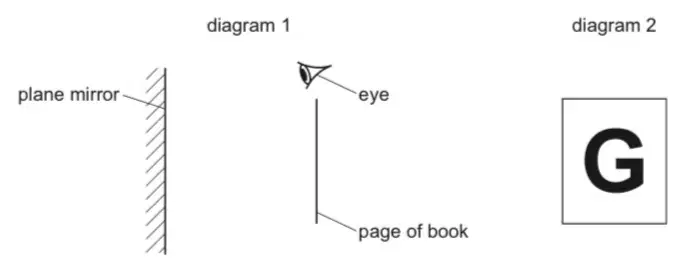
Diagram 1 shows the page of a book in front of a plane mirror. An eye is looking at the image of the page. Diagram 2 shows a large G on the page facing the mirror. What is the appearance of the image of G seen by the eye?


A remote controller emits microwave radiation adiation


Lead absorbs emissions from the radioactive sources
Which statement about evaporation is correct?
evaporation causes the temperature of the remaining liquid to decrease
evaporation does not occur from a cold liquid near its freezing point
evaporation does not occur from a dense liquid, such as mercury
evaporation occurs from all parts of a liquid
Gas is stored in a sealed container of constant volume. The temperature of the gas increases. This causes the pressure of the gas to increase. What happens to the gas molecules during this pressure increase?
The average kinetic energy of the molecules increases
The average separation of the molecules decreases
The average separation of the molecules increases
The volume of each molecule increases
Which causes the random, zig-zag movement (Brownian motion) of smoke particles suspended in air?
air molecules colliding with smoke particles
convection currents as the hot smoke rises
smoke particles colliding with each other
smoke particles reacting with oxygen molecules in the air

A sealed gas cylinder is left outside on a hot, sunny day. What happens to the average speed of the gas molecules and to the pressure of the gas in the cylinder as the temperature of the gas rises?
A
B
C
D
A swimmer feels cold after leaving warm water on a warm, windy day. Why does she feel cold even though the air is warm?
the less energetic water molecules on her skin escape quickly
the more energetic water molecules on her skin do not escape quickly
the water on her skin does not evaporate quickly enough to keep her warm
the water on her skin evaporates quickly and cools her skin
A car tyre has a constant volume. Why does the pressure of the air in the tyre increase when its temperature increases?
the air molecules hit each other less often
the air molecules hit the inside of the tyre less often
the average speed of the air molecules in the tyre is greater
there are more air molecules in the tyre

A student places his thumb firmly on the outlet of a bicycle pump, to stop the air from coming out. What happens to the pressure and what happens to the volume of the trapped air as the pump handle is pushed in?
A
B
C
D

Some gas is trapped in a container of fixed volume. The temperature of the gas increases. Which graph shows how the pressure of the gas changes with temperature?
A
B
C
D

The volume of a gas in a sealed syringe is increased. The temperature of the gas does not change. After this change is made, what has happened to the gas molecules in the syringe?
they move more quickly
they move more slowly
they hit the syringe walls less often
the hit the syringe walls more often

The pressure of a fixed mass of a cylinder is measured. The volume of the gas in the cylinder is then slowly decreased. The temperature of the gas does not change. Which graph could show the change of pressure of the gas during this process?
A
B
C
D

A student suggests some uses for containers made from good thermal conductors and for containers made from poor thermal conductors? In which row are both suggested uses correct?
A
B
C
D

Two plastic cups are placed one inside the other. A small spacer keeps the two cups separated. Hot water is poured into the inner cup and a lid is put on top, as shown. Which statement is correct?
The bench is heated by convection from the bottom of the outer cup
The lid reduces the energy lost by convection
There is no thermal conduction through the sides of either cup
Thermal radiation is prevented by the small air gap

A solid is heated from room temperature. The graph shows how its temperature changes with time as it is heated constantly. At which time has it just become completely liquid?
A
B
C
D

The diagram shows a vacuum flask used to keep liquid hot. How does thermal energy pass through the vacuum?
conduction only
convection only
radiation only
conduction and convection

The diagram shows a block of ice placed in a warm room. At which point is the temperature the lowest?
A
B
C
D

The air in a room is heated by a heater. The diagram shows the circulation of the air in the room. Which statement about the air that is heated is correct?
The air contracts and become less dense
The air contracts and becomes more dense
The air expands and becomes less dense
The air expands and becomes more dense

In a refrigerator, the cooling unit can be fitted either at the top or at the bottom. In an oven, the heater can be fitted either at the top or at the bottom. Which row shows the best position for the cooling unit and the best position for the heater?
A
B
C
D

Ice is trapped by a metal gauze at the bottom of a tube containing water. The water is heated strongly at the top, but the ice only melts very slowly. Why does the ice melt so slowly?
heat energy always travels upwards
hot water is more dense than cold water
metal gauze does not allow heat to pass through
water is a poor conductor of heat

One type of double glazing consists of two panes of glass separated by a vacuum. Which method or methods of energy transfer are prevented by the vacuum?
conduction and convection
conduction and radiation
convection and radiation
radiation only

A substance loses thermal energy (heat) to the surroundings at a steady rate. The graph shows how the temperature of the substance changes with time. What could the portion PQ of the graph represent?
gas condensing
gas cooling
liquid cooling
liquid solidifying

Which row shows the surface that is the better absorber and the surface that is the better emitter of infra-red radiation?
A
B
C
D
One end of a copper rod is heated. What is one method by which thermal energy is transferred in the copper rod?
free electrons transfer energy from the cooler end to the hotter end
free electrons transfer energy from the hotter end to the cooler end
molecules of copper move from the cooler end to the hotter end
molecules of copper move from the hotter end to the cooler end
The same quantity of thermal energy is supplied to two solid objects A and Y. The temperature increase of object X is greater than the temperature increase of object Y. Which statement explains this?
X has a lower melting point than Y
X has a lower density than Y
X has a lower thermal capacity than Y
X is a better thermal conductor than Y
Which quantity gives the thermal capacity of a beaker?
the thermal energy required to change the state of the beaker at constant temperature
the thermal energy required to raise the temperature of the beaker by 1 degree Celsius
the total mass of hot liquid that the beaker can hold
the total volume of hot liquid that the beaker can hold

The table lists the melting points and the boiling points of four different substances. Which substance is a liquid at 0 degrees Celsius?
A
B
C
D

The diagram shows electricity cables being put up on a warm day. The cables are left loose between the poles, as shown in the diagram. Why are the cables left loose?
they will contract on cold days
they will contract on very warm days
they will expand on cold days
they will expand on very warm days

A long thin bar of cooper is heated evenly along its length. What happens to the bar?
it becomes less heavy
it becomes longer
it becomes shorter
it bends at the ends
A circular metal disc is heated. Which quantity decreases?
density
diameter
thickness
volume

In an experiment, a thermometer is placed in a test tube of hot liquid. The temperature of the liquid is recorded every half minute. The table shows the results. What is the melting point of the substance?
0 degrees Celsius
33 degrees Celsius
55 degrees Celsius
73 degrees Celsius

Equal masses of two different liquids are put into identical beakers. Liquid 1 is heated for 100s and liquid 2 is heated for 200s by heaters of the same power. The temperature of both liquids increases by the same amount. Which statement is correct?
both liquids receive the same amount of energy
liquid 1 receives more energy than liquid 2
both liquids have equal thermal capacity
the thermal capacity of liquid 1 is less than thermal capacity of liquid 2

Equal masses of two different liquids are heated using the same heater. The graph shows how the temperature of each liquid changes with time. What does the graph tell us about the liquids?
Liquid 1 has a higher melting point than liquid 2
Liquid 1 has a higher boiling point than liquid 2
Liquid 1 starts to melt sooner than liquid 2
Liquid 1 starts to boil sooner than liquid 2
Which pair contains only physical quantities that vary with temperature and so could be used in making a thermometer?
activity of a radioactive source, volume of a gas
mass of a liquid, volume of a liquid
activity of a radioactive source, mass of a solid
volume of a gas, volume of a liquid
A heater supplies 80J of energy to a block of metal. The temperature of the block rises by 20 degrees Celsius. What happens to the block of metal when its temperature falls by 10 degrees Celsius?
its internal energy decreases by 40J
its internal energy decreases by 160J
its internal energy increases by 40J
its internal energy increases by 160J
A solid object has a very large thermal capacity. What does this mean?
a large amount of energy is needed to make the object become hot
a large amount of energy is needed to make the object melt
a small amount of energy is needed to make the object become hot
a small amount of energy is needed to make the object melt
K = Degrees Celsius + __________
What is internal energy
the average kinetic energy of the particles
heat energy
the sum of the kinetic and potential energy
the average potential energy
Convert
450 K to Celsius723oC
277oC
177 oC
623oC
What is the boiling point of water on the Kelvin scale?
0K
373K
100K
212K
What is the freezing/melting point of water of the Fahrenheit scale?
−273oF
0oF
32oF
273oF

A
B
C
D

A
B
C
D

A
B
C
D

A
B
C
D

A
B
C
D

A
B
C
D

A
B
C
D

A
B
C
D

A
B
C
D

A
B
C
D

A
B
C
D

A
B
C
D

A
B
C
D

A
B
C
D

A
B
C
D

A
B
C
D

A
B
C
D

A
B
C
D

A
B
C
D

A
B
C
D

A
B
C
D

A
B
C
D

A
B
C
D

A
B
C
D
The unit of activity is...
Becquerel
Seconds
Metres
Sievert
The most penetrating form of nuclear radiation is...
alpha
beta
gamma
heat
Which best describes the structure of a beta particle?
helium nucleus
slow moving proton
fast moving electron
high frequency light wave

What is the half-life of this radioactive substance?
5700 years
11400 years
17100 years
22800 years
The overall charge on an alpha particle is...
-1
0
+1
+2
The overall charge on a gamma ray is...
-1
0
+1
+2
A hydrogen atom has an atomic number of 1, mass number of 1. The first isotope of hydrogen has an atomic number of...
0
1
2
3
Carbon-12 has an atomic number of 6 and a mass number of 12. How many electrons would be found in a neutral atom of carbon-12?
6
12
18
24
A radioactive source has an initial activity of 200kBq and a half-life of 15 days. How many days would it take for the activity to fall to 25kBq?
15
30
45
60
A source of background radiation is...
cosmic rays from the Sun
radon gas in the air
radioactive isotopes in food
radioactive minerals in the earth

