Worksheets
Block 5 - Plate Tectonics and Rock Cycle Review
Total questions: 20
Worksheet time: 17mins


The process by which metamorphic rock changes to igneous rock begins with
melting
erosion
deposition
crystallization
Two plates come together or collide at what boundary?
Convergent
Divergent
Transform
Two plates spread or move apart at what boundary?
Convergent
Divergent
Transform
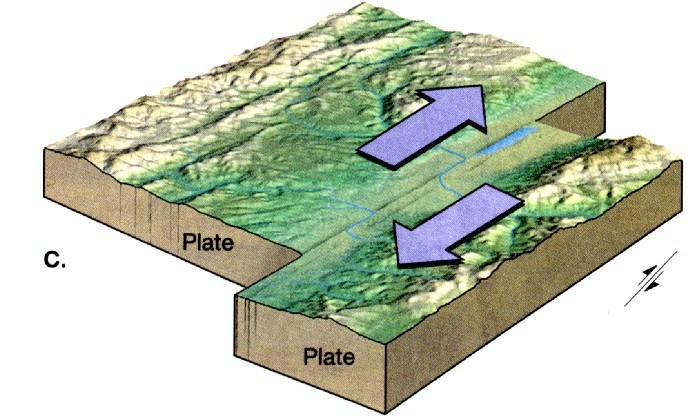
Two plates slide past each other at what boundary?
Covergent
Divergent
Transform

New oceanic crust (sea floor) is created at this boundary.
Divergent Oceanic
Divergent Continental
Convergent Oceanic
Transform

Oceanic crust (sea floor) is destroyed at this boundary.
Convergent Oceanic
Divergent Oceanic
Convergent Continental-Continental
Divergent Continental

The process where oceanic crust slides under another plate and is melted is called ___________.
seafloor spreading
subduction
continental drift
recycling

What two crustal features occur near every subduction zone?
Volcanoes and Trenches
Rift Valleys and Mid Ocean Ridges
Volcanoes and Rift Valleys
Mid Ocean Ridges and Trenches
A divergent boundary in the ocean creates what feature?
Mid Ocean Ridge
Rift Valley
Deep Ocean Trench
Subduction Zone
When two continental plates converge (collide) what type of crustal feature is formed?
Mid Ocean Ridge
Subduction Zone
Rift Valley
Folded Mountains
The process that occurs at a divergent oceanic boundary that creates new crust (sea floor) is called?
Subduction
Seafloor Spreading
Continental Drift
Volcanism
What is the 'magic' that is happening in the mantle that helps move the 'lithospheric plates'?
Convection
Subduction
Seafloor Spreading
Aside from Earthquakes, what is the only thing you will find at transform boundaries?
Volcanoes
Subduction Zones
Folded Mountains
Fault lines
What is the only event associated with ALL plate boundaries?
Volcanoes
Earthquakes
Subduction
Deep Trenches