
 Worksheets
EOC - US History Part II
Total questions: 145
Worksheet time: 48mins
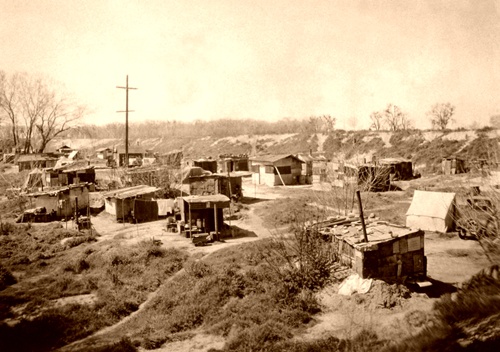
Which of the following is NOT a cause of the Great Depression?
Overproduction and underconsumption
High tariffs restricting trade
buying stocks on the margin
high income taxes
What was President Herbert Hoover's response to the Great Depression?
He believed "rugged individualism" would solve the economy
He created mass welfare
He increased infrastructure to create jobs
He violated his policy of laissez-faire
Money loaned to banks, insurance companies & businesses to jumpstart the economy by Hoover
Reconstruction Finance Corporation (RFC)
Civilian Conservation Corps (CCC)
Works Progress Administration (WPA)
Securities & Exchange Commission (SEC)

Migrant farmers from Oklahoma
Hooverville
Okies
Economy
Soup Kitchens
Dust Bowl
Dry weather turned into severe droughts. Land which had once grown tall grass was now barren. Planting the same crop for so many years had robbed the soil of its nutrients
What is a drought?
An extended period of flooding
An extended period of no rain
A huge blizzard
The name of my cat
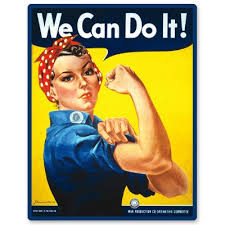
Who is this a image of and what did she a symbol of .....
June the Fighter symbol of women's suffrage
Susan the solider symbol of women working on airplanes
Rosie the Riveter symbol of women working in factories during the war.
When Roosevelt signed the Lend-lease Act, he said that the U.S must become the "arsenal of democracy in order to ?
end the Great Depression
help the Axis powers
help Britain
stay out of the war

What battle is the pacific theater was vital to gain in order the bomb Japan
Okinawa
Iwo Jima
Normandy
Midway
What industry manufactured about 1/3 of military equipment during WWII
steel industry
ship-industry
intercultural sector
automobile industry
The American program to build an atomic bomb was known as the
Manhattan Project
Operation overlord
New York Project
Operation A-bomb
A key to the American success at Midway was.....
the use of new sonar and radar technology.
the use of long-range B-25 bombers launched from aircraft carriers
breaking the Japanese Navy’s secret code.
American submarines.

The strategy of capturing some islands and going around others. That United States used in order to invade Japan.
Double V
Naplam
Lend-Lease
Island hopping
What is another name for the Invasion of Normandy?
Battle of France
Battle of the Bulge
D-Day
V-E Day

What was President Roosevelt referring to in this speech?
The victory at Normandy and liberation of France.
the Japanese bombing of Pearl Harbor.
The Battle of Britain.
Which policy had the goal of supporting the allies and maintaining neutrality?
Atlantic Charter
Appeasement
Cash and Carry
What was the purpose of rationing?
increase supply of natural resources
cause a shortage of crops
provide supplies to the troops
What treaty caused the start World War II?
Treaty of Versailles
Treaty of Paris
Paris Peace Accords
Treaty of Lasting Peace

Which plan aided European countries after World War II?
Marshall Plan
Freedom Plan
Truman Plan
European Plan

Which two cities were attacked with atomic bombs by the United States?
Nagasaki & Hiroshima
Tokyo & Kyoto
Tokyo & Yokohama
Osaka & Kyoto

Causes: Business converts from production of war materials to consumer goods, Americans buy on credit, Workers receive higher wages and better benefits - What was the EFFECT?
American economy grows rapidly after World War II
American economy undergoes another Great Depression
Businesses laid off large numbers of workers
Businesses switched back to old technologies

The state of tension between the United States and the Soviet Union without actual fighting that divided the world into two camps was the what?
Policy of containment
Warsaw Pact
Cuban Missile Crisis
Cold War

After World War II, who joined forces with the United States to resist Chinese and North Korean aggression which later ended in a stalemate?
Soviet Union
South Korea
Cuba
Vietnam

How did the conflict in Vietnam end?
Both sides won
Cease-fire agreement in which U.S. troops withdrew
Soviets removed the missiles in Cuba in response to a U.S. blockade
United States occupied Japan

How did the Cuban Missile Crisis end?
Soviets removed the missiles in Cuba in response to a U.S. blockade
United States responded by placing missiles of its own in China
United States declared war on the Soviet Union
Break up of the Soviet Union into independent countries

Berlin Wall Falls! What happened as a result of the event in the newspaper headline?
Communism spread in Europe
Missiles were removed from Cuba
Collapse of Communism in Europe
Vietnam War ended

President Wipes Out Segregation In The Armed Forces! The newspaper headline is about which President?
Franklin D. Roosevelt
Woodrow Wilson
Harry S. Truman
Herbert Hoover

United States President, John F. Kennedy and Soviet Union Premier, Nikita Khrushchev The political cartoon is about which conflict?
Cuban Missile Crisis
Desegregation
Korean War
Vietnam War

The United States intervened to stop the spread of communism from North Vietnam into South Vietnam as a result of what?
the Domino Theory
the Marshall Plan
United Nations orders
Yellow Journalism

Which of the following was created by the communists in response to the formation of NATO?
Axis Powers
United Nations
League of Nations
Warsaw Pact

Led to increased educational, economic, and political opportunities for minorities and women; Which of the following is being described?
Prohibition
G.I. Bill
Civil Rights legislation
Desegregation of the armed forces

Extended educational, housing, and employment benefits to veterans; Which of the following is being described?
Civil Rights legislation
19th Amendment
G.I. Bill
Prohibition

Eleanor Roosevelt - The First Lady shown in the picture played an important role in what?
passing the G.I. Bill
the Temperance Movement
writing the 19th Amendment
expanding human rights

How did the Baby Boom affect American society after World War II?
Child labor increased
Fewer schools were built
The economy slowed down
Led to changing demographics

Which term means the linking of nations through trade, information, technologies, and communication?
Servicing
Globalization
Outsourcing
Travel


What was the primary goal of Mexican-American litigation during the 1940s and 1950s
Eliminate the legal segregation of Mexican Americans
Form a new nation for Mexican Americans
Create separate Mexican American economic and social institutions
establish affirmative action programs
President Lyndon B. Johnson's war on poverty centered around the belief that __
That the entire country must be help in the struggle against poverty
Only the federal government was responsible for ending poverty
Court systems must be held accountable for poverty
The problem of poverty is easily solved
The movements led by Dr. Martin Luther King and Cesar Chavez were similar in that both___
Both used civil disobedience to bring about social change
supported attempts to overthrow the federal government
boycotted agricultural crops
were elected to national office
What constitutional issue was raised by President Johnson's Great Society
How far could the government extend itself in helping the less fortunate?
Should taxes be raised to stimulate the economy?
What foreign imports should be allowed in the United States?
Should certain key industries be taken over by the federal government?
What was the major goal of the American Indian Movement (AIM)?
To gain better understanding of the American-Indian point of view
to gain U.S. citizenship and representation
to relocate American Indians to urban areas
to end segregation of American Indians in public places
What did the Women's Liberation Movement see as its major goal in the 1960s?
guarantee equal pay for equal work
obtaining the right to vote for women
enabling women to stay home as as work
laws that would allow women to own their own property
Title _____ was passed to ensure equal opportunity in education
Title IX
Title X
Title XI
Title XII
President John F. Kennedy's promise to go to the moon by the end of the 60s during his inaugural address was said to gain public support for____
surpassing the Soviet Union in the space race
establishing a missile defense system
cooperating with Communists countries in space exploration
controlling the spread of nuclear weapons
How did the methods advocated by the Black Panthers to achieve their goals differ from those of Dr. Martin Luther King?
they considered the use of self defense to protect their own community
they formed a third political party
they were passionately anti-Communist
They used passive resistance only
According to the Domino Theory, if South Vietnam fell to Communism, then____
neighboring countries would soon fall to Communism
largen numbers of refugees would seek entry to the U.S.
anti-communists forces would win it back
the United Nations would be forced to intervene
What was President John F. Kennedy's response to Soviet plans to install nuclear missiles in Cuba in 1962?
placed a naval blockade around Cuba and threatened war
He attacked missile silos with air strikes
he had the army seize control of Cuba
He negotiated an agreement with Fidel Castro
Which group achieved the right to vote in the Twenty-sixth amendment?
Americans 18 to 20 years old
people unable to pay poll taxes
Mexican American women
impoverished women
What was the effect of space technology and exploration on the people of the United States
It led to advances in the quality of life for most Americans
It has forced them to find alternate sources of fuel
it focused attention on the need to deregulate the uses of of outer space
it reduced tensions in the space race

Farm worker, labor leader, and civil-rights activist who helped form the National Farm Workers Association, later the United Farm Workers.
MLK
Thurgood Marshall
Cesar Chavez
JFK


A slogan used by Ronald Reagan to describe his philosophy on handling the Cold War and resistance to communist aggression.
"Strike now, strike hard."
"Death from above."
"Peace thru strength."
"All you need is love."

An American nonprofit organization that advocates for gun rights. Founded in 1871, the group has informed its members about firearm-related bills since 1934, and it has directly lobbied for and against legislation since 1975.
Center for Investing in Armaments (CIA)
Firearms Buying Investors (FBI)
American Firearms Coalition (AFC)
National Rifle Association (NRA)

An American politician who served as the 39th President of the United States from 1977 to 1981; his presidency was noted for stagflation, malaise, and the Iran-Hostage crisis. He would later receive the Nobel Peace Prize.
Jimmy Carter
Gerald Ford
George H. W. Bush
John F. Kennedy

An agency of the federal government of the United States which was created for the purpose of protecting human health and the environment by writing and enforcing regulations based on laws passed by Congress.
Land and Forest Protection Service (LFPS)
United States Forest Service (USFS)
Environmental Protection Agency (EPA)
Human and Nature Defense Association (HNDA)

A law intended to encourage banks to help meet the credit needs of the communities in which they operate, including low- and moderate-income neighborhoods, consistent with safe and sound operations.
Financial Distribution Act
Community Reinvestment Act
Savings and Loans Act
Direct Deposit Distribution Act


A group consisting of 12 of the world's major oil-exporting nations. This organization was founded in 1960 to coordinate the petroleum policies of its members, and to provide member states with technical and economic aid.
Organization of Petroleum Exporting Countries (OPEC)
National Association for Trading Oil (NATO)
Union of States Supplying Reserves (USSR)
North American Fuel Trade Association (NAFTA)

What was Ralph Nader's impact on the 2000 election?
He was the first third party candidate to win the presidency
He took conservative votes from Bush, giving Gore the victory
He split the vote in Florida causing calls for a recount and no one was declared a winner
He took liberal votes from Gore, giving Cheney a victory

What stopped the 2000 election recount which gave Bush the victory?
The Campaign Recount law passed by Congress
The Supreme Court's decision in Bush v Gore
President Clinton suspending election after November 8th
An FBI investigation showing mass voter fraud

What was the US government's immediate response to the September 11, 2001 attacks
The US declared war on Afghanistan
The War on Terror began and Afghanistan was invaded
The US withdrew forced from bases in the Middle East
A UN coalition invaded Iraq to overthrow Saddam Hussein

What powers did the government gain from the PATRIOT making it a controversial law.
It gained the power to imprison American citizens without due process rights
To gave the President war powers similar to the War Powers Act
It gave the government power to conduct surveillance without warrants
It gave the Congress the power to oversee military courts

What caused the massive damage and flooding of New Orleans during Hurricane Katrina?
The storm's strength broke the levees designed to stop flooding
The city had no flood prevention technology
The government had cut funding for essential infrastructure upgrades
The city had been recently renovated removing flood protection levees

Who was president during 9/11, Hurricane Katrina, and the War on Terror?
Bill Clinton
George W Bush
Barack Obama
George H.W. Bush

Why did the US and UN invade Iraq in 2003?
The Iraqi government was hiding Osama bin Laden
The Iraqi government masterminded 9/11
Saddam Hussein was allegedly hiding weapons of mass destruction
Iraq has just invaded Kuwait for its oil reserves

Which amendment do critics say the PATRIOT Act violates for Americans?
6th Amendment: Right to a fair trial
4th Amendment: Right to privacy
5th Amendment: Right to due process
1st Amendment free speech rights

Which of these events directly lead to the War on Terror?
Operation Dessert Storm
The passage of the US PATRIOT ACT
The September 11 Attacks
The 1996 Oklahoma City bombings
•NAFTA
•Bosnia & Serbia airstrikes
•“don’t ask don’t tell” policy
•End of “don’t ask, don’t tell”
•SOPA Internet Protest
•Benghazi Embassy attacked
Equal Rights Amendment
OPEC
Kent State
Helsinki Accords
Underwood Simmons Tariff
Bull Moose Party
Federal Reserve Act
"he kept us out of war"
Triangle Shirtwaist Fire
1900s
1910s
1880s
1890s
The "supply side" economics of President Ronald Reagan and President George Bush favored
providing corporate tax incentives to stimulate business growth
increasing Federal taxes to support social welfare programs
establishing government programs to provide jobs for the unemployed
raising tariffs to increase the number of imports
Elements in the Contract with America, such as tax cuts and welfare reform, were based on the premise that
government should assist those in need when necessary.
government should be smaller and more efficient.
the values of government should reflect those of the people.
the branches of government should check and balance each other.
Read the excerpt below and answer the question.
"If there is anyone out there who still doubts that America is a place where all things are possible, who still wonders if the dream of our founders is alive in our time, who still questions the power of our democracy, tonight is your answer."—Barack Obama
President Obama spoke these words
after the capture and death of Osama bin Laden.
when he gave his speech at his presidential inauguration.
after he was announced as the winner of the 2008 election.
when he announced his agenda at his first State of the Union address.

What was the main purpose of Operation Desert Storm?
to reduce the number of nuclear weapons in Iraq
to stop the civil rights violations in Iraq
to reform the political system in Iraq
to drive Iraqi forces out of Kuwait
The bombing of the World Trade Center in New York City in 1993 and the attacks on September 11, 2001 were an example of the growth of what issue at the end of the 20th century?
(a)
To accuse a government official and/or charge with a crime is known as
perjury
political espionage
impeachment
subpoena
the "Southern Strategy" was used by Nixon to win in a landslide in 1972 election
True
False
Osama Bin Laden - leader of _____________ that was responsible for September 11th.
Al-Jazeera
Al-Qaeda
IRAQ
Which was the opponent of George W. Bush in the election of 2000?
Katrina
Andrew
Powell
Gore


Who invented the Polio vaccine?
Joseph Stalin
Jonas Salk
Jasper Liu
Louis Pasteur
taxing and spending
fiscal
monetary
the action by the FED to adjust the size of the money supply, and to adjust interest rates in order to keep prices down and employment high.
fiscal policy
monetary policy
This president created the Department of Homeland Security.
Jimmy Carter
Ronald Reagan
Barack Obama
George W. Bush
Bill Clinton


