Wayground logo

Free Printable Worksheets

Font size

S
M
L
XL
Worksheets

Evolution

Total questions: 20

Worksheet time: 15mins

Name
Class
Date
1.
Change over time is
a)
evolution
b)
generation
c)
growth
d)
biogenesis
2.
Natural selection is
a)
survival of the fittest
b)
humans change
c)
two species are the same
d)
more animals survive
3.

This makes an organism more suited to its environment

a)
species
b)
lifespan
c)
adaptation
d)
mutation
4.
Charles Darwin came up with this theory 
a)
Natural Selection
b)
Mutation
5.
To adjust to a changing environment
a)
Mutation
b)
Adapt
6.
Darwin wrote that organisms with traits that are best suited to the environment will ________________
a)
increase in number
b)
become extinct
7.

The pelvic bone of whales is not needed for movement within the water. This is an example of a(n) ______________ structure.

a)

vestigial

b)

analogous

c)

homologous

8.

The forelimbs of mammals have similar anatomy because these groups descended from a recent common ancestor. Their bone structure is an example of a(n) ______________ structure.

a)

vestigial

b)

analogous

c)

homologous

9.

Many different groups of organisms have wings, even though they do not share a recent common ancestor. This is because they evolved in environments with similar selective pressures. Wings are an example of a(n) ______________ structure.

a)

vestigial

b)

analogous

c)

homologous

10.
Which of the following would represent a sudden environmental change?
a)
Wildfire
b)
Global Warming
c)
Competition for food
11.
Survival of the Fittest and Evolution were proposed by what scientist?
a)
Charles Darwin
b)
Albert Einstein
c)
Steven Hawking
d)
Isaac Newton
12.
What is the advantage of having different shaped beaks?
a)
To look different from other species.
b)
To be able to eat the food readily available in the environment.
c)
To protect itself against predators.
d)
To protect itself against prey.
13.
Where humans have bred organisms together based on traits we like.
a)
Evolution
b)
Natural Selection
c)
Extinction 
d)
Artificial Selection
14.
A remnant or trace of an organism from the past is called a _______.
a)
Ancestor
b)
Skeleton
c)
Fossil
d)
Imprints
15.
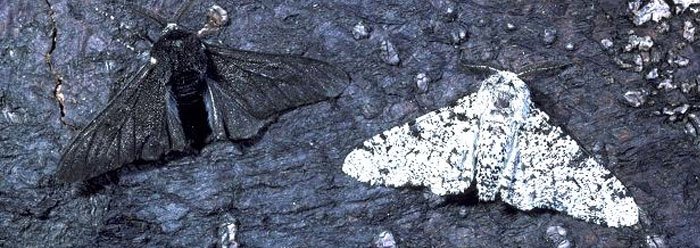
The trees these moths used to live on were white, but have been covered in soot from coal factories. Which moth will be more successful in this environment?
a)
Dark moth
b)
Light moth
c)
Both will be equally successful
d)
Neither will be successful
16.

Which trait did Darwin pay most attention to about the finches in the galapagos islands?

a)

Their Feathers

b)

Their Horns

c)

Their Size

d)

Their Beak Shape

17.

Why are vestigial structures evidence for evolution?

a)

They are useful in the organism and show natural selection at work.

b)

They are not useful in the organism but they were probably useful in some ancestor of that species.

c)

They show that these organs or behaviors help an organism adapt to new environments

18.
Why don't all living things become fossils?
a)
because some living things are too big
b)
because some are subject to catastrophism and others are not
c)

because environmental conditions have to be just right (for formation & to prevent decay)
19.
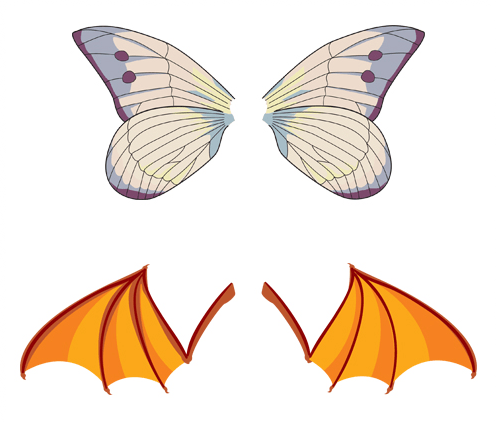
Bird wings and butterfly wings are an example of
a)
Homologous structure
b)
Analogous structure
c)
Camaflouge
d)
Mimicry
20.

A mistake or change that occurs in the DNA sequence is called a ______________________.

a)

Extinction

b)

Speciation

c)

Mutation

d)

Genetic Variation