Wayground logo

Free Printable Worksheets

Font size

S
M
L
XL
Worksheets

Waves

Total questions: 36

Worksheet time: 2hrs 48mins

Name
Class
Date
1.

What do all waves transfer?

a)

Matter

b)

Heat

c)

Electricity

d)

Energy

2.

Which of the following can waves transfer energy through?

a)

solid

b)

liquid

c)

gas

d)

empty space

e)

all of the above

3.

What is the number of complete waves passing a fixed point in a given amount of time?

a)

Amplitude

b)

Intensity

c)

Wavelength

d)

Frequency

4.

Which type of waves have the longest wavelength?

a)

Visible light

b)

Radio waves

c)

X-rays

d)

Gamma-Rays

5.

Shorter wave lengths can carry more energy. Which of these probably carries the MOST energy:

a)

Infrared light

b)

Visible light

c)

X-rays

d)

UV light

6.

What is the distance between the calm sea and the highest wave called?

a)

Wave

b)

Frequency

c)

Amplitude

d)

Magnitude

7.

What does #1 represent?

a)

Period

b)

Frequency

c)

Wavelength

d)

Amplitude

8.

What does #2 represent?

a)

Period

b)

Frequency

c)

Wavelength

d)

Amplitude

9.

Radio Waves are an example of _________ waves.

a)

mechanical

b)

electromagnetic

c)

light

10.

This is a high frequency wave. Which part of the wave is "B"

a)

crest/peak

b)

wavelength

c)

trough

11.

Look at this wave. "A" is which part of a wave?

a)

Crest/Peak

b)

Wave Speed

c)

Resting Point

12.

Which wave has the longest wave length?

a)

top wave

b)

bottom wave

13.

Does this wave have a high frequency or low frequency?

a)

High

b)

Low

14.
How often a wave occurs is the wave's __________________
a)
crest
b)
frequency
c)
wavelength
d)
resting point
15.
Any material that a wave travels through is called a ____________________.
a)
vibration
b)
compression
c)
medium
d)
crest
16.
In what type of wave does the medium vibrate parallel to the direction of the wave?
a)
surface wave
b)
longitudinal wave
c)
transverse wave
d)
electromagnetic wave
17.
In longitudinal waves, the parts where the coils are spread apart are called what?
a)
rarefactions
b)
compressions
c)
mechanicals
d)
longitudes
18.
In what type of wave does the medium move perpendicular to the movement of the wave?
a)
Transverse
b)
Longitudinal
c)
Electromagnetic
d)
Radio
19.
In a longitudinal wave, the parts where the coils are close together are called what?
a)
longitudes
b)
rarefactions
c)
compressions
d)
contractions
20.
Which travels faster, light or sound?
a)
light
b)
sound
21.

Which wave travels in outer space?

a)

light

b)

sound

22.

At which temperature would sound move fastest?

a)

40 degrees

b)

-20 degrees

c)

60 degrees

d)

90 degrees

23.
What type of wave is this?
a)
Transverse
b)
Longitudinal
24.
Distance from 'y' to 'y' is a _______
a)
Wavelength
b)
Amplitude
c)
Compression
d)
Rarefaction
25.
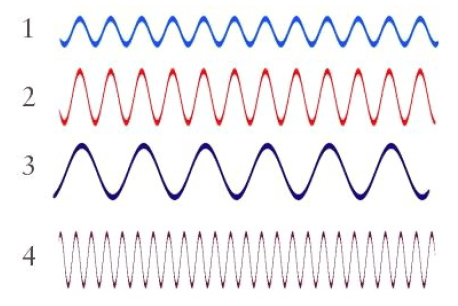
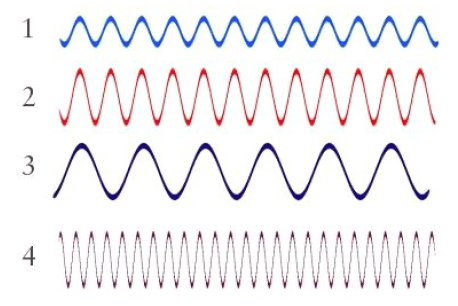
Which wave in the diagram has the greatest frequency?
a)
1
b)
2
c)
3
d)
4
26.
Which wave in the diagram has the greatest wavelength?
a)
1
b)
2
c)
3
d)
4
27.
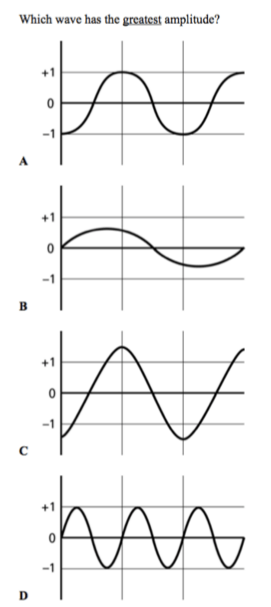
Which wave has the greatest amplitude?
a)
A
b)
B
c)
C
d)
D
28.
What kind of wave is pictured?
a)
Transverse
b)
Longitudinal
c)
surface
d)
none of the above
29.

What type of wave move in a back and forth motion?

a)

Compression wave

b)

Light wave

c)

Transverse wave

d)

Hicks-Riddick Wave

30.
regular disturbances that carry energy through matter or space
a)
crest
b)
energy
c)
wave
d)
trough
31.
In a longitudinal wave, the particles move...?
a)
back and forth
b)
up and down
c)
vertically
d)
in the direction of the hertz
32.
The type of waves that require medium to pass:
a)
Mechanical Waves
b)
Electromagnetic Waves
33.
Which of the following can sound travel through?
a)
solid
b)
liquid
c)
gas
d)
all of the above
34.
Which type of wave is pictured here?
a)
Longitudinal
b)
Transverse
c)
Light 
d)
Electromagnetic
35.

High pitched waves would have wavelengths that are...

a)

at a rarefaction

b)

far apart

c)

close together

d)

at the trough

36.
When the sound source moves, the frequency changes
ex. police car siren sounding lower pitch after the car passes

a)
pitch
b)
frequency
c)
Doppler Effect
d)
medium