
Font size
 Worksheets
Science PASS Review
Total questions: 40
Worksheet time: 2hrs 0mins

This type of plant requires lots of water. Which plant was watered most often? (a)

Why is it important for this clam to have strong muscles?
To chew food with
To keep the shell closed tightly so a predator can't open the shell
To keep his shell really clean
To crawl with

The salamander's life cycle is shown in the picture. Which other animal has a life cycle similar to the salamander? (a)

Which statement correctly describes the sun's apparent movement across the sky?
as earth spins on its axis, it makes the sun appear to move across the sky?
as the sun spins around earth, it moves across the sky
earth rotates 24 hrs, making the sun appear move across the sky.
the sun rotates around the earth every 12 hours, making the sun appear to move across the sky

This chameleon changes colors when the temperatures are cold or hot. Is this an inherited trait or learned behavior due to the environment?
Learned trait (environmental)
Inherited trait


Which constellation is best known because it contains the “big dipper,” which looks like a ladle.
Ursa Major
Ursa Minor
Orion
Leo
Why can't we see constellations during the day?
They move around too quickly.
The stars aren't bright.
The sun is too bright.
They change shape and dissolve.

Orion is visible during the winter night sky and is one of the most recognizable constellations – it contains some of the____stars that we can see and is named for the hunter from Greek mythology.
dullest
brightest
smallest
darkest

Asteroids are large bodies of rock that are too small to be planets. An asteroid belt has many asteroids. The diagram shows the asteroid belt located between Mars and the first outer planet.
Which outer planet is closest to this asteroid belt?
Uranus
Neptune
Saturn
Jupiter
Which planet in the solar system is farthest from the sun?
Mercury
Neptune
Saturn
Venus
The solar system has eight planets and one sun. What is the correct order of these planets, starting from closest to the Sun?
Mercury, Venus, Earth, Mars, Saturn, Uranus, Neptune, Jupiter
Mars, Venus, Earth, Mercury, Jupiter, Saturn, Uranus, Neptune
Venus, Mercury, Jupiter, Earth, Saturn, Neptune, Mars, Uranus
Mercury, Venus, Earth, Mars, Jupiter, Saturn, Uranus, Neptune
The following are identified as planets in Earth's solar system EXCEPT -
Mercury
Venus
Sun
Saturn

sextant
compass
telescope
astrolabe


What happens at a front?
the weather stays the same
the weather changes
What is the symbol for a Cold Front?


What weather can you expect with a cold front?
storms, then cool good weather
a few days of rain

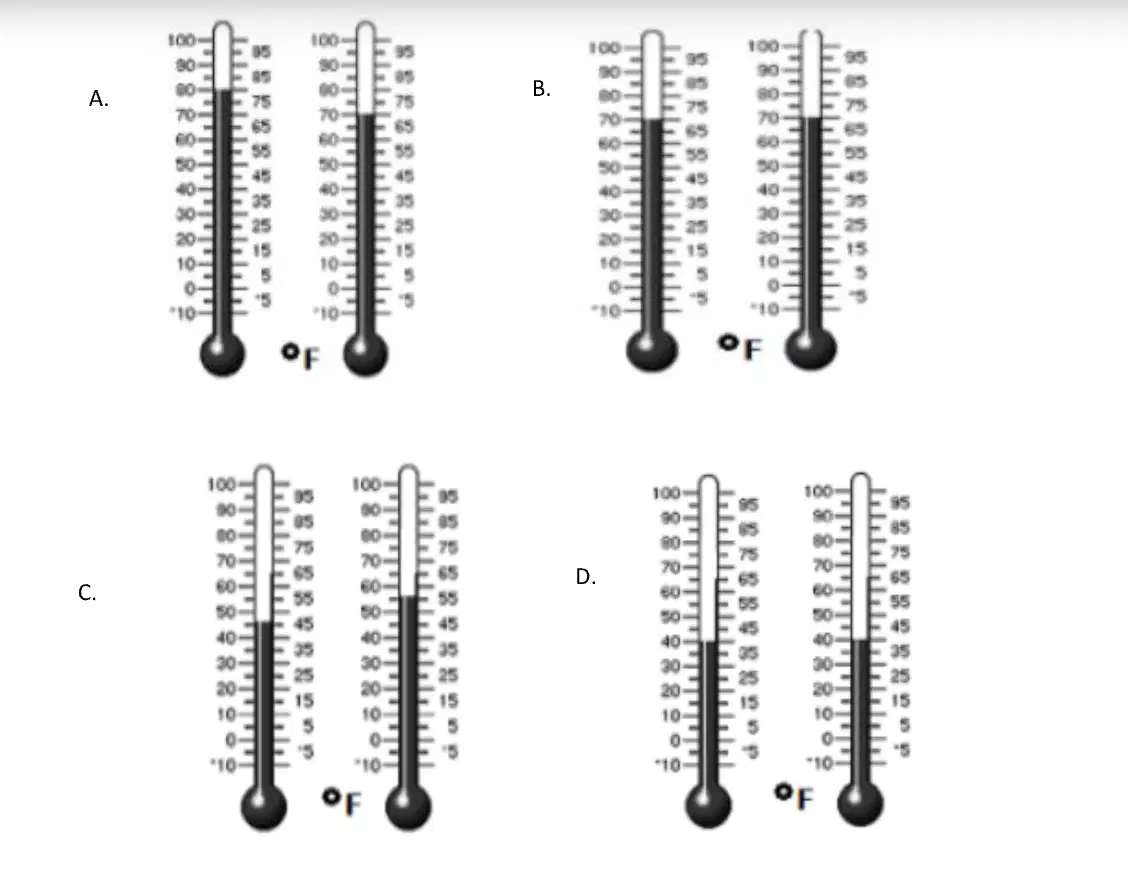
The thermometer on the left shows the air temperature at 1 p.m., and the thermometer on the right shows the air temperature at 2 p.m. Which pair of thermometers would represent an area where a warm front is passing through?
A
B
C
D

The sun rises in the (a) and
sets in the (b) .

What season is the northern hemisphere experiencing in this picture?
summer
fall
winter
spring
The Revolution movement causes
The day and the night
The seasons
In the Rotation movement The Earth turns around
The sun
The imaginary axis
Select all correct answers about ROTATION
Spinning around the axis
Seasons
Day and night
Takes 24 hours or 1 day
Select all correct answers about REVOLUTION.
3 answers
Moving around the sun
Seasons
Day and night
Takes 1 year

