Wayground logo

Free Printable Worksheets

Font size

S
M
L
XL
Worksheets

NGSS review

Total questions: 44

Worksheet time: 22mins

Name
Class
Date
1.

What type of wave is an X ray?

a)

Electromagnetic

b)

Mechanical

2.

What type of wave is this?

a)

Transverse

b)

Longitudinal

3.

Which type of wave has to have a medium in order to travel?

a)

Electromagnetic

b)

Mechanical

4.

How would you describe the movement of matter in a longitudinal wave?

a)

perpendicular to direction of energy

b)

parallel to the direction of energy

c)

In zigzags

d)

Linear

5.

Wavelength measures from

a)

Crest to Crest

b)

Crest the Resting Point

c)

Crest to Trough

d)

Crest to Amplitude

6.
a)
Frequency
b)
Amplitude
c)
Wavelength
d)
Trough
7.
a)
Trough
b)
Crest
c)
Amplitude
d)
Wavelength
8.

An object that is moving has

a)

chemical energy

b)

chemical energy

c)

potential energy

d)

kinetic energy

e)

elastic energy

9.

An object that is at rest on top of a bookshelf has

a)

chemical energy

b)

chemical energy

c)

potential energy

d)

kinetic energy

e)

elastic energy

10.

Which letter shows the ball when it has THE MOST potential energy?

a)

A

b)

B

c)

C

d)

F

e)

G

11.

The Law of Conservation of Energy states:

a)

Energy can created or destroyed but not transformed

b)

Energy cannot be created or destroyed, it can only transformed

c)

Energy can't be created, destroyed or transformed

d)

Energy cannot be created or destroyed.

12.
What is the measurement of the average kinetic energy of a substance?
a)
Kinetic energy
b)
Temperature
c)
Thermal energy
d)
Potential energy
13.
What is a substance that does NOT conduct heat well?
a)
Conductor
b)
Insulator
c)
Convector
d)
Radiator
14.

True or False

Heat transfer is the transfer of heat from cooler objects to warmer objects.

a)

True

b)

False

15.

Which statement is true?

a)

I. All electromagnets are permanent magnets.

b)

II. Increasing the number of coils in an electromagnet decreases it strength.

c)

III. Increasing the batteries increases the strength of an electromagnet.

d)

Both I and II

16.

Which can increase the strength of an electromagnet?

a)

increasing the number of coils around the nail

b)

increasing the number of batteries

c)

making the core bigger

d)

all of the above

17.
What do the lines around this magnet represent?
a)
North Pole
b)
South Pole
c)
Magnetic Declination
d)
Magnetic Field
18.
As the distance between two magnets increases (they get farther apart), the force between them:
a)
Increases
b)
Decreases
c)
Stays the Same
19.
In un-magnetized materials the domains are __________ aligned.
a)
super
b)
slightly
c)
randomly
d)
always
20.
Two factors effecting the magnitude of force of gravity between 2 objects are...
a)
weight and mass 
b)
distance and weight 
c)
mass and matter 
d)
mass and distance 
21.

Weight is _________.

a)

the quantity of matter in an object.

b)

the measure of an object's inertia.

c)

the force exerted by gravity on an object's mass.

d)

equal to the mass of an object.

22.
The amount of matter in an object is 
a)
pressure
b)
weight
c)
mass
d)
force
23.
A person would weigh less on on the Moon than on the Earth because . . .
a)
Moon has more mass, and therefore more gravity
b)
Moon has less mass, and therefore more gravity
c)
Moon has more mass, and therefore less gravity
d)
Moon has less mass and therefore less gravity
24.

the rate at which speed or velocity changes

a)

acceleration

b)

average speed

c)

motion

d)

reference point

25.

What is happening at segment E?

a)

acceleration

b)

deceleration

c)

constant speed

d)

no motion/object at rest

26.
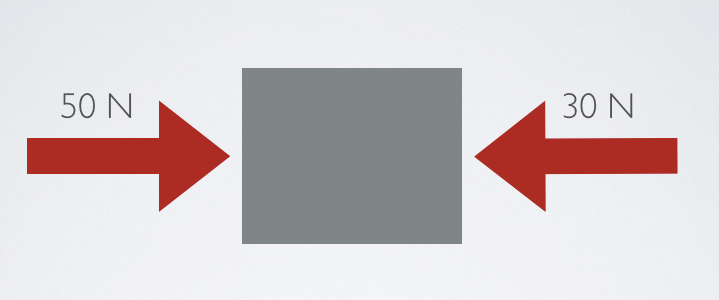
How will this object move? 
a)
It won't move. 
b)
It will move to the right. 
c)
It will move to the left. 
d)
It will move up. 
27.
What is the net force?
a)
30 N left
b)
25 N right
c)
5 N left
d)
55 N right
28.
Friction is a force that acts in an ___________ direction of movement.
a)
similar
b)
opposite
c)
parallel
d)
west
29.
What is Newton's First Law
a)
F=ma
b)
Every action has an equal and opposite reaction
c)
An object at rest stays at rest, an object in motion stays in motion. 
d)
Friction 
30.
This equation goes with which law?
a)
Newton's first law of motion
b)
Newton's second law of motion
c)
Newton's third law of motion
d)
None of these
31.
Which of Newton's laws is illustrated when a magician pulls a tablecloth out from under the dishes without disturbing them?
a)
first
b)
second
c)
third 
d)
fourth
32.
When a cannon fires a cannonball we observe Newton's third law. Which force is the reaction force?
a)
The cannon moving forward
b)
The cannonball moving forward
c)
The cannon moving backward
d)
The cannonball moving backward
33.
Which of the following is a sign that a chemical reaction has occurred?
a)
change in shape
b)
melting
c)
formation of a gas
d)
dissolving
34.
Which of the following is NOT an example of a physical change?
a)
crumpled paper
b)
pencil sharpening
c)
shrunken clothing
d)
rust
35.
A change where one or more new substances are created.
a)
Physical Change 
b)
Chemical Change 
36.

Mixture or Pure Substance?

a)

Mixture

b)

Pure Substance

37.

Mixture or Pure Substance?

a)

Mixture

b)

Pure Substance

38.

Mixture or Pure Substance?

a)

Mixture

b)

Pure Substance

39.

Mixture or Pure Substance?

a)

Mixture

b)

Pure Substance

40.

Mass divided by volume is the formula for calculating----

a)

Mass

b)

Volume

c)

Density

d)

Matter

41.

Reactivity (bubbling, fizzing) is a --- property.

a)

Chemical

b)

Physical

42.
Physical properties are
a)
properties that can be observed without changing the identity of the substance
b)
properties that describe how a substance changes into a completely different substance
c)
properties that we can only observe with our eyes
d)
properties that we need special tools to observe
43.

______________________ can only be recognized when substances react or do not react chemically with one another.

a)

Physical properties

b)

Chemical properties

c)

Flammable properties

d)

Colorful properties

44.
Which is an example of a physical property?
a)
ability to react with acid
b)
 state of matter
c)
flammability
d)
ability to react with oxygen