
 Worksheets
FSSA Review Quiz
Total questions: 36
Worksheet time: 18mins

Patrick used a spring scale like this in an experiment he was conducting.
What did Patrick measure with the spring scale?
force
volume
mass
weight
Which of these is an example of a scientific observation?
“The rock is smooth and gray.”
“What is the best brand of soap?”
“Most people drive black cars.”
“The sun’s light helps plants grow.”
Why is the sun considered to be the center of the solar system?
It is closer to Earth than other stars.
The sun produces light and energy.
Everything in the solar system revolves around the sun.
Our solar system consists of eight planets. What is a planet?
many stars held together
a large object in space that revolves around a star in its own orbit
a large object in space that is composed of gases and gives off light
a rock fragment in space

What type of galaxy is shown in the illustration?
barred spiral
eliptical
irregular
spiral
There are many different colors of stars. Which characteristic determines the color of a star?
temperature
size and shape
distance from Earth
actual brightness
Which of these characteristics distinguishes the outer planets from the inner planets?
The outer planets have many moons.
The outer planets orbit in a different direction.
The outer planets are smaller.

Maria drew the following diagram of the water cycle.
What should she label the process of water moving from the ocean to the atmosphere?
evaporation
condensation
precipitation
transpiration

Malik was given a weather station for his birthday. The picture below shows one of the instruments on the weather station.
What does the instrument measure?
rainfall
air pressure
temperature
humidity

Study the following diagram.
What word belongs on arrow 2?
condensation
freezing
melting
evaporation
Matter may be a gas, solid, or liquid. It can change from one state to another. Which change most often causes matter to change state?
change in mass
change in temperature
change in color
change in volume
Wilson made a list of activities that involve a chemical change. Which of these changes should be included on his list?
making pancakes
picking up rocks
making ice cubes
ringing a bell
Which of the following represents a physical change?


Heidi combined lettuce, tomatoes, cucumbers, and shredded cheese to make a salad. Which best describes what Heidi made?
mixture
solution
compound
element
DeShawn has to dissolve salt in water. Which will NOT help him dissolve the salt faster?
heat the water
cool the water
stir the salt in the water
crush the salt first
Atoms are made up of smaller particles called subatomic particles. Which is a subatomic particle that has no charge?
protons
neutrons
electrons
nucleus
Jacob put yeast into a bowl of water and added a little sugar. He put the bowl in a warm place. After a while, Jacob observed foam spilling out of the bowl. What kind of change is occurring?
physical change
chemical change
scientific change
geologic change
The following pictures show the particles of a substance in different states. All of the pictures show the same substance. Which is most likely a solid?


Chemical energy can be used to produce kinetic energy. Which activity is an example of using chemical energy to produce kinetic energy?
playing piano
using gasoline to run an engine
using a magnet to pick up a steel nail
turning on a light switch
What is static electricity?
a flow of electrons
an electrostatic discharge
a repelling between electrons
a buildup of electric charge on something

This diagram shows the particles that make up an atom.
Which particle is negatively charged?
electron
proton
neutron
both proton and neutron
The pictures below show objects that are charged and objects that are not charged. Based on evidence in the picture, which shows two objects with the same charge?


A light bulb converts electrical energy into which of the following?
light only
heat only
heat and light
light and motion
Philippe needs to choose an item to use to complete a circuit he is making. Which item would you claim would be his best choice?
metal spoon
glass bead
plastic straw
wooden toothpick

Roberto makes an electric circuit that has a switch as one of its parts. The diagram below shows the circuit that he makes.
What would happen to the light bulb if Roberto changes the switch from closed to open?
It would be duller.
It would be brighter.
It would stop glowing.
It would start glowing.
Ariel wants to build an electric circuit with a device that can be turned on and off. Which list contains all of the materials she needs for her circuit?
wire, ruler, switch, battery
string, buzzer, battery, switch
buzzer, wire, switch, light bulb
battery, wire, light bulb, switch

Two boys are about to use the same force to push a parent and a child. Which describes what will happen?
The parent will swing higher.
The parent will accelerate faster.
The child will accelerate faster.
The parent and the child will accelerate at the same rate
Stefan pushes a cart with three books so it just reaches the end of a track.
Next, he puts six books onto the cart. Which claim explains what he must do so that the cart reaches the end of the track?
use less force
use more force
use the same amount of force
use a different cart
The waxy leaves on some trees help keep water inside the leaves. Which body part performs a similar function?
eyes
skin
tongue
ears

The human skeletal system provides structure and support for the body. The following picture shows the basic structures of a plant.
Which labeled plant structure is most similar in function to the human skeletal system?
A
B
C
D

Amy is testing how plants grow in drought conditions. One pot will model normal growing conditions, and the other will model drought conditions. Which of the following factors is most important for Amy to change to model drought conditions?
the number of plants in each pot
the type of soil placed in each pot
the amount of water that the plants get
the number of hours of daylight that each pot receives
What are physical characteristics that help an organism survive?
habitats
extinction
adaptations
learned behaviors
Ocean organisms have adaptations to protect themselves from predators. Which adaptation helps the organism hide from predators?
a jellyfish’s deadly stingers
a shark’s keen sense of smell
an octopus’s ability to change color
an orca’s large mouth full of sharp teeth
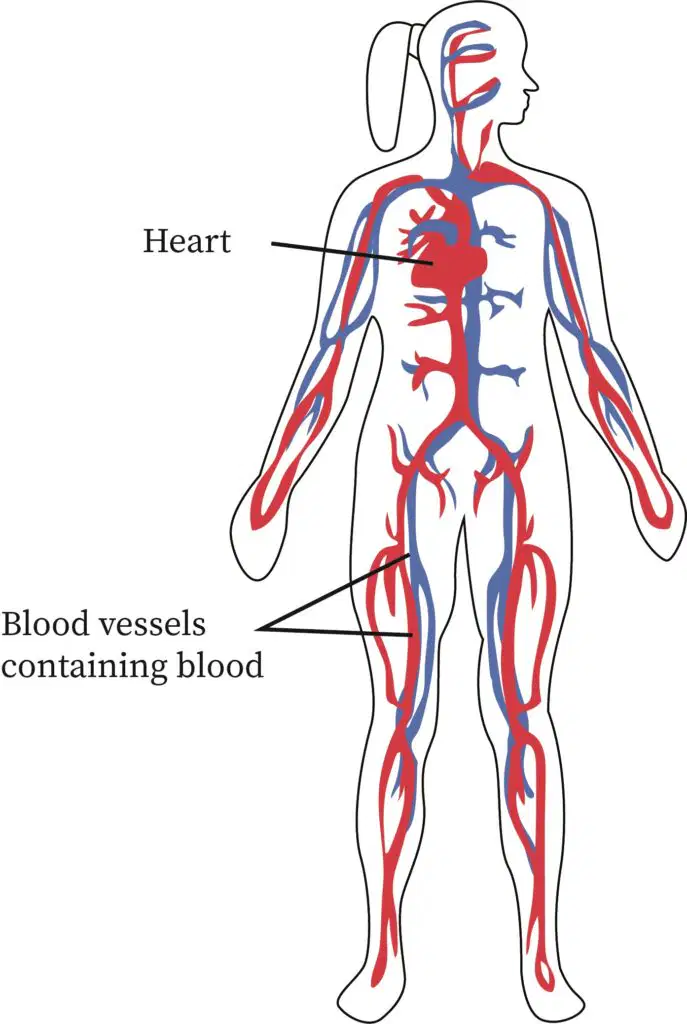
What body system is this?
Nervous
Digestive
Circulatory
Excretory
This body system's main job is to take in oxygen and get rid of carbon dioxide. Which body system is it?
circulatory
respiratory
digestive
skeletal
The brain and spinal cord are the main organs of the ____ system.
digestive
nervous
muscular
skeletal

