
 Worksheets
Unit 4 Test: Waves
Total questions: 34
Worksheet time: 17mins
Which of the following describes the wavelength of a water wave?
the distance from crest to trough
the distance from trough to rest position
the distance from trough to trough
the distance from rest position to crest
A wave with a large amplitude
must have a low crest.
must have a long wavelength.
must have a high crest.
must have a short wavelength.
What happens when the wavelength of a sound wave decreases?
The sound gets softer.
The sound gets louder.
The frequency gets lower.
The frequency gets higher.
What happens when you decrease the amplitude of a sound wave?
The sound gets softer.
The sound gets louder.
The sound has a higher pitch.
The sound has a lower pitch.
A water wave hits a rock and breaks pieces off, making it change shape. This is known as ________.
deposition
tsunami
watering
weathering
A waving flag is an example of a
sound wave.
wave crest.
wave on a string.
wave amplitude.
Sound waves are caused by
waves moving up and down.
air moving in circles.
vibrating matter.
bones in a person's ear.
Hearing music always involves
waves in a liquid
waves on a string.
air moving away from an ear.
matter moving in circles.
Which seismic wave can move through any kind of matter?
P-wave
S-Wave
secondary wave
surface wave
Which is true of P-waves?
The P stands for “penetrating.”
They only move in one direction.
They are similar to sound waves.
They are a type of water wave.
Seismographs detect ________ several seconds after they detect ________.
A. S-waves, P-waves
B. P-waves, S-waves
C. S-waves, surface waves
D. P-waves, surface waves
Which seismic wave can move only through solid rock?
P-wave
S-wave
surface wave
primary wave
Surface waves move matter
in circles.
forward and backward.
in a straight line.
from side to side.
When you throw a pebble into a puddle, the point where the ripple is the highest is called the ____________.
surface
crest
trough
rest position
What are breaking waves?
waves that move in cicles
waves that bob up and down
waves that move from side to side
waves that fall forward with a splash
In which of these waves does matter move only from side to side?
water waves
sound waves
surface waves
waves on a string
The point where the matter carrying a sound wave is spread apart is known as the wave’s ________.
rest position
loudness
crest
trough
Water waves, waves on a string, and sound waves all
move in circles.
move from side to side.
push matter together and spread it apart.
spread out in all possible directions.
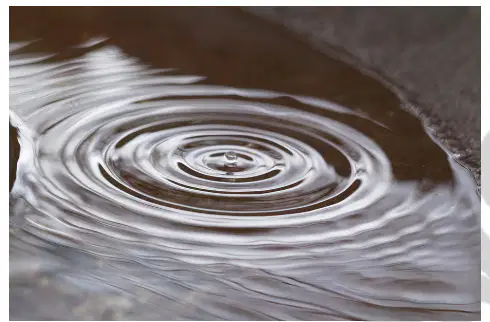
Lin is at a pond and tosses a pebble into the water. Below is a picture of what happens. Which BEST explains what happens in this example of a wave?
A. A wave forms and moves through the air.
B. A wave forms and stops before it forms a pattern.
C. A wave spreads out from the pebble in all directions as a pattern in the water.
D. A wave spreads toward the pebble in one direction and forms a pattern in the water.
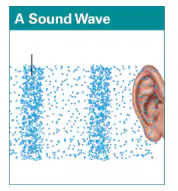
Juan is listening to his favorite song. The diagram shows how the sound wave travels to his ear. Which label should Juan add to the arrow?
crest
matter
trough
pattern
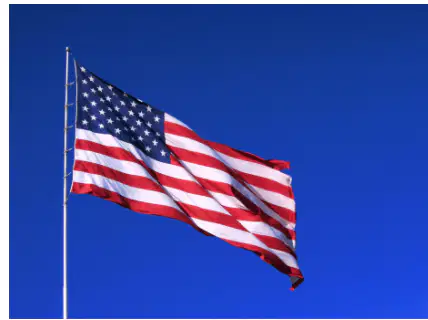
Sarah sees a flag waving in the wind. She notices that the flag moves in a similar pattern as a wave on a string. Which claim about a flag wave is BEST supported by the evidence in the picture?
The flag moves in small circles.
The flag moves through the air at a fast rate.
The flag moves side to side but stays in the same place.
The flag moves forward and backward without moving too far.
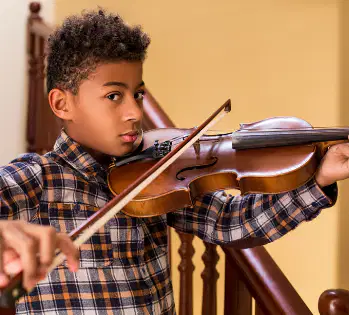
Marcus is playing his violin. Which BEST explains how the sound waves move as he plays?
They move in a circle.
They move side to side.
They move up and down.
They move forward and backward.

Ana started a new fitness program at the gym. For one exercise, she had to wave heavy ropes up and down. Which claim is BEST supported by evidence in the photograph?
The matter in the ropes falls forward and backward.
The matter in the ropes travels with the ropes in small circles.
The waves on the ropes move through the air like a coiled spring toy.
The waves on the ropes move in a repeating pattern of crests and troughs.
Jessie goes to the beach with her family. She notices how fast the waves are coming at her. The peaks of the waves are getting closer and closer to each other.
amplitude
frequency
wavelength
rest position
Kiley and her friends are playing with a jump rope outside. While her friends hold the rope and shake it, Kiley observes the number of crests of waves that pass a certain point over 20 seconds. In this time, there are 6 crests that pass the point.
2 waves/minute
6 waves/minute
14 waves/minute
18 waves/minute
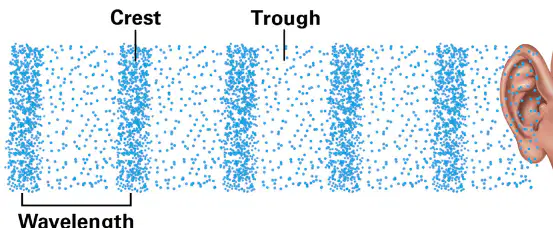
Janelle is mixing music in her school’s computer lab. She has found a clip with a medium pitch, which is shown below. Now she is looking for a high-pitched sound clip. What characteristic would the high-pitched clip have compared to the medium-pitched clip?
The crest would be lower.
The crest would be higher.
The wavelength would be longer.
The wavelength would be shorter.
Alex and his brother are surfing in the ocean. While they wait for a big wave, they bob up and down with the waves. Alex tries to explain the pattern of the waves and wavelengths to his brother.
It measures the height of the water wave.
It measures the distance between the troughs of a wave.
It measures the number of crests that pass in a set time period.
It measures the distance between the crest and the trough of a wave.
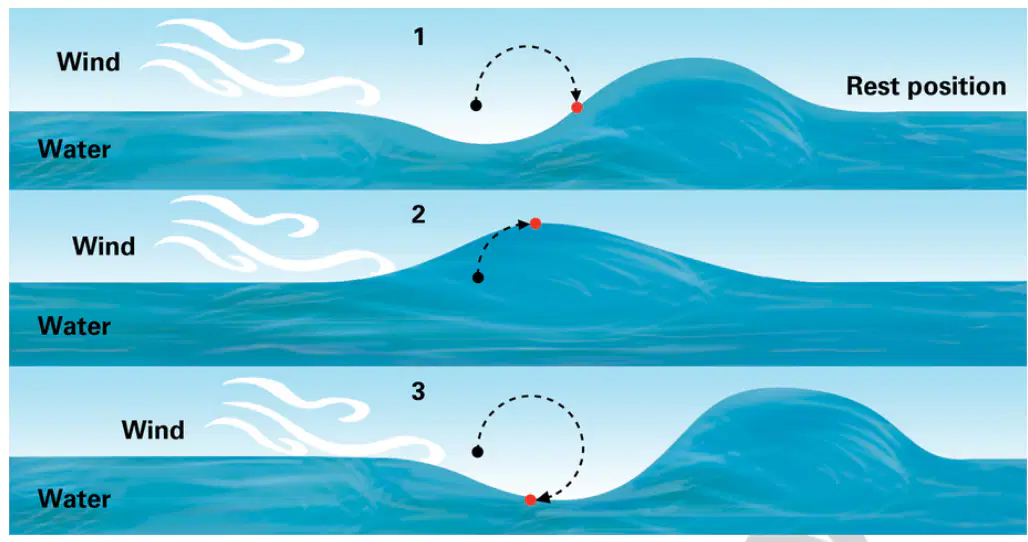
While at the beach with his family, Joe watches the waves on the ocean and sees how wind forms a water wave. Which is the CORRECT order of steps for how air makes a water wave?
1, 2, 3
1, 3, 2
2, 1, 3
3, 2, 1
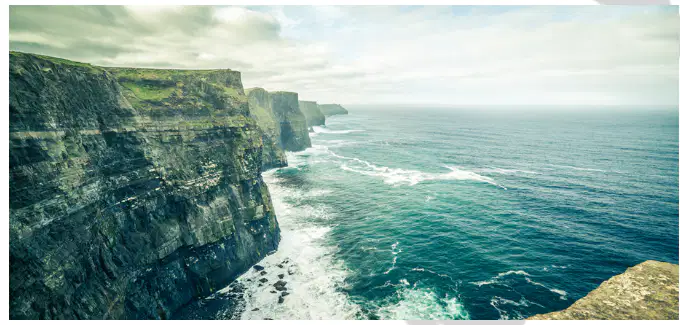
Ariana and her family go for a drive along the coast. Above the water, they see sharp cliffs. Which BEST explains how the motion of the waves impact the cliffs over time?
The waves change the shape of the cliffs due to weathering the rocks.
The waves increase the size of the cliffs due to weathering the rocks.
The waves increase the size of the cliffs by pushing them farther away.
The waves change the shape of the cliffs by pushing them closer together.
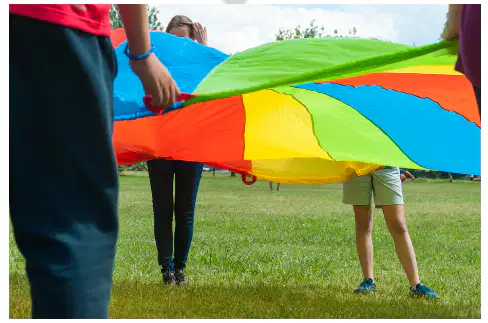
Ashton’s gym class plays with a parachute, as shown in the picture below. The parachute is an example of waves on a string. The parts of the wave are labeled on the picture to show the pattern of the wave’s movement.
1: Crest, 2: Crest, 3: Trough
1: Crest, 2: Trough, 3: Crest
1: Trough, 2: Trough, 3: Crest
1: Trough, 2: Crest, 3: Trough
Rory is at a science museum. To get the earthquake machine to begin moving, she needs to move the steps in the correct order. The table below tells the pattern of events when an earthquake occurs. Which is the correct order of the events?
A. 1, 2, 3, 4
B. 2, 3, 4, 1
C. 3, 4, 2, 1
D. 4, 1, 2, 3
Mary’s town has a small earthquake. Before the earthquake, her dog started barking. Which of the following types of waves did her dog detect?
A. P-waves only
B. S-waves only
C. P-waves and S-waves
D. P-waves, S-waves, and surface waves
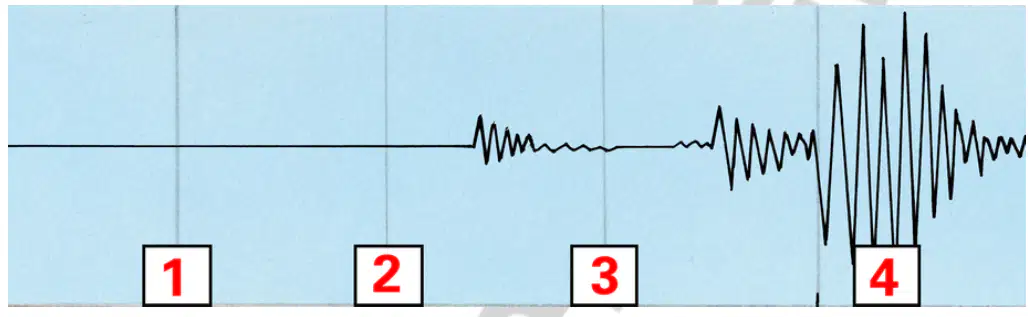
Jolene works at a university. She studies earthquakes. When an earthquake occurs anywhere in her area, the waves of the earthquake are recorded by a seismograph in Jolene’s office. Which of the following represents an S-wave on her seismograph?
1
2
3
4
Tetsuo is visiting his aunt in Japan when an earthquake happens. His uncle was at work one hour away, and he barely felt the earthquake. Which of the following patterns BEST explains why his uncle did not feel the earthquake?
A. As surface waves spread out, they get weaker because the amplitude gets larger.
B. As surface waves spread out, they get stronger because the amplitude gets larger.
C. As surface waves spread out, they get weaker because the amplitude gets smaller.
D. As surface waves spread out, they get stronger because the amplitude gets smaller.

