
 Worksheets
May DPM Review - 4th Life Science
Total questions: 40
Worksheet time: 3hrs 45mins

Animals that change form as they become adults
metamorphosis
offspring
life cycle
reproduction

This is the second stage of a the life cycle of an animal that goes through a complete metamorphosis
eggs
larva
pupa
adult

The third stage in the life cycle of an animal that goes through a complete metamorphosis. This is the stage before adult, and in this stage, the animal usually makes a hard case around itself as it changes inside.
pupa
larva
eggs
adult

The second stage in the life cycle in animals that go through an incomplete metamorphosis; this stage is after the egg, and right before adult
pupa
larva
nymph
egg

a characteristic that a living thing gets from its parents
inherited trait
learned behavior
acquired trait
instinct

an animal that eats dead plants and animals, including waste
omnivore
decomposer
herbivore
carnivore

When the seed of a plant sprouts
germinate
pollen
response
reproduce

Flowers produce this powdery material; it forms in the male part of the flower and is used in reproduction of the plant
pollen
embryo
seed
flower

a living thing that makes its own food
producer
consumer
omnivore
herbivore
Why are most pots and pans made of metal?
Metal dissolves when heated.
Metal is a good conductor.
Metal is a good insulator.
Metal can produce its own thermal energy.

The rubber cord
The plastic outlet cover
The metal prongs
The painted wall

stop watch
spring scale
ruler
thermometer

Albert says that sample 1 is a liquid and sample 2 is a solid.
Becca says that both samples are solids.
Which physical property will help the students decide who is right?
color
mass
shape
volume

2.Which statement below best explains which ball has the greatest volume?
The bowling ball because it is the heaviest.
The beach ball because it is the largest.
The tennis ball because it bounces the highest.
The soccer ball because it is the thickest.

3.What is the volume of the gold ring?
64 mL
4 mL
68 mL
8 mL

5.Which of the following correctly describes how the temperature changed from 8:00 AM to 12:00 PM?
The temperature decreased by 15⁰C.
The temperature became warmer by 43⁰C.
The temperature became cooler by 28⁰C.
The temperature increased by 15⁰C.

6.Which table below best describes the physical properties of the toy car?


7.Which of the following lists all of the items attracted to the magnet?
Steel paper clip
cotton swab, marble, penny
paper clip, foil, penny
penny and foil

9.Based on the data collected in the chart, what conclusion can the student make?
Most metal objects sink, and most plastic objects float.
Only large objects sink, and small objects float.
The length of the object affects whether it will sink or float.
The mass of the object affects whether it will sink or float.

16.Which chart below shows the correct classification for all the mixtures and solutions the student was comparing?
A
B
C
D

18.Which box and T-chart correctly compares and contrasts the two mixtures?


What do the arrows in the food chain indicate about the flow of energy in an ecosystem?
Energy is continuously recycled by the organisms in an ecosystem.
Energy flows in one direction in an ecosystem, from producers to consumers.
More of the available energy in an ecosystem is given to large animals than to small animals.
Organisms at the end of the food chain receive more energy than those at the beginning.

How would the removal of earthworms from the food chain affect the other organisms?
The number of bass will increase.
The number of crayfish will decrease.
The crayfish will get their energy directly from the sun.
The number of bass and ospreys (bird) will increase.


Which of these is an example of erosion?
Light shinning onto a mountain
Rain breaking down rock
Wind blowing away sediment
All of the above
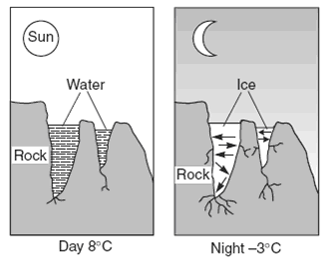
Which statement best explains why this process results in weathering?
What is the force that causes objects to fall to Earth?
Friction
Gravity
Magnetism
Pressure
Your mom is shopping at Costco. As she adds more items into her cart, she will need to use less force to move the cart as its mass increases.
True
False
An icy road would have ________ friction.
more
less
Some students wanted to find out if a tennis ball and a baseball dropped from the same height hit the ground at the same time. This investigation tests the effect of which of the following?
wind
friction
gravity
magnetism
Students conducted an investigation in which they measured the distance a toy car traveled after rolling down a ramp covered with sandpaper or wax paper. Which of these questions can the students answer by analyzing the results of their investigation?
How does changing the height of a ramp affect the distance a toy car rolls?
How does changing the surface of a ramp affect the distance a toy car rolls?
How does mass affect the distance a toy car moves after rolling down a ram?
How does the design of a toy car affect its movement after rolling down a ramp?
Which property of soil can be described with the words, "smooth," and "rough"?
Shape
Texture
Size
Color
Many plants cannot grow in sandy soil. Why is this true?
Sandy soil does not hold enough water.
Air cannot pass through sandy soil.
Roots cannot easily push through sandy soil.
Sandy soil has too many nutrients.
Aniyah grabs a soil sample in her hand. She rolls it into a ball. The soil feels sticky and easily forms a ball. What type of soil does she have?
gravel
sand
clay
topsoil

A student wanted to investigate which type of soil retains the most water. She put 200 mL of water in each type of soil. The results are shown above.
According to the diagram above, which soil retains the LEAST amount of water?
Soil A
Soil B
Soil C
Soil D

