
 Worksheets
APCSP Exam Review
Total questions: 63
Worksheet time: 1hrs 13mins
The mayor of a city is interested in learning what goals are most important for residents of the city. Members of her staff visit one of the many neighborhoods in the city and ask 20 residents to fill out a survey. The mayor is concerned that the survey may be biased and not accurately reflect the overall interests in her town. Which of the following strategies is MOST likely to address concerns about the data being biased or inaccurate
Finding the same people surveyed previously to ask more detailed questions.
Visiting the same neighborhood to collect more survey responses
Visiting multiple new neighborhoods to collect more survey responses
Having her staff collect the data using an app rather than paper surveys
In which of the following situations would parallel systems MOST likely be used to help analyze data?
Data analysis involving two or more columns of data
Data analysis involving both string and numeric data
Data analysis involving large datasets
Data analysis that could result in two or more different types of visualizations
A team of researchers wants to create a program to analyze the amount of pollution reported in roughly 3,000 counties across the United States. The program is intended to combine county data sets and then process the data. Which of the following is most likely to be a challenge in creating the program?
A computer program cannot combine data from different files.
Different counties may organize data in different ways.
The number of counties is too large for the program to process.
The total number of rows of data is too large for the program to process.
Which of the following applications is most likely to benefit from the use of crowdsourcing?
An application that allows users to convert measurement units (e.g., inches to centimeters, ounces to liters)
An application that allows users to purchase tickets for a local museum
An application that allows users to compress the pictures on their devices to optimize storage space
An application that allows users to view descriptions and photographs of local landmarks
A mobile application is used to display local traffic conditions. Which of the following features of the application best exemplifies the use of crowdsourcing?
Users can save an address to be used at a later time.
Users can turn on alerts to be notified about traffic accidents.
Users can submit updates on local traffic conditions in real time.
Users can use the application to avoid heavily congested areas.
Tranmission Control Protocol (TCP):
Which of the following are logic gates?
AND
Switch
IF
Else
OR

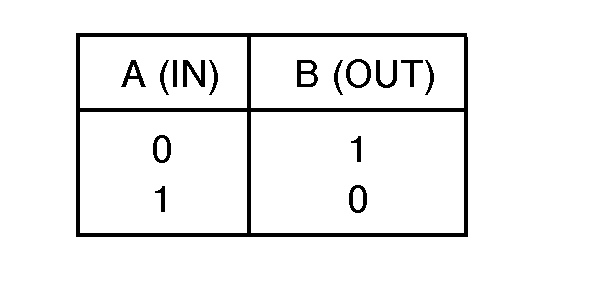
Which logic gate is associated with the truth table?
NAND
OR
NOT
AND

Which logic gate is associated with the following truth table?
AND
NAND
OR
OR

Which logic gate is associated with the truth table?
AND
OR
NAND
NOR

Look at the truth table below and choose the correct option.
False, False
True, False
False,True
True,True

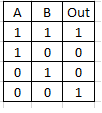
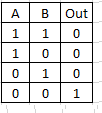
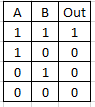
Which is the truth table for the AND gate?
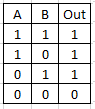
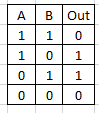
Select the best description to explain what a binary search algorithm is.
Put the elements in order, check each item in turn.
Put the elements in order, compare with the middle value, split the list in order and repeat.
Elements do not need to be in order, check each item in turn.
Elements do not need to be in order, compare to the middle value, split the list in order and repeat
3 5 9 10 23
How many comparisons would it take to find number 9?
1 5 10 13 48 68 100 101
How many comparisons would it take to find number 101?
What does SSL stand for?
Secure Socket Layer
Secret Secure Layer
Security Saver Layer
Taking a secret message and reproducing the original plain text is known as?
Caesar Cipher
Encryption
Cipher Text
Decryption
Asymmetric encryption uses only 1 key.
True
False
Maybe
God Knows
The process of converting plaintext to ciphertext.
cryptography
cyphertext
decryption
encryption
Information that is readable without performing any cryptographic operations.
cryptography
plaintext
encryption
decryption
a syntax error

print(Hello world!)
A finite set of instructions that accomplish a task.
Problem
Algorithm
Sequencing
Iteration
_________ is an artificial and informal language that helps programmers develop algorithms. _________ is a "text-based" detail (algorithmic) design tool.
Problem
Algorithm
Pseudocode
Iteration

Any algorithm whose efficiency includes an n2, n3, n4 … is called ___________.
Problem
Polynomial
Pseudocode
Efficiency

Any algorithm whose efficiency includes an 2n, 3n, 4n … is called ______________.
Problem
Polynomial
Exponential
Efficiency
Algorithms with a polynomial efficiency or lower (constant, linear, square, cube, etc.) are said to run in a reasonable amount of time.
true
false
Algorithms with exponential or factorial efficiencies are examples of algorithms that run in an unreasonable amount of time.
false
true
Provides a "good enough" solution to a problem when an actual solution is impractical or impossible.
Heuristic
Undecidable Problem
Unreasonable Time
Reasonable Time
A problem for which no algorithm can be constructed.
Heuristic
Undecidable Problem
Unreasonable Time
Reasonable Time

Programs run in order, one command at a time.
Sequential Computing
Parallel Computing
Distributed Computing
Speedup

Programs are broken into small pieces, some of which are run simultaneously.
Sequential Computing
Parallel Computing
Distributed Computing
Speedup
How many bits are in an ipv4 address?
16
32
64
128
What is an IP address?
A unique string of numbers that identifies each computer on a network.
An unique number to identify mouse and keyboard
An address used to find a printer
An address to identify computer hardware
IP stands for __________.
Internet Protocol
Identification Protocol
Internet Address
Internet Person
iMax
Each part contains 8 bit of numbers
Each part is separated by periods
The description above refers to _______
Which layer of the Internet Protocol stack uses IP addresses?
Application
Transport
Internet
MAC
Which choice lists examples of logical operators?

The grid below contains a robot represented as a triangle, initially facing toward the top of the grid. The robot can move into a white or gray square but cannot move into a black region.
The code segment below uses the proceduregoalReached, which evaluates to true if the robot is in the gray square and evaluates to false otherwise.
REPEAT UNTIL(goalReached())
{
<MISSING CODE>
}
Which of the following replacements for <MISSING CODE> can be used to move the robot to the gray square?
IF(CAN_MOVE(left))
{
ROTATE_LEFT()
MOVE_FORWARD()
}
IF(CAN_MOVE(forward))
{
MOVE_FORWARD()
ROTATE_LEFT()
}
IF(CAN_MOVE(left))
{
ROTATE_LEFT()
}
MOVE_FORWARD()
IF(CAN_MOVE(forward))
{
MOVE_FORWARD()
}
ELSE
{
ROTATE_LEFT()
}

The following question uses a robot in a grid of squares. The robot is represented by a triangle, which is initially facing right.
Which of the following code segments will move the robot to the gray square along the path indicated by the arrows?
botStepper(2)
botStepper(3)
botStepper(3)
botStepper(4)
botStepper(2)
MOVE_FORWARD
botStepper(3)
botStepper(3)
MOVE_FORWARD
botStepper(4)

The question below uses a robot in a grid of squares. The robot is represented as a triangle, which is initially in the center square and facing toward the top of the grid.
The following code segment is used to move the robot in the grid.
count ← 1
REPEAT 4 TIMES
{
REPEAT count TIMES
{
MOVE_FORWARD()
}
ROTATE_LEFT()
count ← count + 1
}
Which of the following code segments will move the robot from the center square along the same path as the code segment above?
count ← 0
REPEAT 4 TIMES
{
count ← count + 1
REPEAT count TIMES
{
MOVE_FORWARD()
}
ROTATE_LEFT()
}
count ← 0
REPEAT 4 TIMES
{
count ← count + 1
ROTATE_LEFT()
REPEAT count TIMES
{
MOVE_FORWARD()
}
}
count ← 0
REPEAT 4 TIMES
{
REPEAT count TIMES
{
ROTATE_LEFT()
}
MOVE_FORWARD()
count ← count + 1
}
count ← 0
REPEAT 4 TIMES
{
ROTATE_LEFT()
REPEAT count TIMES
{
MOVE_FORWARD()
}
count ← count + 1
}

