
 Worksheets
Ex 6.5 Covalent Molecules
Total questions: 13
Worksheet time: 8mins
Name
Class
Date
1.
How do covalent bonds form?
a)
Donating & receiving valence e- between atoms.
b)
Opposite slight charges attract each other between compounds.
c)
Scientists are still not sure how they form.
d)
Sharing valence e- between atoms.
2.
How many valence electrons does oxygen have?
a)
2
b)
3
c)
6
d)
4
3.
How many valence electrons does carbon have?
a)
1
b)
2
c)
3
d)
4
4.
In an electron dot diagram, two pairs of shared electrons represents a ...
a)
single bond
b)
double bond
c)
triple bond
d)
quadruple bond
5.
How many electrons are shared in a double bond?
a)
2
b)
4
c)
6
d)
8
6.
Since covalent compounds do not have free charges, they are
a)
good conductors
b)
poor conductors
c)
ionic
d)
metallic
7.
The covalent bond forms between
a)
a metal and nonmetal
b)
a nonmetal and nonmetal
c)
a metal and metal
8.
The number of electron pairs shared in double bond.
a)
One
b)
Two
c)
Three
9.
The number of pairs of electrons shared in triple covalent bond
a)
Two
b)
Three
c)
One
10.
What is the name of CO
a)
Carbon oxide
b)
Carbon dioxide
c)
Carbon monoxide
d)
Carbon II oxide
11.
What's the formula for chlorine dioxide
a)
ClO2
b)
CLO
c)
ClO3
d)
HClO2
12.
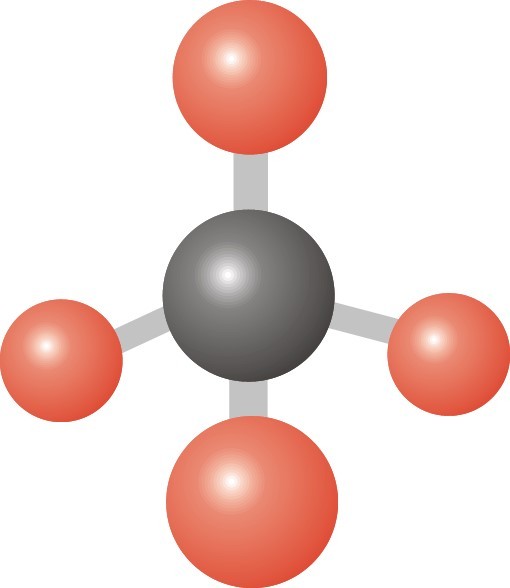
Who could this molecule be?
a)
CH4
b)
CO2
c)
PCl5
d)
BF3
13.
Chlorine exists as a diatomic element of Cl2. A chlorine atom has 7 valence electrons. Draw the arrangement of valence electrons in this covalent molecule using a 'dot-and-cross' diagram. Include the nucleus (represented by its symbol).

100 %

