
Font size
 Worksheets
Science Benchmark 4 for Twins Part 5
Total questions: 499
Worksheet time: 7hrs 11mins
Which lists the layers of the earth in the correct order? (from the outside)
Core, Mantle, Asthenosphere
Asthenosphere, Mantle, Core
Mantle, Asthenosphere, Core
Mantle Asthenosphere, Core
Which layer of the Earth has plasticity and could be represented in a model with toothpaste?
Crust
Mantle
Asthenosphere
Lithosphere
What is the coolest layer of the Earth?
inner core
lithosphere
crust
mantle
What is the hottest layer of the Earth?
inner core
lithosphere
crust
mantle
A LIMITED number of Elements make up the Earth's Crust. True or False?
True
False

What are the names of plates A and D?
Nazca and Pacific
African and South American
African and North American
North American and Pacific

What is the name of the plate labeled G?
Nazca
Indo- Australian
African
South American

What is the name of the plate labeled J?
Eurasian
Pacific
North American
African
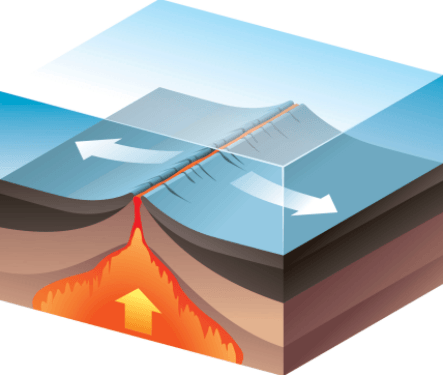
What is formed where these plates are spreading apart?
new ocean floor
earthquakes
volcanoes
mountains
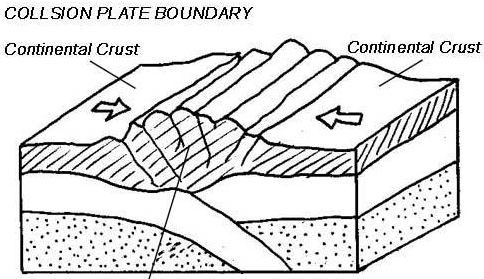
What is formed where 2 CONTINENTAL PLATES COLLIDE?
ocean basin
earthquakes
mountains
volcano
Which is less dense?
Oceanic Crust
Continental crust
Which is more dense?
continental crust
oceanic crust
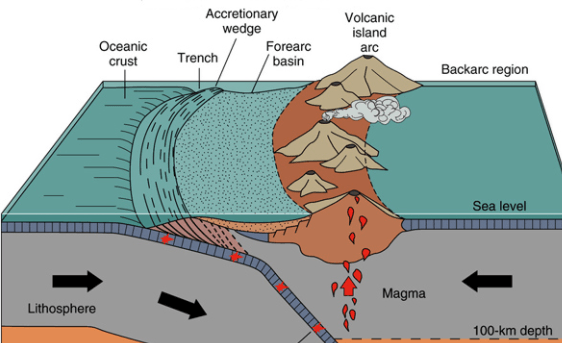
When a continental plate collides with a oceanic plate which plate is subducted (goes under)?
continental
oceanic
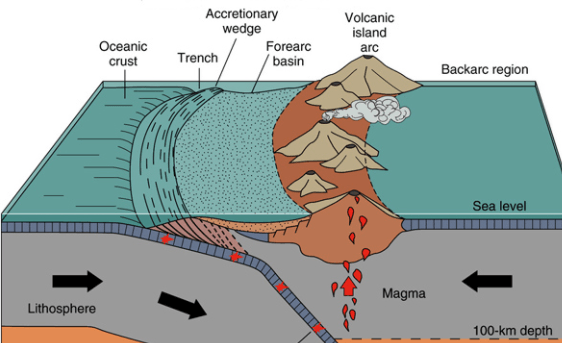
What happens to a plate that is subducted (goes under)?
it melts
it freezes
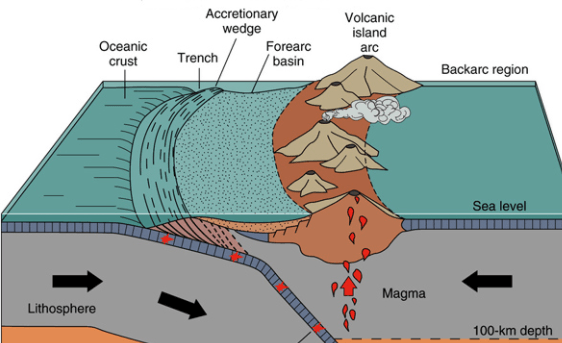
What landform is likely to be created where one plate is forced under another?
Volcano
Earthquake
Ocean Basin
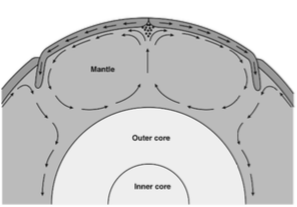
The figure shows part of what scientists think is happening in Earth’s mantle.
What process does the figure show occurring in the mantle?
Hot rock expands, becomes less dense, and rises toward the surface of Earth.
Hot rock expands, becomes more dense, and rises toward the surface of Earth.
Hot rock becomes less dense and moves towards the outer core.
Hot rock becomes more dense and moves towards the lithosphere.
Earth’s temperature increases with depth. Which of the following is a result of the motion of materials caused by high temperatures in Earth’s mantle?
earthquakes and volcanoes
radioactive atoms in minerals
ocean tides
erosion and deposition
Evelyn is making a model of Earth to show how the physical layers correspond to the compositional
layers. Which of the following should Evelyn show in her model?
The physical layers exactly match the compositional layers.
The crust is the only compositional layer not included in the physical layers.
The physical layers of the inner core and outer core form a single compositional layer.
The physical layer of the asthenosphere includes the compositional layer of the crust.
Earth’s physical layers correspond to Earth’s compositional layers. Which part of the mantle is also part
of the lithosphere?
the fluid, hot part
the rigid upper part
the soft moving part
the lower stationary part
Mount Everest formed when two tectonic plates collided. Which of the following processes lead to the
formation of Mount Everest?
eriosion
substidence
pushed up or uplift
weathering
Basalt forms when lava cools on Earth’s surface. Granite forms when magma cools within the Earth. Which of these statements correctly classifies both basalt and granite?
Basalt and granite are both igneous rocks.
Basalt and granite are both metamorphic rocks.
Basalt is igneous rock, and granite is metamorphic rock.
Basalt is metamorphic rock, and granite is igneous rock.
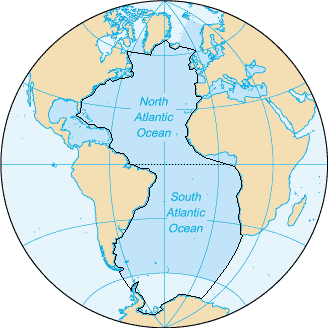
Fossils of the same plants and animal species have been found on continents that are separated by the Atlantic Ocean. Which of the following statements does this observation support?
These animals and plants crossed the Atlantic Ocean.
The Atlantic Ocean was once a large body of freshwater.
The continents that are now separated by the Atlantic Ocean once formed a single landmass.
The continents that are now separated by the Atlantic Ocean have the same kinds of organisms today as they did millions of years ago.

The figure shows a process that takes place on the ocean floor.
Which of the following is most likely to result from the process shown in this figure?
petrification
trace fossil formation
continents moving
glacial melting
Earth’s surface features slowly change over time. For example, sharp, jagged mountain ranges become lower and more rounded over time. What factor(s) is responsible for this change in their shape?
weathering and erosion
depostion
movement of continents
collisions between continental plates
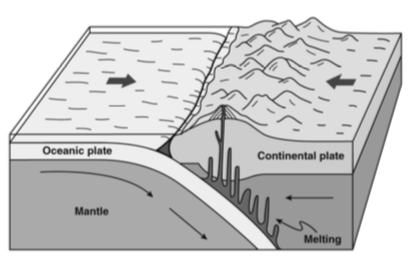
Subduction occurs when one plate slides beneath another plate. The figure below shows the process of subduction. Notice that the oceanic plate slides beneath the continental plate.
What happens when the crustal plates move as shown in the figure?
An ocean forms.
Volcanic mountain ranges form.
Sea-floor spreading occurs as the oceanic plate moves.
A transform boundary forms where the subduction occurs.
The motion of tectonic plates can cause both slow and rapid changes in Earth’s surface. Which is an example of a rapid change?
earthquake
seafloor spreading
mountain range formation
formation of an ocean trench
It might seem that, since the surface of the Earth is a fairly moderate temperature, Earth's core would also be of a fairly moderate temperature. Using creative logic, scientists have determined that material below the surface of the Earth is liquid and very hot. Which event on the surface of the Earth would support that conclusion?
an earthquake
an erupting volcano
the temperature of the ocean water
high surface temperature in the deserts

Which of the following lists the Earth's layers from innermost to outermost?
Inner Core, Crust, Lithosphere, Asthenosphere
Inner core, Outer Core, Mantle, Crust
Outer Core, Inner Core, Mantle, Crust

What is Pangea?
a fern that lives close to the equator
a large ice sheet
a supercontinent made of the present-day continents

Seafloor spreading is a process that...
Destroys oceanic crust
Occurs at the mid-ocean ridges
Causes continents to plow through the seafloor

Which is most likely to form along a convergent tectonic boundary?
a delta
an ocean basin
a mountain range
a valley

What happens at a transform plate boundary?
Plates move away from each other
Plates move toward each other
Plates slide past each other
In divergent plate boundary...
two plates separate
two continental plates collide
two plates slide past one another
What is the theory of plate tectonics?
Earth’s outer layer is made up of large, moving pieces called plates
Cracks in the Earth's crust cause volcanoes
The Earth was created by meteors crashing into each other

When oceanic and continental crust converge, the oceanic plate will dive beneath the continental plate. What best explains the results of this action?
The oceanic crust is moved upward by the radiation of heat
The oceanic crust will melt as it moves deeper in the earth.
The continental crust will form a mountain range.
The two crusts will form an ocean basin

Which layer of the Earth is liquid and composed mostly of iron and nickel?
inner core
crust
outer core
mantle

What are tectonic plates?
slabs of oceanic crust
slabs of continental crust
slabs of crust and upper mantle

What was the name of the theory that Alfred Wegener proposed explaining why the continents moved?
seafloor spreading
continental drift
land moving
rifting

The evidence to prove continental drift was discovered prior to Wegener's death?
True
False

Scientists understand that continents move because of the _________ moves underneath the ________
lithosphere and mantle
convection currents and magentism
asthenosphere and lithosphere

A region, known as the Ring of Fire, follows the border of the Pacific Ocean basin. Why do so many earthquakes and volcanoes occur in this region?
Transform boundaries completely surround this region of the Pacific Ocean
Only powerful convergent plates are located along the Ring of Fire.
Two plates are diverging in the center of the Pacific Ocean basin.
Numerous tectonic plate boundaries are located along the edges of this region.
The movement of Earth's plates results in changes in Earth's surface. Some of these changes occur very quickly, while others may take millions of years. Which of the following is most likely formed from a rapid change?
a mountain range
a mid-ocean ridge
a volcano
a valley
Mountains like the Himalayas in southern Asia form because these plate boundaries collide...
Divergent Plate Boundary
Convergent Plate Boundary
Transform Plate Boundary
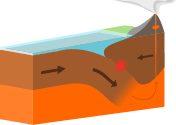

What type of boundary interaction is this?
oceanic-continental
continental-continental
oceanic-oceanic
divergent
Where is the earth's crust the thickest?
Below the ocean
Below a mountain
At the Equator
At the North Pole
Which word best characterizes the lower mantle?
Scalding
Cool
Molten
Lukewarm
What is the only entirely liquid layer of the earth?
The upper mantle
the outer core
the inner core
the lower mantle
If the earth's mantle were completely solid, _____________ plates could not move around.
Tectonic
Technical
Titanic
Agnostic

Based on the current position of the continents, in what general direction did South America drift away from Pangaea?
East
West
South
North
What evidence did Alfred Wegener use to support his theory of continental drift?
Fossil discoveries
The Himalaya Mountains
Ancient maps of the world
Charts of seismic activity
What is true of tectonic plates?
They are constantly moving
Earthquakes cause them to move
They don't move for centuries at a time
There are fewer and fewer of them
Where is Earth's heat energy most concentrated?
The mantle
The lithosphere
The core
The crust
Which of the following best describes the location of the mantle?
Above the crust
Between the crust and the lithosphere
Between the crust and the core
Beneath the core
What is the underlying force that drives plate tectonics?
Ocean tides
Volcanic eruptions
The rock cycle
Convection Currents
Convection currents are powered by
heat
motion
pressure
density
What is the large landmass that consisted of all the land 300 million years ago?
Pangea
Pongo
Portuguese
Turtle Island
What do scientist believe to cause the tiny wobble in Earth's spin?
areas of solid iron floating over the molten core
the blending of materials between the upper core and the inner core
the amount of pressure put on the core from the weight above
the amount of magnesium in the core
What is the theory of Earth's plates called?
plate tectonics
plate floor spreading
volcanic eruptions
continent floor spreading
A convergent boundary is
where two tectonic plates collide together
where two tectonic plates spread apart from each other
where two tectonic plates bump each other and rub against each other
where tectonic plates pull apart and collide together
Divergent tectonic plates is where
tectonic plates collide together
tectonic plates move apart from each other
tectonic plates bump and rub against each other
tectonic plates collide together and pull apart from each other
What causes a tsunami?
an earthquake under the sea
by molten rock bubbling up out of trenches
by mountains forming under water
an earthquake in mountainous regions
Why is understanding tectonic plate movement important to understanding our Earth?
It lets us know why we have seasons
It explains why there are so many countries
It explains how landforms were made and why earthquakes happen
It explains why the weather changes so quickly
Where two plate slide by each other in opposite directions is called a _______________________?
transform boundary
divergent boundary
convergent boundary
Pangea is ___________________________________
the name of the super continent that once existed
the name of the person who invented the theory of plate tectonics
the name of the tallest mountain range in the world
the name of the machine that measures earthquakes
Tectonic plates move at the rate of ________________________.
1 mile per hour
2 - 5 centimeters a year
2 miles a year
Tectonic plates do not move
___________________ create mountains, ocean trenches, and rearranges islands.
Hurricanes
Tornadoes
Volcanoes
Tectonic plate movements
What makes the tectonic plates move?
Convection, the heating and cooling of magma inside the earth
Storms that happen over the ocean
Global warming
The different moon phases
Which one of these is NOT proof the plate tectonic theory?
Fossils of the same animal have been found on different continents that are separated by ocean
Matching rock layers have been found on different continents separated by ocean
The continents look like puzzle pieces that fit together
There are ancient cave pictures of one large continent
Volcanoes and mountains are created at ________________
divergent boundaries
convergent boundaries
transform boundaries
New ocean floor, and ridges in the ocean floor are created at
divergent boundaries
convergent boundaries
transform boundaries
Most earthquakes happen at ____________________________.
divergent boundaries
convergent boundaries
transform boundaries
The scientist who came up with Tectonic Plate Theory was?
Merriweather Lewis
Thomas Edison
Alfred Wegner
Albert Einstein
Where two tectonic plates meet is called a ____________________.
rift
gap
boundary
volcano


melted rock located beneath Earth's surface
lava
crust
magma
mantle
melted rock on Earth's surface
crust
lava
mantle
magma
Fossils are
Imprints of animal remains, leaves, and other organic material that has been buried.
Are rocks that go underground.
Are purple in color most of the time.
Are found in magma of extrusive rocks.


Which feature is created when tectonic plates collide?
sinkholes
folded mountains

The matching coastlines of Africa and South America help support which theory?
the theory of evolution
the theory of gravity
the theory of continental drift

What causes faults?
the shrinking of Earth
the heating of Earth
the movement of tectonic plates

Identical fossils in Africa and South America support which theory?
the big bang theory
the plate tectonics theory
the theory of evolution

Where are most volcanoes and earthquakes located?
in the middle of continents
along the edges of tectonic plates
in the tropics

The tectonic plates are floating on material that is moving in Earth's ___________.
mantle
outer core
inner core

The movement of tectonic plates is believed to be caused by ________.
convection currents in the mantle
Earth's magnetic field
the gravitational pull of the moon

Earth's crust and upper mantle are broken into pieces called _________.
continents
tectonic plates
faults

Ocean trenches are often found at what type of plate boundaries?
divergent
convergent
transform

What type of rock forms along divergent plate boundaries?
igneous
sedimentary
metamorphic

What do convection currents cause?
solid rocks
sea floor spreading
cementation

What do the tectonic plates do at transform boundaries?
move apart
slide past each other
collide

What do tectonic plates do at convergent boundaries?
move apart
slide past each other
collide

Which geologic feature forms when tectonic plates collide?
sinkholes
mountains
valleys

What can the movement of tectonic plates produce?
glaciers
earthquakes
fossils

Most major earthquakes are caused by ________.
faults
tsunamis
movement along tectonic plates

Label number 1 (the brown area).
crust
mantle
outer core
inner core

Label number 2 (the yellow area).
crust
mantle
outer core
inner core

Label number 3 (the orange area).
crust
mantle
outer core
inner core

Label number 4 (the red area).
crust
mantle
outer core
inner core

How do scientists learn about the physical properties of Earth's different layers?
They ask major political leaders their opinions about scientific research.
They discuss and debate ideas about Earth's layers after looking at the internet.
They study scientific books and magazines about Earth and choose the best idea.
They measure seismic waves and make inferences based on changes in wave speeds.
What is magma made of?
solid rock
melted rock
small pieces of sediment
If magma increases in temperature (get hot) what will happen?
It moves down (sinks)
It moves up (rises)
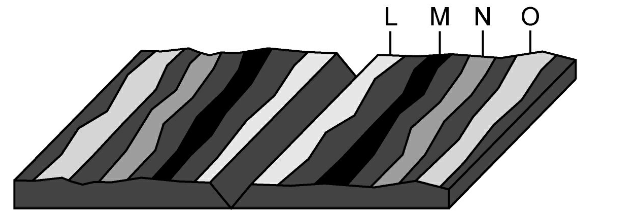
The lithosphere is broken into pieces called
tectonic sections
tectonic plates
tectonic portions
tectonic collisions
Which physical layer is the soft, malleable part of the mantle?
lithosphere
asthenosphere
mesosphere
core
Select the three compositional layers of Earth.
crust
lithosphere
mantle
core
Select all that are true about the inner core.
It is made of iron and nickel
It is solid
It is liquid
It is at the center of Earth
Which is true about oceanic crust?
It is thicker than continental crust
It is more dense than continental crust
It is less dense than continental crust
It makes up the mantle
Select the three mechanisms that drive tectonic plate motion.
mantle convection
slab pull
ridge push
continental drift
Which layer do the tectonic plates sit on?
Crust
Lithosphere
Asthenosphere
Mantle
The crust and the rigid upper part of the mantle make up which physical layer?
lithosphere
asthenosphere
mesosphere
inner core
How are the inner and outer core similar?
They are both liquid
They are both solid
They are both made of iron and nickel
They are the outermost layers
Many scientists think that the most important mechanism driving tectonic plate motion is ...
mantle convection
slab pull
ridge push
plate tectonics
What process is being described "molten rock from inside Earth rises through the cracks in the ridges, cools, and forms new oceanic crust"
sea-floor spreading
mantle convection
subduction
slab pull
The continents were joined in a single large landmass they call Pangaea. Over this span of time, the continents have moved to their present day locations. What is this theory called?
plate tectonics
continental drift
sea-floor spreading
subduction
When Convergent boundaries happen, crust is ______
formed/created
destroyed
doubled
nothing happens, neither created or destroyed
When transform boundaries happen, crust is ______
formed/created
destroyed
doubled
nothing happens, neither created or destroyed
When divergent boundaries happen, crust is ______
formed/created
destroyed
doubled
nothing happens, neither created or destroyed
what are the evidence that earth's tectonic move causing change to Earth's surface choose 3
melting ice in the artic
Fossils and continent shapes
Land warping and ocean floor spreading
Location of volcanoes and earth surface like the horseshoe ring in the Pacific Ocean
Explorers sailing in different oceans

Which of the following best explains what is happening at point B on the model below?
Two tectonic plates colliding at a convergent boundary, creating a subduction zone which recycles crust.
Two tectonic plates colliding at a divergent boundary, creating new crust and rift valleys.
Two tectonic plates colliding at a transform boundary, creating a subduction zone which recycles crust.
Two tectonic plates colliding at a convergent boundary, creating new crust and rift valleys.
Four students are trying to explain the movement of tectonic plates. Each student presented his or her idea: Student 1: Tectonic plates move quickly due to the gravitational pull from the inner core; Student 2: Tectonic plates move slowly due to convection currents in the mantle caused by heat from the sun; Student 3: Tectonic plates move slowly due to the movement in the outer core; Student 4: Tectonic plates move slowly due to heat from the core causing convection in the mantle. Which student has the best explanation?
Student 1 because gravity is the strongest in the inner core and pulls the plates apart from each other.
Student 2 because convection currents caused by the sun's heat are strongest in the mantle.
Student 3 because the spinning movement of the outer core travels through the mantle which causes plates to shift.
Student 4 because the heat caused by the pressure on the inner core radiates out to cause the mantle to have convection currents.
Mount Everest is the tallest mountain in the world that is found in the Himalayan Mountain range. Everest is located on a major plate boundary that often causes sudden earthquakes in the area. Mount Everest is also growing taller by about one inch per year. What is the best explanation for the increase in height of the mountain?
Mount Everest is located on a divergent boundary where two continental plates are colliding.
Mount Everest is located on a convergent boundary where two continental plates are colliding.
Mount Everest is located on a divergent boundary where oceanic and continental plates are colliding.
Mount Everest is located on a convergent boundary where oceanic and continental plates are colliding.
How does fossil evidence support Wegener's hypothesis of continental drift?
Similar fossils found on far apart landmasses support that the continents were once a single landmass.
Fossil evidence suggest that the continents have always been in their current positions.
No similarities exist between fossils on different continents.
Plant and animal fossils sow evidence of changes in Earth's polarity.

Students in Earth science class were presented with the data table showing the types of fossils found in various rock layers. Which of the following arguments best explains the data?
Student 1 claims there are more fossils in Layer 3 than in Layer 1 because Layer 3 is older.
Student 2 claims there are no fossils from water animals in Layer 1 because the water dried up.
Student 3 claims there are more fossils in Layer 3 than in Layer 2 because the temperature became colder over time.
Student 4 claims there are no fossils from land plants or animals because water animals consumed them.

Which argument best explains the difference in species from rock layer 1 to rock layer 2?
The climate that formed rock layer 1 allowed for more diversity in ferns while the climate that formed rock layer 2 restricted plant diversity.
The climate that formed rock layer 2 allowed for more diversity in ferns while the climate that formed rock layer 1 restricted plant diversity.
Rock layer 1 had higher diversity due to summer weather while rock layer 2 had lower diversity due to winter weather.
Rock layer 2 had higher diversity due to summer weather while rock layer 2 had a lower diversity due to winter weather.
Mr. Jones is teaching his class about the various changes of Earth's surface over time. He wants his students to explain the evidence that supports the claim that fossils can show proof of the changing of Earth's surface. Which of the following statements best explains how students can use fossils as evidence?
Plant fossils can be used as evidence of Earth's surface changing because similar fossils found in various locations supports that Earth was once a supercontinent.
Plant fossils can be used as evidence of Earth's surface changing because different fossils found in one specific location on Earth supports that Earth was once a supercontinent.
Animal fossils can be used as evidence of Earth's surface changing because different fossils found in various locations supports that Earth was once a supercontinent.
Animal fossils can be used as evidence of Earth's surface changing because similar fossils found in one specific location of Earth supports that Earth was once a supercontinent.
Katie's class is having a debate about how to use evidence to support their claim that fossils can explain how Earth's climate has changed. Which piece of evidence best supports the claim?
Fossils of flowers that were known to be tropical were found in very cold locations like Antarctica.
Fossils of flowers that were known to be tropical were found in both tropical locations like Australia as well as arctic locations like Antarctica.
Fossils of flowers that were known to be arctic are found in very cold locations like Antarctica.
Fossils of flowers that were known to be arctic are found in both tropical continents like Australia as well as arctic continents like Antarctica.
Students at a middle school collected data to compare and contrast fossils found in rock layers to explain how the Earth is continually changing. A team of four students made observations of the fossil evidence to better understand the changes that have taken place on Earth over time. They then used these observations to provide evidence to support the argument that the Earth's surface has changed over time and continues to change. Which student best explains the evidence that supports the changing of Earth's surface?
Student A
Student B
Student C
Student D
Mike and his friend Chad are working on posters to accurately show how to use fossil evidence to support a claim of how fossils show evidence of the changing surface. Mike has designed poster A and Chad designed poster B. Which poster accurately shows how fossil evidence is used to support the claim?
Poster A and Poster B are both accurate because the map displays the fossils' evidence as supporting that Earth's surface has always been divided into continents.
Poster B is more accurate because the map displays the fossils' evidence as supporting that Earth's surface was once one land mass.
Poster A is more accurate because the maps display the fossils' evidence as supporting that Earth's surface has always been divided into continents.
Poster A and Poster B are both accurate because the maps display the fossils' evidence as supporting that Earth's surface was once one land mass.
Ashley disagrees with her teacher that Earth's surface has changed over the centuries. She says that it is difficult to believe because no one was around during this time to see it with their own eyes, but she can see the 7 continents that make up Earth's surface now. Her classmates try to explain the evidence that can be used to support this theory of continental drifting. Which of the following best supports the theory of continental drifting?
Classmate #1 says that the landmass called Pangaea existed and we know this because all of the continents such as North America and South America fit together like puzzle pieces.
Classmate #2 says that the landmass called Pangaea existed and we know this because fossil evidence found in Africa were only in Africa.
Classmate #3 says that the landmass called Pangaea existed and we know this because fossils of similar animals were discovered on different continents that fit together like puzzle pieces.
Classmate #4 says that the landmass called Pangaea existed and we know this because fossils of similar animals were discovered on different continents that do not fit together like puzzle pieces.
A Texas shoe factory relies heavily on the use of fossil fuels. The owner of the factory wishes to make his company more environmentally friendly by increasing the use of natural resources. However, he is uncertain as to which resources to use. What questions should the owner ask first to determine which alternative resource would be best to use in his factory?
What alternative resources are the cheapest?
How can the use of fossil fuels save his company money?
Which natural resources are most readily available in Texas?
Is nuclear energy too unreliable and unsafe to be used in his factory?

A family is planning to build a new house using this model. What question can be asked to find out how the family will use renewable or nonrenewable resources in their new home?
How does the ground-source heat pump heat and cool the home?
How much heat does the family plan to use each winter?
How does the ground-source heat pump impact the surrounding environment?
How much energy is required to heat a home of this size?
Which of the following is formed at Continent- Continent convergent boundaries?
Volcanic Mountains
Earthquakes
Non-volcanic Mountain Ranges
Both volcanoes and earthquakes
Which of the following is the a picture of a ocean to ocean convergent boundary?


None of those show a ocean to ocean convergent
What formations happen at ocean to ocean subduction zones?
Deep oceanic trenches
Mountain Ranges
Coastal Volcanic Mountains
Both mountains and volcanoes
The cascade mountain range, where Mt. St Helens is formed, was created because of a ...
Subduction zone
Ocean - continent boundary
crust melted and magma formed volcanic mountain ranges
All of those above
At which boundary is crust DESTROYED (when melting in the mantle!)?
Continent- continent Convergent
Transform boundaries
Subduction zones
All convergent boundaries
Which is an example of a plate boundary which has formed the Himalayas Mountain Range (home of Mt. Everest!) ?
Ocean- continent convergent boundary
Ocean- Ocean convergent boundary
Continent - continent Convergent boundary
Transform boundary
Which of the following is the photo which formed JAPAN- a volcanic island arc?


At which plate boundaries does a SUBDUCTION zone occur?
Continent to continent convergent boundary
Ocean- continent convergent boundary
ocean- ocean convergent boundary
Both Ocean-Ocean and Ocean- Cont. Boundaries
Both Ocean- Cont. and Cont- cont. Boundaries
How were the Colorado Rockies Formed?
Continent Continent Convergent COLLISION!
Deep Ocean- Ocean subduction zone
Shallow subduction of ocean under continent plate
Which plate is the SUBDUCTING or sinking plate in a convergent boundary?
The dense oceanic plate
The Thick continental plate
Neither
Both ocean and continental plate can sink.
When the subducting plate sinks into the mantle it heats up and melts. This can form which of the following?
Coastal volcanic mountain arcs like the Cascades (Mt. St. Helens)
Oceanic volcanic island arcs like Japan (Mt. Fuji)
Very tall mountain ranges like the Himalayas (Mt. Everest)
Both Volcanic arcs- continental and oceanic.
Fill in the blank: The oceanic plate is _______ dense than the continental plate so it sinks, or subducts, under the continental plate.
Less
More
Same
At which of the following boundaries is CRUST neither created OR destroyed- it is just reformed?
Ocean- continent boundary
Ocean- ocean continent boundary
Continent- continent boundary
Divergent Boundary
At which of the following plate boundaries is there little to no activity happening (no volcanoes and no large earthquakes)
Ocean-ocean convergent
ocean- cont. convergent
cont- cont convergent
divergent
What formations happen at ocean to ocean subduction zones?
Deep oceanic trenches
Mountain Ranges
Coastal Volcanic Mountains
Both mountains and volcanoes


Process by which new ocean crust forms.
Seafloor spreading
Continental drift
Mid-ocean ridge
Rift
A(n) _____is an area of many fractured pieces of crust along a large fault.
mid-ocean ridge
subduction zone
fault zone
A(n) _____is an underwater mountain chain.
mid-ocean ridge
subduction zone
fault zone
Scientists have observed that plates move at rates ranging from 1 cm to 12 cm per _______.
century
decade
day
year
The thickest layer of Earth
core
mantle
crust
The thinnest layer of Earth
core
mantle
crust
The lower boundary of the crust is called the Mohorovicic discontinuity, or __________.
"Moho"
plasticity
oceanic crust
core
How do scientists learn about the physical properties of Earth's different layers?
They ask major political leaders their opinions about scientific research.
They discuss and debate ideas about Earth's layers after looking at the internet.
They study scientific books and magazines about Earth and choose the best idea.
They measure seismic waves and make inferences based on changes in wave speeds.
If magma increases in temperature (get hot) what will happen?
It moves down (sinks)
It moves up (rises)
The Earth's north magnetic pole has NOT always been at its present location.
true
false
A ____________ is a crack in the Earth's surface.
Tsunami
fault
epicenter
seismologist
An ____________ is the location on the Earth's surface above where the earthquake began.
fault
epicenter
tsunami
volcano
The size of earthquakes are measured on the Richter Scale.
True
False
___________________ is the name of a series of waves that is so powerful it can destroy a city.
Thunder Storm
earthquake
volcano
Tsunami
Most Tsunamis are caused by ___________________.
earthquakes
floods
volcanoes
rain
Most Tsunamis occur mostly in the ________________.
Atlantic Ocean
Pacific Ocean
Panama River
Pee Dee River
A tsunami can travel over 1,000 miles.
True
False
A ________________ forms when two of the Earth's plates pull apart.
earthquake
tsunami
volcano
flood
A ___________ is an opening in the Earth's crust where magma erupts to the Earth's surface.
Volcano
canyon
valley
earthquake
Lava is molten ____________ rock once it erupts to the Earth's surface.
cool liquid
warm liquid
frozen liquid
hot liquid
___________________ are formed when lava from a volcano cools.
Metamorphic rock
Sedimentary
rock
Igneous rocks
The 1980 Mount St Helens eruption was the most destructive volcano in __________________.
Japan
Hawaii
US History
Where do most earthquakes and volcanoes happen?
mid-ocean ridges
plate boundaries
in the mantle
rift valley
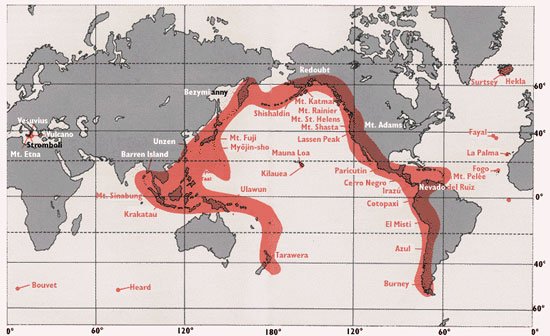
This is the name for the chain of volcanos around the edge of the Pacific Plate.
March Maddness
Earthquake Alley
Ring of Fire
Circle of Death

What is the measure of the amount of energy released in an earthquake?
Earthquake
Epicenter
Magnitude
In an earthquake, the point underground where the rocks first begin to move
Epicenter
Normal fault
Focus
Reverse fault

The hot spot volcanoes that are the Hawaiian Islands formed through _____________ processes of repeated lava outflows building up layer upon layer until an entire island resulted.
destructive
constructive
Can a process that alters the Earth’s surface be both destructive and constructive, such as earthquakes and volcanic eruptions?
True
False
In the Pacific Ocean, a hot spot slowly releases magma. Over time, this lava stacks and cools on top of each other to create a volcanic island. As the tectonic plate moves over the hot spot, the hot spot is able to produce more magma, which then will stack and cool to make another island. This process will repeat over and over again. Does this scenario describe constructive forces, destructive forces, or both?
Constructive: The hot spot helps create a new island, which builds up the earth's crust
Both: The hot spot creates a volcanic island, but that volcano will erupt and destroy everything around it
Both: The hot spot creates a volcanic island, but destroys other islands in the process
Destructive: The hot spot burns a hole through the plate above it, which destroys the crust.
Over long periods of time, one plate slips underneath another plate, which created a trench. As the one plates slips deeper into the mantle, it begins to melt. Does this scenario describe constructive forces, destructive forces, or both?
Destructive: When seafloor spreading occurs, part of the ocean floor is destroyed.
Constructive: When subduction occurs, new crust can be made.
Both: Seafloor spreading occurs, where old crust is destroyed and new crust is created.
Destructive: When subduction occurs, the bottom plate melts, which destroys the crust.
In the Pacific Ocean, two oceanic plates transform. Energy is released from the plates, causing a massive underwater earthquake. This eventually causes a huge wave to form, which traveled to Japan. When the waves got to Japan, they destroyed everything they touched. Does this scenario describe constructive forces, destructive forces, or both?
Destructive: The underwater earthquake caused the ocean crust to shift and change and the waves destroyed everything in their path
Constructive: The underwater earthquake caused the ocean crust to shift and change and the waves destroyed everything in their path
Destructive: The earthquake caused a tornado that destroyed the coast of Japan
None of the above
After a storm, a giant vortex of wind forms overhead. Eventually, the funnel of wind touches down on the ground. The funnel picks up things like man-made objects and rocks and throws them around, dropping them in new locations. The funnel digs a hole into the ground as it moves through the area as well. Eventually, the funnel dies down and the storm ends. Does this scenario describe constructive forces, destructive forces, or both?
Destructive: The tornado causes weathering to occur when it digs a hole into the crust and erosion to occur when it moves rocks around
Destructive: This describes a tsunami, which causes erosion to occur as it picks up rocks and sediments and moves it somewhere else
Both: The tornado causes erosion by moving the sediments around, which is constructive, and weathering occurs as it breaks down the crust, which is destructive
Constructive: A tornado causes deposition to occur when it picks up the man-made objects and rocks and moves them somewhere else
In Alaska, two continental plates meet each other at a transform boundary. At this plate boundary, plates strike and slip past one another. As this happens, energy is built up between the plates. Eventually, the energy is released in the form of seismic waves, which can sometimes crack the crust nearby. Does this scenario describe constructive forces, destructive forces, or both?
Constructive: An earthquake causes the crust to move upwards and build up the earth
Destructive: An earthquake occurs, so the crust to crack and shift, which destroys the crust
Both: A tsunami causes the crust to shake, but nothing is created or destroyed
Destructive: An earthquake and a tsunami will occur, which means that the crust will crack and shift, and the tsunami wave will cause erosion to occur
Two continental plates move towards one another and collide. Over long periods of time, the plates continue to push against one another. Does this scenario describe constructive forces, destructive forces, or both?
Destructive: When two continental plates collide, a rift valley is made, which destroys part of the earth's crust.
Constructive: When two continental plates collide, a volcano is formed, which can eventually erupt and make new land
Both: When two continental plates collide, a volcanic mountain is made, which can erupt and destroy the area around it, but can also create new land
Constructive: When two continental plates collide, a mountain is created, which builds up the earth
When two oceanic plates move towards one another, they do not collide, but one slips underneath the other. When this happens, the bottom plate melts into magma. Over time, that magma rises, cools, and stacks. When this happens, a chain of volcanic islands can be created. Does this scenario describe constructive forces, destructive forces, or both?
Destructive: Subduction causes the plates to melt into magma and the magma melts everything around it
Both: Subduction melts the plates and destroys it, but then the magma rises and cools to create island arcs
Both: Subduction melts the plates and destroys it, but the magma rises from a hot spot to create islands
Constructive: Magma cools to create volcanic islands
What is weather?
The amount of moisture in the air
The number of clouds in the sky
The speed of the wind
The state of the atmosphere at any particular time.
Why is the temperature lower at night than during the day?
There are more clouds at night to block the sun's rays
Winds blow harder at night
The temperature depends on energy from the sun
There is less water in the air at night
Which of the following devices measures air pressure?


If it's a hot day outside, what can you conclude?
There are a lot of clouds in the sky
The air can hold a lot of moisture
The wind is blowing extremely fast
The air can hold very little moisture
Why can't you see the water vapor in the air?
It exists as a clear, colorless gas
It's all been condensed
There is very little of it
It's all far away, in the upper atmosphere
What is the difference between absolute humidity and relative humidity?
Absolute humidity represents how much water the air actually holds; relative humidity is how much water the air can hold
Relative humidity makes the air sticky; absolute humidity makes the air dry
Absolute humidity is how much water the air can hold; relative humidity represents how much water the air actually holds
Absolute humidity is expressed as a percentage; relative humidity is expressed as a whole number
Why does it tend to be cool at the Earth's poles?
They are farthest from the sun
They have high absolute humidity
They have the worst weather
Sunlight strikes them at extreme angles
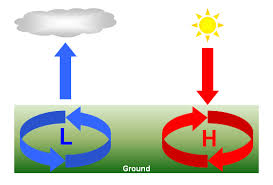
What are the characteristics of a high-pressure system?
Wind and rain
Humidity and thunder
Extremely hot temperatures
Clear skies and sun
If the air is only holding one-third as much moisture as it can possibly hold, what is the relative humidity?
25 percent
50 percent
33 percent
67 percent
What will happen if the relative humidity is 100 percent, and the temperature begins falling?
It will start to rain
The air will be sticky and uncomfortable
The temperature will rise
The barometric pressure will rise
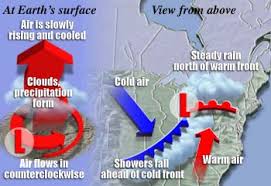
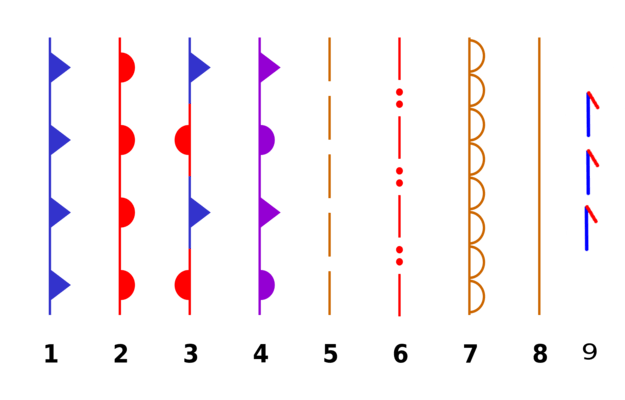
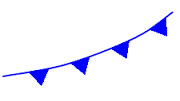


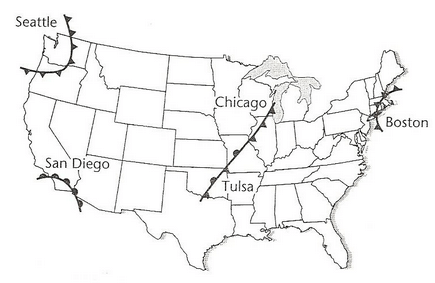
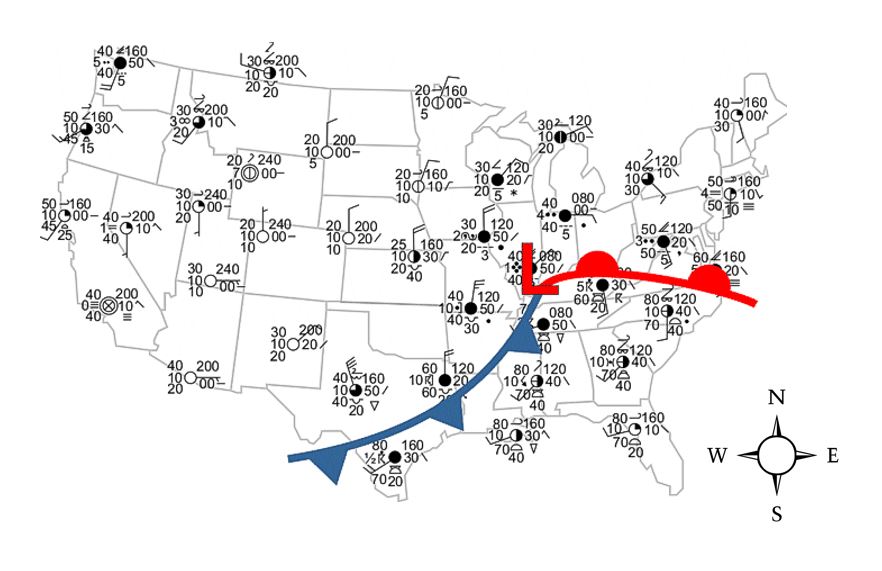
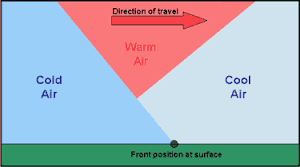
Which one shows a warm front?


Why do coastal regions have warmer winters and cooler summers that regions inland?
There is more direct sunlight near the coast.
Mountain ranges usually form along coasts.
The motion of the waves creates wind.
Oceans warm up and cool down slowly
What latitude will have the highest angle of insolation?
90 N
0 (Equator)
15 S
15 N
Which sentence describes climate?
The temperature yesterday was 42 F
The sky was full of clouds before the storm.
Winters in Canada are cold.
The wind speed was 15 mph.
Which human activity has caused climate change?
Industry
Transportation
Farming
Electricity
All of these
Compared to the base of a mountain, the peak will have...
warmer temperatures and denser air
warmer temperatures and less dense air
colder temperature and denser air
colder temperatures and less dense air
During a day at the beach, which statement is true
The water will heat up faster than the sand
The sand will heat up faster than the water
1. Bright, sunny day
2. Night falls
3.Land and ocean begin to lose stored heat fro the sun
4. One (land or ocean) first reaches a temperature that is equal to the one of its surrounding
5. High pressure front moves in over the land


Air is made up of atoms and molecules.
True
False
Air has no weight.
True
False
Air is made up of a mixture of many different kinds of gases.
True
False
Gases are invisible
True
False

Which box below shows a more dense object?
Left
Right
Define Density
The weight of a column of air pushing down on an area
The Amount of Mass in a given volume
The force pushing on an area
The distance above sea level
Define Pressure
The weight of a column of air pushing down on an area
The Amount of Mass in a given volume
The force pushing on an area
The distance above sea level
Define Altitude
The weight of a column of air pushing down on an area
The Amount of Mass in a given volume
The force pushing on an area
The distance above sea level
Define Air Pressure
The weight of a column of air pushing down on an area
The Amount of Mass in a given volume
The force pushing on an area
The distance above sea level
Air pressure is measured with a
thermometer
hot-air balloon
satellite
barometer
As I walk up Mt Everest, the density of air...
decreases
increases
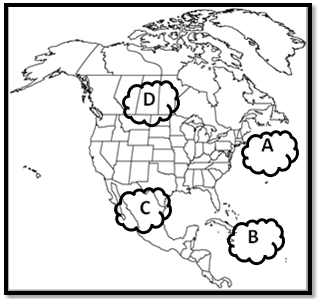
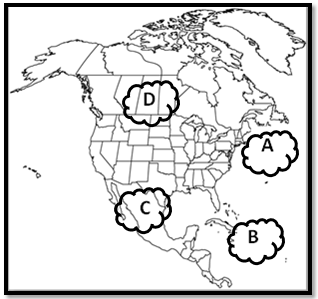
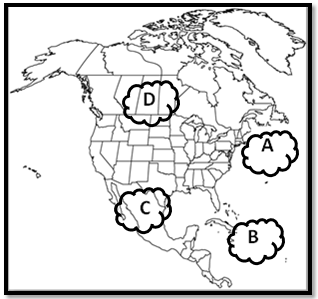
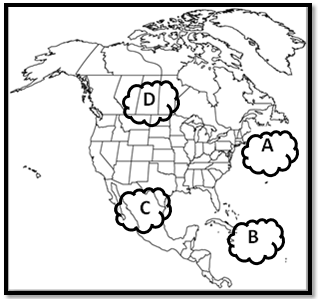
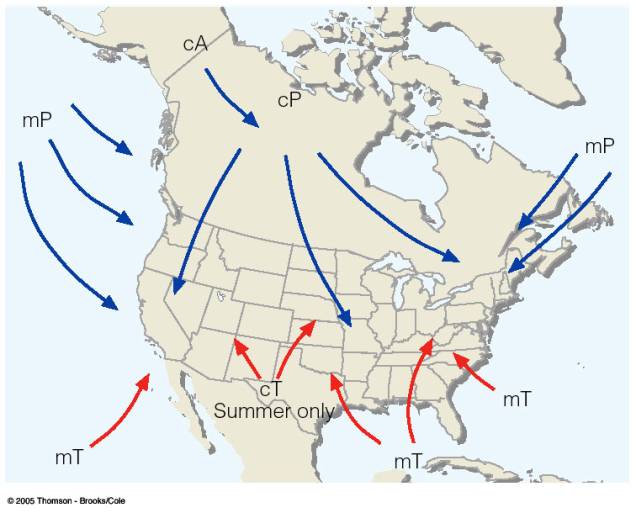
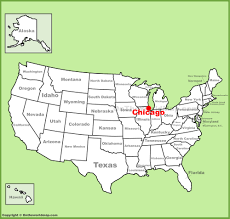
What type of air mass is found over CHICAGO?
Maritime Polar
Maritime Tropical
Continental Polar
Continental Tropical

What type of air mass is found over the UNITED KINGDOM?
Maritime Polar
Maritime Tropical
Continental Polar
Continental Tropical
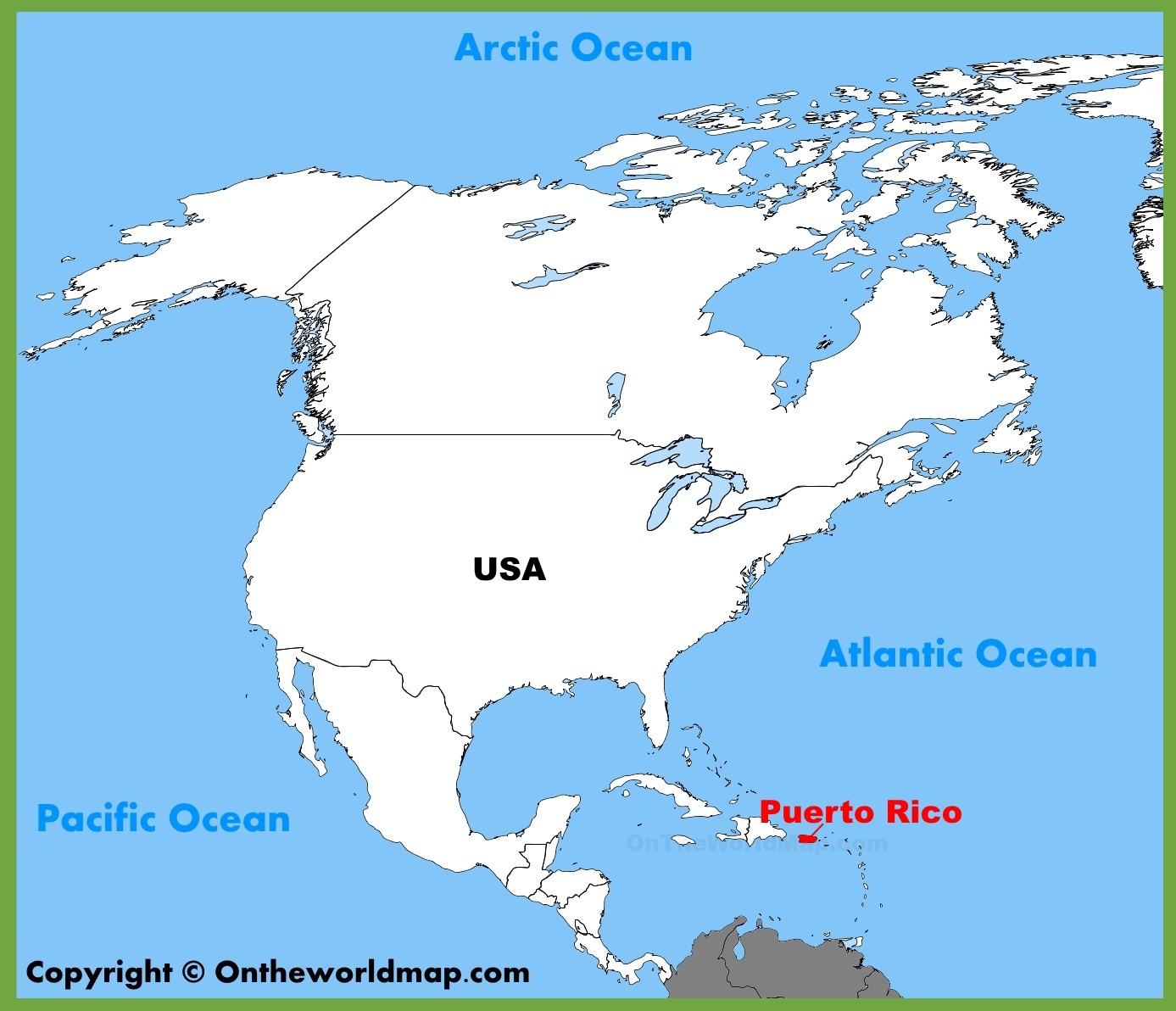
What type of air mass is found over PUERTO RICO?
Maritime Polar
Maritime Tropical
Continental Polar
Continental Tropical

What type of air mass is found over EGYPT?
Maritime Polar
Maritime Tropical
Continental Polar
Continental Tropical
Which type of air mass is HOT and DRY?
Maritime Polar
Maritime Tropical
Continental Polar
Continental Tropical
Which type of air mass is HOT and HUMID?
Maritime Polar
Maritime Tropical
Continental Polar
Continental Tropical
The amount of water vapor in the air is known as ___.
dew point
humidty
relative humidity
rain
Which will hold more water, warm air or cold air?
Warm Air
Cold AIr
The amount of water vapor in the atmosphere compared to the maximum amount it could hold is known as...
Saturation
Vaporicity
Absolute Humidity
Relative Humidity

What does high absolute humidity mean?
It is cold.
It is hot.
There is a little water vapor in the air.
There is a lot of water vapor in the air.
Which type of air has more kinetic energy?
Warm air
Cold air

In the sponge lab, which sponge was used to represent warm air?
Large Sponge
Medium Sponge
Small Sponge
If you were to take a sponge with water in it and squeeze it, this could be used to model which process in nature?
Air cooling down and creating water droplets
Air warming up and causing rain
Air filling up with more water from evaporation
Which type of air has more space for water molecules to be held?
Warm air
Cold Air
Cool Air

Is the air typically colder at the top or bottom of a mountain?
Bottom
Top

If the air temperature cools, but the TOTAL amount of water vapor in the air stays the same, what will happen to the RELATIVE humidity?
relative humidity will decrease
relative humidity will increase
relative humidity will stay the same
If the air temperature gets warmer, but the TOTAL amount of water vapor in the air stays the same, what will happen to the RELATIVE humidity?
relative humidity will decrease
relative humidity will increase
relative humidity will stay the same
What is climate?
What's going on with the atmosphere at any particular time
The type of weather that occurs during a particular season
An area's pattern of weather over a long period of time
How much sunshine an area gets
If the air temperature stays the same, but the TOTAL amount of water vapor in the air increases, what will happen to the RELATIVE humidity?
relative humidity will decrease
relative humidity will increase
relative humidity will stay the same
How does water vapor get into the air?
Condensation from clouds
Evaporation from the ocean and lakes
Precipitation from clouds
People putting it there
The dew point is the temperature that water vapor in the air starts to condense to form water droplets. How does the absolute humidity (total water in the air) affect the dew point?
When the absolute humidity is higher, the dew point is higher
When the absolute humidity is lower, the dew point is higher
The absolute humidity has no affect on the dew point
It is summertime and the air is holding lots of water. All of sudden, the temperature drops rapidly. What is likely to happen?
It is likely to rain, because cold air cannot hold as much water
It is likely to become sunny, because cool air has less clouds
What are clouds made of?
Water droplets
Water vapor
Dust
Air
Which of these scenarios is most likely to create clouds? Choose two
Evaporation puts more water vapor in the air
The air temperature increases with no increase in water vapor in the air
The air temperature decreases with no increase in water vapor in the air
The rate of evaporation slows down, putting less water vapor in the air
Humidity describes water in which state of matter?
Solid
Liquid
Gas
All three
Which location likely has the highest average humidity?


Water molecules that move faster are more likely to:
Evaporate
Condense
Precipitate
Reach equilibrium
The air generally becomes drier when:
Evaporation is greater than condensation
Condensation is greater than evaporation
Evaporation and condensation are equal
Evaporation and condensation stop
In order to stay at equilibrium, an environment would have to be:
Hot
Humid
Wet
Sealed
Summer days tend to be more humid than spring days mainly due to:
Lower air pressure
Warmer temperatures
Stronger winds
Less rainfall
Relative humidity compares the amount of water vapor in the air to:
The dew point
The air temperature
The maximum potential amount
The total volume of liquid water in the area
There are 15 water molecules in the air, and the relative humidity is 75 percent. The maximum potential number of water molecules is:
15
20
25
30
What must be true if dew forms on grass?
The sun is about to set
The grass is wet from precipitation
More water is evaporating than condensing
The temperature near the grass is below the dew point
Why do hot, humid days feel so uncomfortable?
The air has very little moisture
Our bodies produce less sweat
Sweat evaporates more slowly
Humid air does not carry a breeze
How many major climate types are there, worldwide?
3
4
5
6
Why are tropical climates so hot?
Because there is very little rain
Because they receive more direct sunlight than other areas
Because there is not much vegetation in tropical areas
Because there are more hours of daylight in tropical areas than in any other area
What can you infer about arid climates from their name?
They receive very little rainfall
They receive very little direct sunlight
Their temperature varies with the seasons
Humans cannot live there
How is the Gobi Desert different from the Sahara Desert?
The Gobi receives more than 25 cm of rainfall per year; the Sahara doesn't
The Gobi Desert is very hot; the Sahara is fairly cold
The Gobi Desert is fairly cold; the Sahara is very hot
The Sahara receives more than 25 cm of rainfall per year; the Gobi doesn't
Which of the following is a true statement about temperate climates?
They often have very cold winters
They often have very warm summers
They often receive less than 25 cm of rainfall per year
They are usually completely uninhabited
How are continental climates different from temperate climates?
They receive less rainfall
They have hotter summers
They have colder winters
They are located closer to the equator
What kind of climate would you find in New England (northeast US)?
Continental
Temperate
Polar
Subarctic
If you wanted to live in a temperate climate, where could you move?
Riyadh, Saudi Arabia
Phnom Penh, Cambodia
Montreal, PQ, Canada
Los Angeles, California
What is climate?
the condition of the atmosphere at any given time and place
cloud cover and temperature
precipitation and humidity at a given time and place
weather conditions in an area over a long period of time
Climate is affected by many factors including:
latitude, elevation, and proximity to bodies of water
tides and currents
wind
snow and sleet
Which two factors determine the climate in a particular region?
temperature and latitude
precipitation and humidity
temperature and precipitation
humidity and air pressure
At which latitude would you expect to find the warmest air temperatures?
23.5° S
0°
66.5°N
66.5°S
At which latitude would you expect to find the coldest air temperatures?
66.5°N
0°
23.5° S
23.5°N
These areas is located between 66.5°N and the North Pole and 66.5°S and the South Pole. It has low temperatures and very little precipitation.
Polar Climate Zones
Temperate Climate Zones
Tropical Climate Zones
The Arctic Climate Zones
What is elevation?
the depth of the ocean
the height of the atmosphere
the depth of a lake
the height above sea level
What is the temperature and humidity of a mountain region?
very warm in summer and cooler in other seasons with high humidity
Low temperatures due to altitude, humidity is lower the higher you go
very hot temperatures during the day and cold at night, little to no humidity
very cold year round, high humidity
The areas located between 23.5°N and 66.5°N and 23.5°S and 66.5°S. These zones have hot summers and cold winters and usually have four seasons.
Polar Climate Zones
Temperate Climate Zones
Tropical Climate Zones
Oceanic Climate Zones
What are the three main climate zones?
tropical, thermal, polar
tropical, temperate, polar
cold, super hot, blah
polar, tropical, humid
What climate zone is located near the equator where the sun is directly overhead all year?
polar
tropical
desert
temperate
Which factor does NOT affect the kind of climate an area has?
distance from the equator (latitude)
elevation
proximity to bodies of water
wind direction
These areas are located between 23.5°N and 23.5°S of the equator. These zones receive direct sun rays, have higher temperatures, and lots of rain.
Polar Climate Zones
Temperate Climate Zones
Tropical Climate Zones
Oceanic Climate Zones
The climate of a particular region is NOT affected by:
latitude
minerals
nearby water
elevation
Which city would you expect to have the overall colder climate?
Atlanta, Georgia (elevation of 1,050 feet)
Baton Rouge, Louisiana (elevation of 56 feet)
Chicago, Illinois (elevation of 579 feet)
Steamboat Springs, Colorado (6, 732 feet)
Areas closer to the equator receive more direct energy from the Sun and have warmer temperatures.
True
False
The higher the elevation of an area, the _______ the climate.
warmer
cooler
Most of the United States is in Earth's ___________ climate zone.
polar
tropical
temperate
subtropical

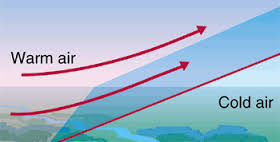
What type of front is shown?
Warm Front
Cold Front
Occluded Front
Stationary Front

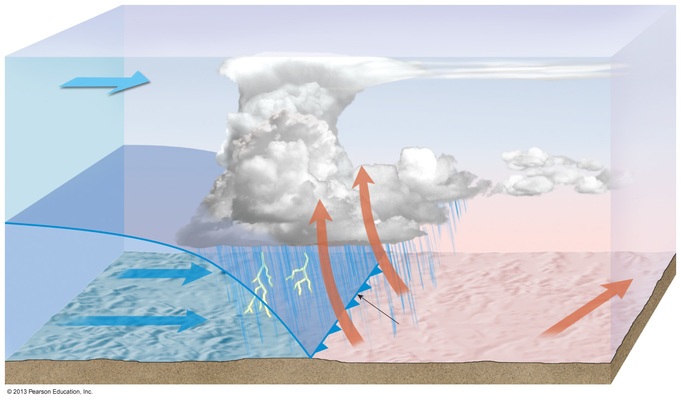
What type of front is shown?
Warm Front
Cold Front
Occluded Front
Stationary Front

How does the air in this type of front move?
Warm air slowly moves over cold air
Warm air rapidly moves up when meeting cold air
Warm air is trapped between two colder air masses
Warm air meets cold air and cannot move

How does the air in this type of front move?
Warm air slowly moves over cold air
Warm air rapidly moves up when meeting cold air
Warm air is trapped between two colder air masses
Warm air meets cold air and cannot move

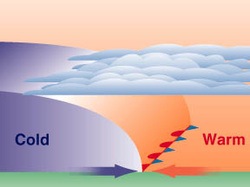
How does the air in this type of front move?
Warm air slowly moves over cold air
Warm air rapidly moves up when meeting cold air
Warm air is trapped between two colder air masses
Warm air meets cold air and cannot move

How does the air in this type of front move?
Warm air slowly moves over cold air
Warm air rapidly moves up when meeting cold air
Warm air is trapped between two colder air masses
Warm air meets cold air and cannot move
What type of weather does this front bring?
Cloudiness and light precipitation; warm and mild weather follows
Thunderstorms can occur; cool, fair weather follows
Many days of clouds and precipitation
Temperature drops; strong winds and heavy precipitation

What type of weather does this front bring?
Cloudiness and light precipitation; warm and mild weather follows
Thunderstorms can occur; cool, fair weather follows
Many days of clouds and precipitation
Temperature drops; strong winds and heavy precipitation

What type of weather does this front bring?
Cloudiness and light precipitation; warm and mild weather follows
Thunderstorms can occur; cool, fair weather follows
Many days of clouds and precipitation
Temperature drops; strong winds and heavy precipitation

What type of weather does this front bring?
Cloudiness and light precipitation; warm and mild weather follows
Thunderstorms can occur; cool, fair weather follows
Many days of clouds and precipitation
Temperature drops; strong winds and heavy precipitation
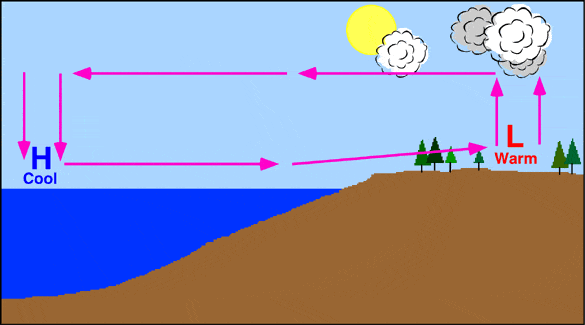
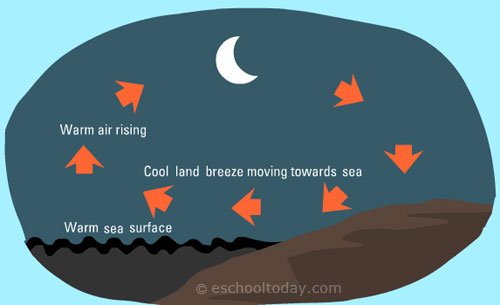


The arrow above the land is going up and is red because
the land is warm so it warms the air and warm air rises.
the land is cold so it warms the air and cool air sinks.
the land is cold so it cools the air and cool air sinks.
the land is warm so it warms the air and cool air rises.
The arrow above the water is coming down and is blue because
the water is warm so it warms the air and warm air sinks.
the water is cold so it warms the air and cool air sinks.
the water is cold so it cools the air and cool air sinks.
the water is warm so it warms the air and cool air sinks.

In a Seabreeze, the sea has:
High Pressure and Lower Temperature
High Pressure and High Temperature
Low Pressure and Low Temperature
Low Pressure and High Temperature

In a Land Breeze, the land:
Have Higher Temp and High Pressure
Have Low Temp and Low Pressure
Have Low Temp and High Pressure
It can be high and low Pressure and temp, it depends on the weather.

