
 Worksheets
Bio (1.1)
Total questions: 31
Worksheet time: 1hrs 1mins
Name
Class
Date
1.
Which organelle is the site of protein synthesis?
a)
Mitochondria
b)
Nucleus
c)
Chloroplast
d)
Ribosome
2.
Which organelle stores water & nutrients?
a)
Vacuole
b)
Nucleus
c)
RIbosome
d)
Cell Membrane
3.
Which organelle is the site of aerobic respiration (creates ATP/energy)?
a)
mitochondria
b)
chloroplast
c)
vacuole
d)
nucleus
4.
Which organelles differentiate animal cells from plant cells?
a)
cell wall, chlorplast, and large vacuole
b)
chloroplast and mitochondria
c)
ribosomes and nuclei
d)
membrane bound organelles and nuclei
5.
What would happen if all of the chloroplasts were removed from a cell?
a)
Respiration could no longer occur
b)
Photosynthesis could no longer occur
c)
Protein Synthesis could no longer occcur
d)
Osmosis could no longer occur
6.
Controls what enters and leaves the cell
a)
Mitochondria
b)
Cell Membrane
c)
Cell Wall
d)
Nucleus
7.

According to cell theory, where did this cell come from?
a)
another living cell
b)
energy from sun
c)
a multicellular organism
d)
the nonliving environment
8.

Robert Hooke, Anton van Leeuwenhoek, Theodor Schwann, Rudolf Virchow, and Matthias Schliden were all responsible for what theory?
a)
The Theory of Gravity
b)
The Theory of Relativity
c)
The Cell Theory
d)
The Theory of Continental Drift
9.
Which of the following is NOT a cell theory.
a)
All non-living things are made of cells
b)
All cells come from pre-existing cells
c)
Cells are the basic unit of structure and function of all living things
10.
what is the control center in a cell
a)
mitochondria
b)
DNA
c)
nucleus
d)
movement
11.

This organelle helps plants keep their rigid structure.
a)
Cell wall
b)
Cell membrane
c)
Chloroplast
d)
Nucleus
12.
This is a double layer of phospholipids that creates a barrier between the cells internal and external environments; it controls what comes in or out of the cell (selective permeable)
a)
Nucleus
b)
Cilia
c)
Cell membrane
d)
Flagella
13.
_ are organelles responsible for digesting certain materials within the cell.
a)
vacuoles
b)
chloroplasts
c)
lysosomes
d)
cell membrane
14.
The "cell jelly" that holds all the organelles in the cell
a)
Cytoplasm
b)
Endoplasmic Reticulum
c)
Golgi
d)
Cytoskeleton
15.
A cell has a nuclear membrane surrounding the nucleus, ribosomes, and membrane bound organelles. This is a _______ cell.
a)
Prokaryotic
b)
Bacteria
c)
Eukaryotic
d)
Unidentifiable
16.
Oldest, simplest type of cell
a)
Prokaryote
b)
Eukaryote
c)
both
17.
Contain plasmids
a)
Prokaryote
b)
Eukaryote
c)
both
18.
Has Mitochondria
a)
Prokaryote
b)
Eukaryote
c)
both
19.
Which has ribosomes?
a)
Prokaryote
b)
Eukaryote
c)
both
20.
Has cytoplasm
a)
Prokaryote
b)
Eukaryote
c)
both
21.
Has nucleus
a)
Prokaryote
b)
Eukaryote
c)
both
22.
Bacteria
a)
Prokaryote
b)
Eukaryote
c)
both
23.
Has chloroplast
a)
Prokaryote
b)
Eukaryote
c)
both
24.
more complex
a)
Prokaryote
b)
Eukaryote
c)
both
d)
both
25.
multicellular
a)
Prokaryote
b)
Eukaryote
c)
both
26.
plants
a)
Prokaryote
b)
Eukaryote
c)
both
27.
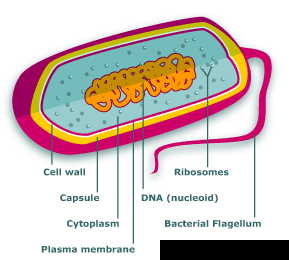
Which type of cell?
a)
Prokaryote
b)
Eukaryote
28.

Which type of cell?
a)
Prokaryote
b)
Eukaryote
29.
A single-celled organism that lacks a membrane-bound nucleus, mitochondria, or any other membrane -bound organelle .
a)
Prokaryote
b)
Eukaryote
c)
Nucleus
d)
Single-celled organism
30.
Where is the DNA found in a prokaryotic cell?
a)
floating around in the cytoplasm
b)
in the nucleus
31.
All cells in an organism have the same DNA. However, only certain genes are activated in different types of cells. This is ..
a)
osmosis
b)
differentiation
c)
photosynthesis
d)
respiration
100 %

