
 Worksheets
Ecology
Total questions: 44
Worksheet time: 25mins
there would be more energy

In the woods, there are ducks and mice. They both compete for grasshoppers as the only source of food in that area at that time. The ducks outcompete the mice, and the mice die out in that area. This is an example of:
Neutralism
Commensalism
The competitive exclusion principle
Mutualism

In this photo, what is an abiotic factor?
Deer
Grass
rain
What would be a good example of a primary consumer?
carnivore
detrivore
decomposer
herbivore

Which organisms would be at the top or last trophic level?
plant
herbivore
omnivore
carnivore

The monkey would be a
decomposer
producer
primary consumer
secondary consumer

90% of the energy that gets lost as you move up a food pyramid or chain gets lost as
pollution to the environment
heat to the environment
energy for decomposers
gets recycled
What percentage of energy is passed on to the next trophic level?
5%
10%
50%
90%


Which contribute to a positive population growth?
immigration
positive birth rate
emigration
positive death rate

Which of the following describes the population of elephants in Kenya from 1973-1989?
(immigration + births) – (emigration + deaths) = 0
(immigration + births) – (emigration + deaths) = 1
(immigration + births) – (emigration + deaths) < 0
(immigration + births) – (emigration + deaths) > 0
A population’s emigration in one month totaled 2 individuals. During the same period, immigration was 12 individuals. Natality (births) was 8, and mortality was 15 due to a parasite infection. What was the net effect on the population size?
+5
+3
0
-4
What type of factor has an increasing impact as the population size increases?
density-independent
density-dependent
cohort effect
survivorship factor
Which of the following are density dependent factors?
competition for resources
predation
disease
natural disasters
Which of the following are examples of a density independent factors?
forest fire
seasonal cycles
storms
disease
Factors like predation can have a positive benefit to the population of prey organisms because predators tend to keep prey populations below their ___________.
carrying capacity
sustainibility number
exponential growth point
competition level
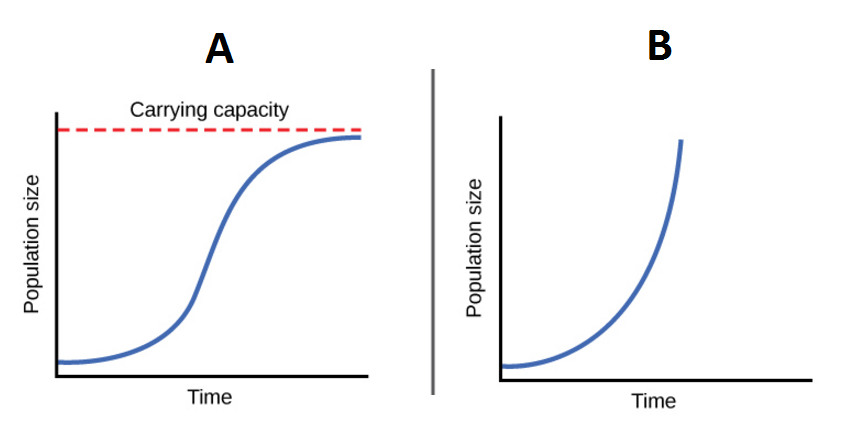
What type of growth model is shown in image A?
Exponential
Logistic
What type of growth model is shown in image B?
Exponential
Logistic
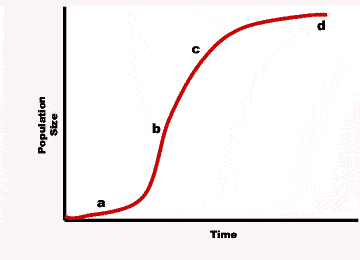
What point on the graph represents carrying capacity?
a
b
c
d
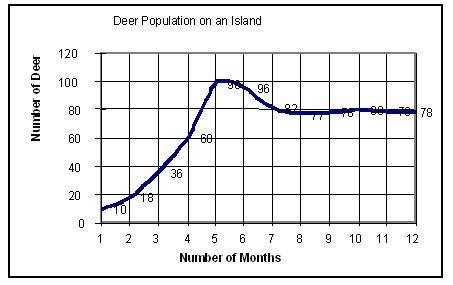
Which choice most closely approximates the deer population's carrying capacity based on the graph?
100
80
60
10


This graph shows ....
When one population increases, the other decreases.
When one population decreases, the other increases.
When one population increases, the other increases instantly.
When one population increases, it causes the other to increases shortly after.
Define population density and distribution.
The average number of people in a given unit area and how a population is spread over an area.
The number of houses per square kilometre and urbanisation rates.
Where people live on the surface of the earth.
The number of a people in a country and where they are situated.
Which of the following is NOT a challenge to a growing population?
Overcrowding
Housing shortages
Overuse of resources
Increased food supplies

Calculate the density of the human population in the pictured habitat.
360 ft230 humans
360 ft250 humans
38 ft230 humans
38 ft250 humans

What might happen if the earth exceeds its carrying capacity?
There might not be room for people to move around.
There might not be enough food and water for everyone.
The continents might sink into the oceans.
Most of the people on the planet would starve.
What happens when the birth rate equals the death rate
zero population growth
negative population growth
positive population growth

