
 Worksheets
Algebra 1 Final Exam
Total questions: 94
Worksheet time: 54mins
Check all that are Rational
Irrational
Integers
Whole Numbers
Natural Number
The set of natural numbers plus a “0”
W = {0, 1, 2, 3,…}
Natural Numbers
Integers
Irrational Numbers
Whole Numbers
The set of natural numbers, their negatives and 0
= {-3, -2, -1, 0, 1, 2, 3,…}
Whole Numbers
Integers
Natural Numbers
Real Numbers
A subset of real numbers that are not rational or numbers whose decimal parts neither repeat nor terminate.
Irrational Numbers
Real Numbers
Rational Numbers
Integers
True or False: Some of the integers are natural numbers.
True
False
Check all that apply to this number: -4
Rational
Irrational
Integer
Whole Number
Natural Number
Check all that apply to this number: 45
Rational
Irrational
Integer
Whole Number
Natural Number
Check all that apply to this number: 3
Rational
Irrational
Integer
Whole Number
Natural Number

Which represents label D?
Rational
Irrational
Integer
Whole Number
Natural Number
Which represents label A?
Rational
Irrational
Integer
Whole Number
Natural Number
Number A: 3.34343434343434...
Number B: 3.14158271957392...
How would you classify number A and why would you classify it this way?
Rational
Irrational
The decimal never repeats and never terminates
The decimal terminates
The decimal is repeating
Number A: 3.34343434343434...
Number B: 3.14158271957392...
If you were to multiply A x B what type of number would the answer be? How do you know?
Rational
Irrational
Rational x Irrational is Rational
Rational x Irrational is Irrational
Rational x Rational is Rational
Any value that makes an equation true when substituted for the variable.
Properties of Equality
Equation
Solution
Variable
If a = b ,
then a + c = b + c .
Addition Property of Equality
Subtraction Property of Equality
Multiplication Property of Equality
Division Property of Equality
If a = b, then ac = bc.
Addition Property of Equality
Subtraction Property of Equality
Multiplication Property of Equality
Division Property of Equality
If a = b , then b = a .
Symmetric Property of Equality
Commutative Property of Addition/Multiplication
Associative Property of Addition/Multiplication
Distributive Property
(a + b) + c = a + (b + c)
(ab)c = a(bc)
Symmetric Property of Equality
Commutative Property of Addition/Multiplication
Associative Property of Addition/Multiplication
Distributive Property

Which property would step #2 be labeled as?
Combine Like Terms
Commutative Property of Addition
Subtraction Property of Equality
Division Property of Equality
Addition Property of Equality
Which property would step #4 be labeled as?
Combine Like Terms
Commutative Property of Addition
Subtraction Property of Equality
Division Property of Equality
Addition Property of Equality
Which property would step #6 be labeled as?
Combine Like Terms
Commutative Property of Addition
Subtraction Property of Equality
Division Property of Equality
Addition Property of Equality
Two inequalities either joined by the word "and" or by the word "or"
Compound Inequality
Graph of an Inequality
Conjunction
Disjunction
Two inequalities either joined by the word "or"
Compound Inequality
Graph of an Inequality
Conjunction
Disjunction
Which inequality symbol best fits the verbal phrase:
"X is no more than 7"


Which inequality symbol best fits the verbal phrase:
"X is less than 7"
Which inequality symbols are represented by an open circle?
How many solutions do equations have?
Infinitely many
One
None
A few
What happens to the inequality symbol when you divide by a negative?
The symbol goes away
The symbol stays the same
The symbol is flipped
Nothing Happens
X values may also be considered: (select all that apply)
Input
Output
Domain
Range
f(x)
Shows the relationship between two elements, written in a specific order using parentheses notation and a comma separating the two values.
Function
Ordered Pair
Mapping
Relation
A relation in which each input is paired with exactly one output
Function
Ordered Pair
Mapping
Relation
The set of all outputs for a function.
Range
Domain
Finite
Infinite
A set has an unlimited number of elements.
Range
Domain
Finite
Infinite

Label B of the function notation:
The output variable
The name of the function
The input variable
Equivalent to "y"
A visual check to see if a graph represents a function;
Mapping Diagram
Table
Vertical Line Test
Set of ordered pairs
Check all that apply to the "Y" value
f(x)
dependent variable
range
output
independent variable

Check all that apply to the following graph:
Discrete
Continuous
Linear
Not a function
Function
A graph in which the data consists of individual points that are not connected by a line or curve.
Domain
Continuous
Range
Discrete

Which of the following represents the range of the graph?
−3≤x≤8
−4.5≤y≤2.5
−3≤y≤8
−4.5≤x≤2.5
Which of the following represents the x intercept of the function?
y = -4.5
(0,-4)
(3,0)
y = 8

Select all that apply to label (b)
absolute maximum
absolute minimum
relative maximum
relative minimum
endpoint
Select all that apply to label (d)
absolute maximum
absolute minimum
relative maximum
relative minimum
endpoint

What does this formula stand for? Select all that apply
Rate of change
Vertical change over horizontal change
Change in y over change in x
Change in x over change in y
Horizontal change over vertical change
Which axis is considered horizontal?
x
y
origin
length
Which of the following represents horizontal change?
y2−y1
x2−x1


What is the slope of the graph pictured?
−32
−23
32
23
Consider the following story problem:
An Alexandria zoo membership it is $50 per year and a discounted price of $6 per visit.
What is the dependent variable?
Number of years
Amount of money given to the zoo
Number of visits
Membership fee
Consider the following story problem:
An Alexandria zoo membership it is $50 per year and a discounted price of $6 per visit.
What is the rate of change and what does it represent?
$50; the amount per year
$6; the amount per visit
$50; the amount per visit
$6; the amount per year
What happens to the inequality symbol when you multiply or divide by a negative?
The symbol goes away
The symbol stays the same
The symbol is flipped
Nothing Happens
A line that separate the coordinate plane into two regions
Axis
Boundary Line
Symbol
Divider
Inequality symbols that create a closed half - plane and all points on the line are included in the solution.
Select the graph that contains an open half plane.


Consists of two or more linear inequalities with the same variables
Linear Equation
System of Equations
System of Inequalities
Ineqaulity
Restriction on the value of a variable or the value of an expression involving one or more variables
Constraint
Viablility
Viable
Nonviable
Solutions that do not make sense in context to a real world situation
Constraint
Viablility
Viable
Nonviable

Which coordinate point is a solution to the system of inequalities?
(o,o)
(2,2)
(1,-3)
(4,-1)

The solution to the system of linear equations is...
(a)
Select all the methods you can use to solve a system of equations
Graphing
Elimination
Substitution
Using a Table
Desmos
Lines who's graphs do not intersect
System of equations
Coincident Lines
Parallel Lines
Perpendicular Lines

How many solutions does the following graph have?
One solution
Two solutions
No solutions
Infinitely many solutions

How many solutions does the following graph have?
One solution
Two solutions
No solutions
Infinitely many solutions
Point slope form of a linear equation
y = mx + b
y - y1 = m (x - x1)
Ax + By = C
y + x = b
How many terms are in this polynomial?
2x3 - 8x2 + 3x - 7
7
1
4
2
Select all the polynomials that are in standard form.
x2+5x−14
2y4−3y+6y2−13
14x5−x3+2x
3+5x+x2−5x3
8x7+4x5−9x3+x4−12x
x2-2x+5?

Which term best represents "A"
Leading Coefficient
Degree of the Polynomial
Terms
Constant
Which term best represents "C"
Leading Coefficient
Degree of the Polynomial
Terms
Constant


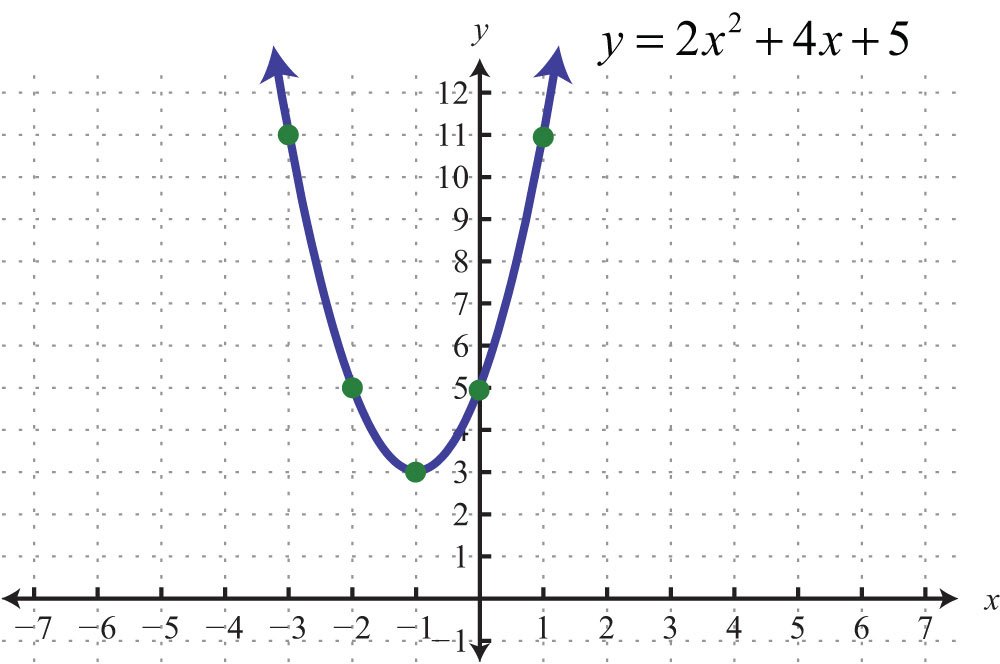
The graph of a quadratic function
Axis of Symetry
Parent Function
Parabola
Vertex
The y value of the vertex is considered the parabola's...
Maximum or Minimum value
Axis of Symetry
Vertex
Quadratic
Domain
X values of a graph
Y values of a graph
Shift of a graph
Change of a graphs shape
The line that passes through the vertex of a parabola and divides the parabola into two symmetrical parts
Vertex
Axis of Symetry
Parent function
Transfomation
Change in the position, size, or shape of a parent graph
Translation
Transformation
Vertex
Reflection

