
 Worksheets
Acids, Bases, & Solutions Test
Total questions: 55
Worksheet time: 2hrs 50mins

Which of the following is NOT a property of acids?
corrosive
sour taste
turns litmus paper blue
feels watery
As one moves up the pH scale from 1 to 14, what happens to the concentration of H+ in the solution?
concentration of H+ decreases
concentration of H+ increases
concentration of H+ stays the same
A pH of 13 is how many times more acidic than a pH of 12?
2
20
10
100

According to Bronsted-Lowry, what is the definition of an BASE?
a substance that donates a hydrogen (H+) ion
a substance that donates a hydroxide (OH-) ion
a substance that accepts a hydrogen (H+) ion
a substance that accepts a hydroxide (OH-) ion
According to Arrhenius, what is the definition of an ACID?
a substance that contains hydroxide and ionizes to produce OH-
a substance that contains hydrogen and ionizes to produce H+
a substance that contains hydrogen and ionizes to produce OH-
a substance that contains hydroxide and ionizes to produce H+
Molarity (M) = moles of solute / _________________________.
L of solvent
mL of solvent
L of solute
mL of solute

When an acid and base has been neutralized the pH will be?
1
4
7
10

What is being donated/accepted between conjugate acid-base pairs?
a hydrogen (H+) ion
a hydroxide (OH-) ion
water
a neutron
pH is the measure of the concentration of ______.
Acids
H+ ion
OH- ion
Bases

pH stands for ____________________________.
pretty Hydrogen
productive Hydrogen
potential Hydrogen
probably Hydrogen
Solutions with a pH lower than 7 are called _____
acids
bases
indicators
neutral
Solutions with a pH greater than 7 are called_________.
acids
bases
indicators
neutral
On the pH scale, which number indicates neutral?
0
1
7
14
Neutralization is a reaction between a(n)
acid and a base
acid and a metal
base and a salt
salt and water
If a solution has a pH scale of 9, the solution is
acidic
alkaline
neutral
saturated
What happens when an acid and a base are mixed together?
they explode
nothing will happen
a salt & water are formed
a weaker base & stronger acid are formed
During an experiment about the rate of dissolving you test temperature. In one beaker you use room temperature water, one beaker you use hot water and the last beaker you use ice water. In what order would the beakers dissolve the solute from slowest to fastest?
hot, cold, room temperature.
cold, hot, room temperature.
cold, room temperature, hot.
hot, room temperature, cold.

In this model what is being changed about the solution?
There is more solvent being added making it concentrated.
There is more solute being added making it concentrated.
There is heat being added to speed up the rate of dissolving.
There is nothing special about this model.

The picture shows how you might change an variable in an experiment about what affects the rate of dissolving. What results do you expect to see?
A will dissolve slowest because it has the largest number of particles.
D will dissolve slowest because it has the smallest surface area.
All pieces will dissolve at an equal rate.
C will dissolve slowest because it has the most bonds between sugar molecules.

Look at the solubility curve - as a GENERAL rule (that means there are exceptions, as always, in science) what trend can be states about how temperature affects the solubility of the compounds shown.
Temperature has NO affect.
The relationship is inversely proportional - as temperature increases, the solubility decreases.
The relationship is directly proportional - as temperature increases, the solubility increases.
It varies - the solubility will increase and then decrease when it reaches a certain temperature.
If you were testing what might affect the rate of dissolving of sugar, you could test the affect of agitation (shaking, stirring, etc). Which of the following BEST explains how this will change how fast the solute will dissolve.
Stirring the solution exposes the solute to fresh solvent more quickly.
Stirring helps more solvent evaporate.
Stirring causes more ions to precipitate out of solution.
Stirring equalizes the water temperature.

How many grams of KCl will dissolve in 100mL of water at 75oC?
35 grams
40 grams
45 grams
50 grams
Indigestion and heartburn is causes by an over production of stomach acid. If you were suffering from indigestion, what types of foods should you avoid?
Foods that have a pH BELOW 7.
Food that have a pH ABOVE 7.
Food that have a pH of 7.
Food has no impact on indigestion.

The table shows the pH values of a sample of substances. According to the substances, which is most acidic.
Stomach acid
Oven cleaner
Eggs
Milk
Acids will neutralize a base, and bases will neutralize acids. If you add a base to a solution containing a strong acid, what will happen to the pH of the solution?
The pH will increase.
The pH will decrease.
The pH will stay the same.
We used pH strips as the indicators in our household acid and base substance test. We also talked about litmus papers as another type of indicator. What property changes on the pH strip or litmus paper to show if an substance is an acid or base?
Smell.
Color.
Concentration.
Taste.

You can buy salt in different forms - granulated (like what you have on your table), course ground (kosher salt) and rock salt (for making ice cream).
If you used the rock salt as the solute in a rate of dissolving investigation, which of the following WOULD NOT increase the rate at which the rock salt would dissolve?
Crushing the solute.
Stirring the solution.
Heating the solution.
Increasing the amount of solute.

Vinegar, fruit juice, and cola are examples of:
salts
neutral substances
bases
acids
NaOH may be found in drain cleaners and as a component of soaps. Is NaOH an acid or a base?
Acid
Base
Neither (Neutral)

If you check the pH of cooking oil with litmus paper, the results will indicate that the oil is:
Acidic
Basic
Neutral
The pH scale is a range from:
1-7
0-14
1-5
1-14
These can burn you if they are strong enough.
Acids
Bases
Water
Acids & Bases

Diagram 1 shows the set-up of the apparatus for the reaction between an acid and magnesium. What are the bubbles of gas X?
Oxygen gas
Hydrogen gas
Carbon dioxide
Nitrogen gas

This table shows the pH of four solutions. Which of the solutions can dissociates completely to OH– ions in water because it is a strong base?
P
Q
R
S
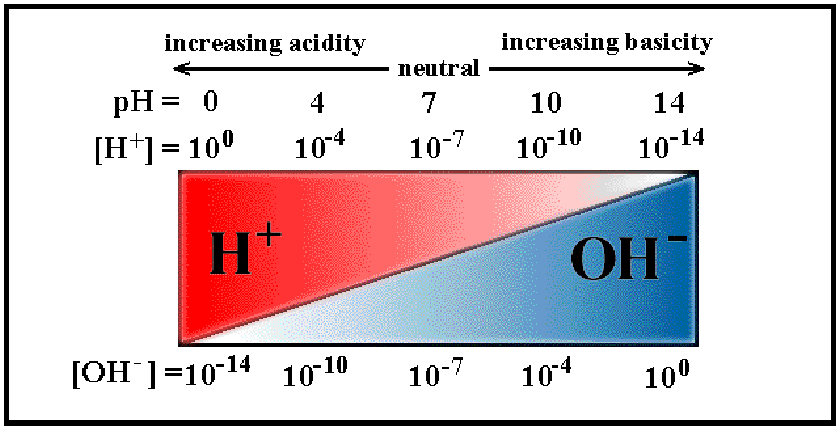
True or false: a neutral solution has equal amounts of H+ and OH-.
True
False

Which of the following is the strongest base?
oven cleaner - 13.5
lemon juice - 2.5
soap - 10
blood - 7.4

Which of the following is the weakest base?
oven cleaner - 13.5
lemon juice - 2.5
soap - 10
blood - 7.4


How do you know when you have a saturated solution?
You don't see anymore material in the solution. It has dissolved.
The material dissolves and no more will dissolve because you see it collect at the bottom.
The solution is bubbling and cloudy.
The solution is clear and there is nothing at the bottom.
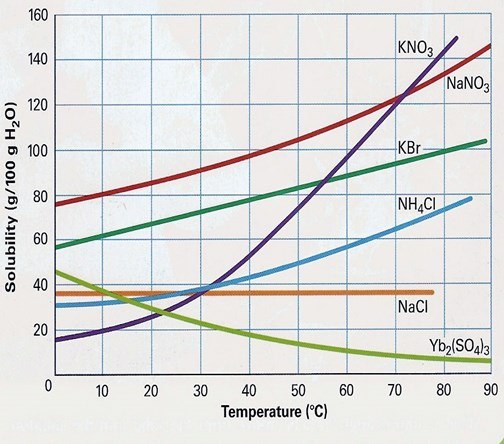
At 30'C, which substance has the lowest solubility?
KNO3
KBr
NaCl
Yb2(SO4)3
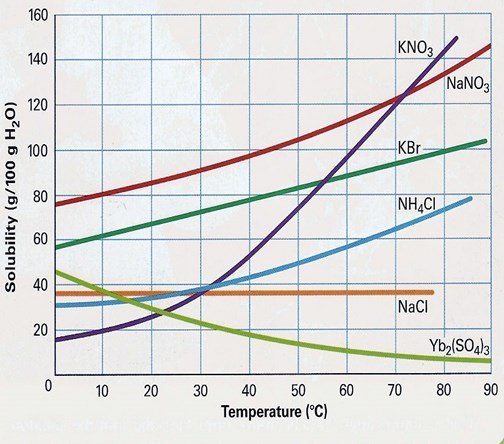
At which temperature do KBr and KNO3 have the same solubility?
60
55
50
Never
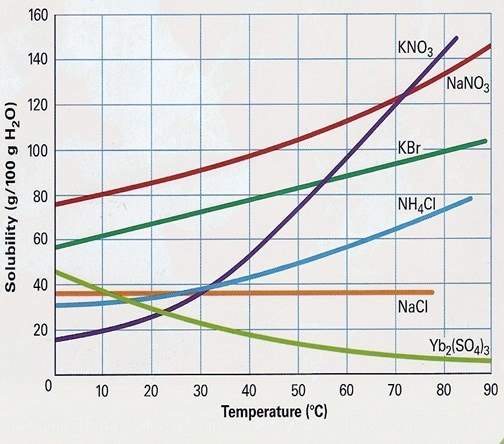
Determine the solubility for the substances at 55'C and arrange them in order from lowest to highest solubility.
NaCl, NH4Cl, KBr, NaNO3
NaCl, NH4Cl, NaNO3, KBr
NH4Cl, NaCl, NaNO3, KBr
NaNO3, KBr, NH4Cl, NaCl

When suffering from heartburn, one will need to take a medicine that is...
neutral to alleviate the acid burn
alkaline to alleviate the acid burn
acidic to alleviate the acid burn
supersaturated to alleviate the acid

Human blood needs to maintain a pH of this to keep us alive.
7.35-7.45
as close to 0 as possible
7.8 or higher
6.8 or lower

To help maintain our blood's pH level, we have _______ to keep our body in equilibrium.
buffers
friends
enzymes
antacids

This solution is known as the "universal solvent" because of its ability to dissolve so many substances.
water
acid
bases
Kool-aid

