
 Worksheets
B2 - Transport
Total questions: 23
Worksheet time: 16mins
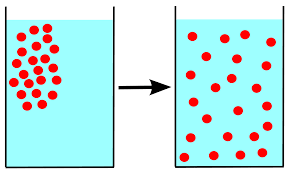


Osmosis needs _____ energy.
zero
a lot of
10 kilowatts
some
_____ is the amount of a given substance contained in a solution
concentration
equilibrium
diffusion
facilitated diffusion

If the dots represent sugar, what direction will water flow?
Into the cell
Out of the cell
Into and out equally (equilibrium)
Which cell would water move into?


The diagram represents two liquids separated by a membrane through which osmosis can occur. What movement of molecules will occur.
Molecules of the dissolved substance move from left to right
Molecules of dissolved substance move from right to left
Overall, water molecules move from left to right
Overall, water molecules move from right to left

The diagram shows a plant cell before and after being placed in liquid X for 30 minutes, and an animal cell before and after being placed in liquid Y for 30 minutes. What describes liquids X and Y?
X: Concentrated solution, Y: Concentrated solution
X: Concentrated solution, Y: Pure water
X: Pure water, Y: Concentrated solution
X: Pure water, Y: Pure water

Which diagram shows the appearance of a plant cell after it is placed in distilled water.
A
B
C
D

Which diagram shows the appearance of a plant cell several minutes after it has been placed in a concentrated solution of sugar?
A
B
C
D

The diagram shows a plant cell that has been placed in a concentrated solution for 30 minutes.What identifies X and Y?
X: cell membrane, Y: air
X: cell membrane, Y: concentrated solution
X: cell wall, Y: air
X: cell wall, Y: concentrated solution

The diagram shows an experiment using a potato. Which shows the result after 24 hours?
A
B
C
D

The diagram shows a freshly cut potato strip, a strip suspended in liquid X and one suspended in liquid Y. What identifies the liquids?
X: Concentrated sugar solution, Y: very dilute sugar solution
X: pure water, Y: dilute sugar solution
X: Dilute sugar solution, Y: Concentrated sugar solution
X: pure water, Y: concentrated sugar solution

The diagram shows two solutions that are separated by a partially permeable membrane. In which direction will most water molecules move in relation to their concentration gradient?
From X to Y against the water potential gradient
From X to Y down the water potential gradient
From Y to X against the water potential gradient
From Y to X down the water potential gradient
Which liquid has a higher water potential?
A dilute sucrose solution
A concentrated salt solution
A concentrated sugar solution
A very concentrated salt solution
Which liquid has a lower water potential?
Distilled water
A dilute sugar solution
A concentrated sugar solution
A very concentrated sugar solution
Two beakers contain 50 cm3 of water. Beaker A has 1 g of salt added to it. Beaker B has 2 g of salt added to it. Which statements correctly compare the beakers?
Beaker A is more concentrated than beaker B
Beaker A is less concentrated than beaker B
Beaker A is more dilute than beaker B
Beaker A has a higher water potential than beaker B
Beaker A has a lower water potential than beaker B

