wayground logo

Free Printable Worksheets

NEW

Font size

S
M
L
XL
Worksheets

Social Studies Yearly Review Part One

Total questions: 56

Worksheet time: 33mins

Name
Class
Date
1.

The French and Indian War happened AFTER the Stamp Act.

a)

True

b)

False

2.

England repealed (canceled) of the Stamp Act in 1766 because of Colonist protesting and rioting.

a)

True

b)

False

3.

The French and Indian War cost King George and Great Britain a lot of money. To help pay for the war, the British colonies were ordered to

a)

give up their food

b)

work for free

c)

become a part of the Army

d)

pay taxes

4.

The tax on all items in the colonies made of paper material was called the

a)

Stamp Act

b)

Sugar Act

c)

Townshend Act

d)

Boston tea Party

5.
Why were the colonists angry about "taxation without representation?"
a)
The colonists wanted to pay taxes on stamps and tea
b)
The colonists had no representation in Parliament
c)
The colonists fought to write the Declaration of Independence
d)
The colonists were loyal to the British and wanted to keep them happy
6.
What 2 countries were fighting in the French and Indian War?
a)
America and France
b)
France and Britain
c)
Britain and Germany
d)
France and Spain
7.
  What was the purpose of the Treaty of Paris in 1763?
a)
The purpose of the Treaty of Paris in 1763 was to end the Revolutionary War. 
b)
The purpose of the Treaty of Paris in 1763 was to create an agreement between Chief Pontiac and the British colonists. 
c)
The purpose of the Treaty of Paris in 1763 was to end the French and Indian War.   
d)
The purpose of the Treaty of Paris in 1763 was to recognize America as a free and independent nation.
8.
During the French and Indian War, the British and French were fighting over control of which area?
a)
Mississippi River Valley
b)
Ohio River Valley
c)
Connecticut River Valley
d)
Pennsylvania River Valley
9.

Why do you suppose the Indians and the French were allies?

a)

The French forced them to fight because the Indians were enslaved by them.

b)

The British attacked the Indians first, and the French decided to help the Indians.

c)

The French and Indians helped one another. They traded furs and goods.

d)

The French were fighting the Indians in the war.... The Indians didn't help the French at all.

10.

Why did the British think they should have control of the Ohio River Valley?​

a)

They felt that they needed the land of the Ohio River Valley. They had many settlers who wanted to farm the rich soil there.​

b)

They had been trapping animals and trading furs with Native Americans for many years and felt they had rights to the Ohio River Valley.

11.

Why did the French think they should have control of the Ohio River Valley?

a)

They had been trapping animal and trading furs with Native Americans for many years and felt they had rights to the Ohio River Valley.

b)

They felt that they needed the land of the Ohio River Valley. They had many settlers who wanted to farm the rich soil there.​

12.

Who dressed up like Native Americans and raided ships?

a)

Daughters of Liberty

b)

Sons of Liberty

c)

King George

d)

Republicans

13.

Who were the Sons of Liberty?

a)

A very peaceful group of protestors

b)

King George's sons

c)

an army made up of Loyalists

d)

Group of men that protested laws like the Stamp Act

14.

What happened at the Boston Tea Party?

a)

Sons of Liberty threw all the tea in the ocean

b)

Patriots sat and had tea with King George

c)

Native Americans threw all the tea in the ocean

d)

King George had a sale on tea

15.
What event does this drawing show?
a)
Tarring and feathering
b)
Boston Tea Party
c)
Boston Massacre
d)
American Revolution
16.
Why did Great Britain tax the American colonies?
a)
The British were in debt from buying too many fidget spinners.
b)
The British were in debt from fighting the French in a war.
c)
The British were in looking for money to pave their roads.
17.
How did the Americans feel about the Stamp Act?
a)
Happy, because everyone loves getting stamps for good grades.
b)
Sad, because they wouldn't get to use a stamp to mail a letter to the king.
c)
Angry, because Great Britain wrote the law without them.
18.
Who was the 1st colonial protester killed in the Boston Massacre?
a)
Samuel Adams
b)
John Adams
c)
Crispus Attucks
d)
Paul Revere
19.

The snake on the flag represents . . . 

a)

The King of France

b)

13 British Colonies in North America

c)

Parliament

d)

The King of England

20.
After Shay's rebellion, America decided that--
a)
They needed a stronger national government
b)
Give farmers more money
c)
They needed a weaker national government
d)
farmers need more land
21.
The Great Compromise was a compromise between--
a)
Mass. Plan and New Jersey Plan
b)
Virginia Plan and New Jersey Plan
c)
Virginia Plan and New York Plan
d)
Virginia Plan and Delaware Plan
22.
The Virginia Plan wanted representation based on--
a)
population
b)
equality for every state
c)
state size
d)
money
23.
The New Jersey Plan wanted representation in government based on--
a)
population
b)
equality for every state
c)
state size
d)
money
24.
What kind of congress did the Great Compromise establish?
a)
1 House that controls everything
b)
2 Houses that have no power
c)
2 Houses that both vote on laws
d)
1 House that has no power
25.
How many slaves were counted for representation and taxation?
a)
Every slave was counted.
b)
Out of 4 slaves, only 3 were counted.
c)
Out of 100 slaves, only 3 were counted.
d)
Out of 5 slaves, only 3 were counted.
26.
Farmers were made because they could not pay their...
a)
taxes
b)
debt
27.
James Madison said "We need to rebuild the republics based on a central government that is ________ than the states."
a)
stronger
b)
weaker
28.
Southern representatives thought ______ was too important to their economy (money or resources), so they would not get rid of it.
a)
slavery
b)
taxes
c)
debt
29.
There would be a system of checks and balances that would protect the government from any branch having ______ power.
a)
too much
b)
too little
30.
Some states did not believe that _____ should count as people.
a)
cattle
b)
babies
c)
slaves
31.
In September, 1787, the _______ was signed.
a)
Pledge of Allegiance
b)
Declaration of Independence
c)
Constitution
32.
George Washington is the 1st _____ of the United States.
a)
senator
b)
king
c)
president
33.

The beginning of the Constitution is called...

a)

Ratification

b)

Preamble

c)

Chapter 1

d)

First Amendment

34.

Nine states had to officially accept the Constitution. This is called...

a)

Nine Pin

b)

legislation

c)

ratification

d)

unification

35.

A change to the Constitution

a)

bill

b)

representation

c)

majority

d)

amendment

36.

A constitution is ...

a)

a compromise

b)

a plan for the government

c)

a republic

d)

the Bill of Rights

37.

City where the Constitution was written in 1787

a)

Philadelphia

b)

Washington D.C.

c)

New York City

d)

Yorktown

38.

Writer of the Virginia Plan; Father of the Constitution

a)

George Washington

b)

Thomas Jefferson

c)

James Madison

d)

Alexander Hamilton

39.

An agreement in which both sides give something up to settle a disagreement

a)

majority

b)

amendment

c)

compromise

d)

pinky swear

40.

First and failed plan for government for the United States of America

a)

the Mayflower Compact

b)

the Common Sense pamphlet

c)

the Treaty of Paris

d)

the Articles of Confederation

41.

Number of branches in the United States government

a)

four

b)

three

c)

two

d)

one

42.

The legislative branch

a)

writes laws

b)

enforces laws

c)

decided the fairness of laws

d)

is your in-laws

43.

Which branch of the government does the president head?

a)

the cabinet branch

b)

the executive branch

c)

the Supreme Court branch

d)

the branch called Congress

44.

If a law is unconstitutional, it may be thrown out by which branch of the government?

a)

the judicial branch

b)

the executive branch

c)

the legislative branch

d)

a veto

45.
Under the Articles of Confederation, the government consisted of _______________ branch of government.
a)
3
b)
2
c)
1
d)
4
46.
One weakness of the Articles of the Confederation was ____________. 
a)
The ability of Congress to tax.
b)
The inability of Congress to tax.
c)
The ability of Congress to declare war.
d)
The ability of Congress to create courts.
47.
Under the Articles of Confederation, America used a national currency (money)
a)
True
b)
False
48.
Under the Articles of Confederation, each state got __________ vote. 
a)
b)
2
c)
1
d)
5
49.
The Articles of Confederation created a _________________ type of government.
a)
strong
b)
average
c)
weak
d)
federal
50.
The Articles of Confederation were...
a)
the King's plan for how to govern the newly freed colonies
b)
the first Constitution
c)
the first government of the U.S.
d)
George Washington's plan for taking power as the new King
51.
The Articles of Confederation limited the government's power by...
a)
giving the most power to the president
b)
preventing Congress from printing money
c)
not allowing Congress to draft soldiers to the army
d)
imposing a 15 year term limit on all members of Congress
52.
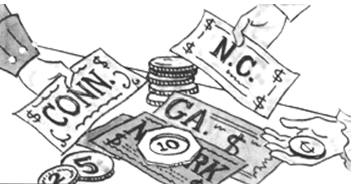
This picture shows which weakness of the Articles?
a)
no common currency
b)
no executive branch
c)
no power to tax
d)
one vote for each state
53.
In the Articles of Confederation, where was most of the government power placed?
a)
The States
b)
The National Government
c)
The Continental Congress
d)
The Legislative Branch
54.
Who led the farmers against the government of Massachusetts?
a)
Daniel Shays
b)
the Government
c)
all of the farmers were leaders
d)
Thomas Hobbes
55.

Who was the president under the articles?

a)

George Washington

b)

Each governor voted on a president

c)

The most senior Senator

d)

There wasn't one

56.

The main cause for many of the rules in the Articles of Confederation was that the delegates at the Continental Congress...

a)

did not want to give the states too much power because they'd proven they were willing to rebel against a government.

b)

wanted to create a government that was identical to England's government.

c)

were concerned about giving the central government too much power because the King had used his power unfairly.

d)

wanted to unify the states together, which included creating one army and one type of currency.