
 Worksheets
Plate Tectonics and the Rock Cycle
Total questions: 40
Worksheet time: 1hrs 12mins
Divergent plates move _______ each other.
away from
towards
underneath of
over-top of
If a process builds up the Earth's surface it is _________.
Destructive
Constructive
Where do volcanoes most commonly form?
Along the equator.
In Earth's polar regions.
In the middle of tectonic plates.
Near tectonic plate boundaries.
Breaks in the crust called __________ form where plates meet.
mountains
rift valleys
faults
trenches

What is the correct order (starting from the surface) of Earth’s layers?
crust, outer core, inner core, mantle
mantle, outer core, inner core, crust
crust, mantle, outer core, inner core
outer core, inner core, crust, mantle
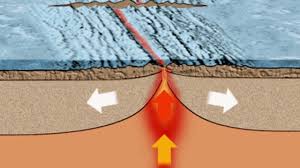
In sea-floor spreading, molten material rises from the mantle and erupts
along the edges of all the continents.
along mid-ocean ridges.
in deep-ocean trenches.
at the north and south poles.

The process by which the ocean floor sinks beneath a deep-ocean trench and back into the mantle is known as _______
convection.
continental drift.
subduction.
conduction.
The geological theory of _______ states that pieces of Earth’s lithosphere are in constant, slow motion.
subduction
plate tectonics
deep-ocean trenches
sea-floor spreading
Scientists think that convection currents flow in Earth’s
continents.
mantle.
lithosphere.
inner core.

The place where two plates come together is known as a _______
transform boundary.
divergent boundary.
convergent boundary.
rift valley.

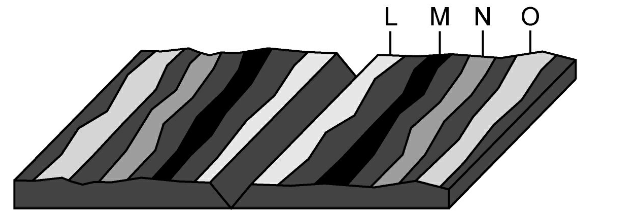
Below is a picture of sea-floor spreading. How are the ocean crusts moving?
Converging
Diverging
Sliding
No movement


Which of the following causes Earth's tectonic plates to move?
Energy from the Sun
Magnetic Pole Reversal
Convection currents in the mantle
Faults in Mountain Ranges

Islands can from from magma which is pushed up at a __________ plate boundary
Divergent
Convergent
Transform

How is it possible for new crust to be formed without increasing the surface area of the Earth?
Crust is destroyed at the same time it is created
New crust is underwater where it sinks
New crust breaks more easily than old crust

Why does oceanic crust subduct under continental crust?
Oceanic crust is thin
Oceanic crust is dense
Continental crust is thin
Continental crust is dense


Which theory helped scientists understand how and where volcanoes erupt?
Theory of Plate Tectonics
Theory or Relativity
Theory of the Rock Cycle
Big Bang Theory
A bowl shaped area that may form at the top of a volcano around the central vent
crater
vent
tube
leftovers

Which process is best illustrated by the diagram?
igneous rock formation
sedimentary rock formation
igneous rocks changing into metamorphic rocks
sedimentary rocks changing into metamorphic rocks
Which is the process that breaks up rock on Earth’s surface?
deposition
melting
compaction
weathering

what is the rock cycle.
molten rock that is stored underground.
rock material that forms where rocks are broken down into smaller pieces.
a process that changes one type of rock into another type of rock.
How are metamorphic rocks formed?
heat and pressure
melting and cooling
weathering, erosion, compaction, and cementing
Where does the heat for metamorphic rocks come from?
Magma underground
The sun
Surrounding rocks

