Wayground logo

Free Printable Worksheets

Font size

S
M
L
XL
Worksheets

Algebra 2 Advanced 2nd Semester Practice Final

Total questions: 63

Worksheet time: 4hrs 50mins

Name
Class
Date
1.

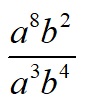
Which expression is equivalent (equal) to  (6−4)−262\frac{\left(6^{-4}\right)^{-2}}{6^2} .

a)

 666^6 

b)

 6−106^{-10} 

c)

 6−86^{-8} 

d)

 6106^{10} 

2.
a)
b)
c)
d)
3.
a)

A

b)

B

c)

C

d)

D

4.
Which of the following is the function shown in the graph?
a)
f(x)= -√(x+4) -2
b)
f(x)= √(x-4) -2
c)
f(x)= -√(x-4) -2
d)
f(x)= √(x+4) +2
5.

Which graph shows the following function?

f(x)=2  3x−4+3f\left(x\right)=2\ \ ^3\sqrt{x-4}+3  

a)
b)
c)
d)
6.
Find the domain and range of the function
Hint:  Use a scratch graph to help you visualize things. 
a)
Domain: (-∞, ∞)  Range: [-∞, 4]
b)
Domain: [1, ∞)  Range: (-∞, 4]
c)
Domain: [-1. ∞) Range: [4, ∞) 
d)
Domain: [4, ∞) Range: [-1,∞) 
7.

Rewrite the following

∛x5

a)

x3/5

b)

x5/3

c)

x2

d)

x3⋅x5

8.
 Solve the equation.
a)
36
b)
18
c)
-18
d)
27
9.
Solve for x:
(2x - 1)3/4 + 9 = 36
a)
27
b)
13
c)
41
d)
82
10.
Solve
a)
20
b)
-4
c)
4
d)
-10
11.
Multiply and Simplify
a)
(n-10)/8n+56
b)
(n-10)(n+7)/8n+56
c)
(n-10)/8
d)
(n+10)/8
12.
Divide and Simplify
a)
1/6
b)
(x+10)/ (6x+60)
c)
(x+8)/ (6x+60 )
d)
(x+10)(x+8)/ (6x+60)
13.
a)
A
b)
B
c)
C
d)
D
14.
a)
A
b)
B
c)
C
15.
Solve for r
a)
5
b)
- 5, 4
c)
- 5
d)
5, 4
16.
Solve and check for extraneous solutions
a)
x=5
b)
x= -5
c)
No Solution
17.
Identify the LCD.
a)
x2(x - 2)
b)
x(x - 2)
c)
x
d)
(x - 2)
18.

Solve for x:
 3x−7x+2>1\frac{3x-7}{x+2}>1 

a)

 (−2, 92)\left(-2,\ \frac{9}{2}\right) 

b)

 (−∞,−2)∪(92, ∞)\left(-\infty,-2\right)\cup\left(\frac{9}{2},\ \infty\right) 

c)

 (−∞,−2)∪(73, ∞)\left(-\infty,-2\right)\cup\left(\frac{7}{3},\ \infty\right) 

d)

 (−2, 73)\left(-2,\ \frac{7}{3}\right) 

19.

Solve the rational inequality and state your solution in interval notation.


 −xx−3≥0\frac{-x}{x-3}\ge0 

a)

 (0, +∞)\left(0,\ +\infty\right) 

b)

 [0, 3)\left[0,\ 3\right) 

c)

 (−∞, 0)∪(3, +∞)\left(-\infty,\ 0\right)\cup\left(3,\ +\infty\right) 

d)

 (−∞, 0]∪[3, +∞)\left(-\infty,\ 0\right]\cup\left[3,\ +\infty\right) 

20.
Which asymptote(s) are determined by looking at the denominator?
a)
vertical
b)
horizontal
c)
slant
d)
none
21.

Find the Vertical Asymptotes

a)

x=0, −2x=0,\ -2

b)

x=2x=2

c)

x=−3, 2x=-3,\ 2

d)

x=−3, 1x=-3,\ 1

22.
Find the horizontal asymptote.
a)
None
b)
y = 0
c)
y = -1/3
d)
y = -3
23.
a)
y = 0
b)
y = 1/2
c)
y = 2
d)
None
24.

What is the X-Intercept?

a)

(0,0)

b)

(4,0)

c)

(0,4)

d)

(-5,0)

25.

Find the coordinates of the hole.

a)

(-3, -3)

b)

(-3, 3)

c)

(3, -3)

d)

(3, 3)

26.

What feature is being calculated here?

a)

x-intercepts

b)

y-intercept

c)

Vertical Asymptote

d)

Horizontall Asymptote

e)

Oblique Asymptote

27.

What is the only way to actually calculate

Oblique Asymptotes ?

a)

Plug zero in for y or f(x) and solve

b)

Plug zero into all the x's and evaluate

c)

Set the Denominator equal to zero and solve

d)

Use Limits

e)

Use Polynomial Long Division

28.

What is the Horizontal Asymptote of this function?


f(x)=x4+7x3 +12x22x3+10x2f\left(x\right)=\frac{x^4+7x^{3\ }+12x^2}{2x^3+10x^2}  

a)

y = 2

b)

y = 0

c)

y = 0.5

d)

No Horizontal Asymptote. It's an Oblique Asymptote

e)

y = 1.583

29.

What is the Horizontal or Oblique Asymptote?


* Write your equations with a variable (x or y) , = , and NO spaces

(a)  
30.
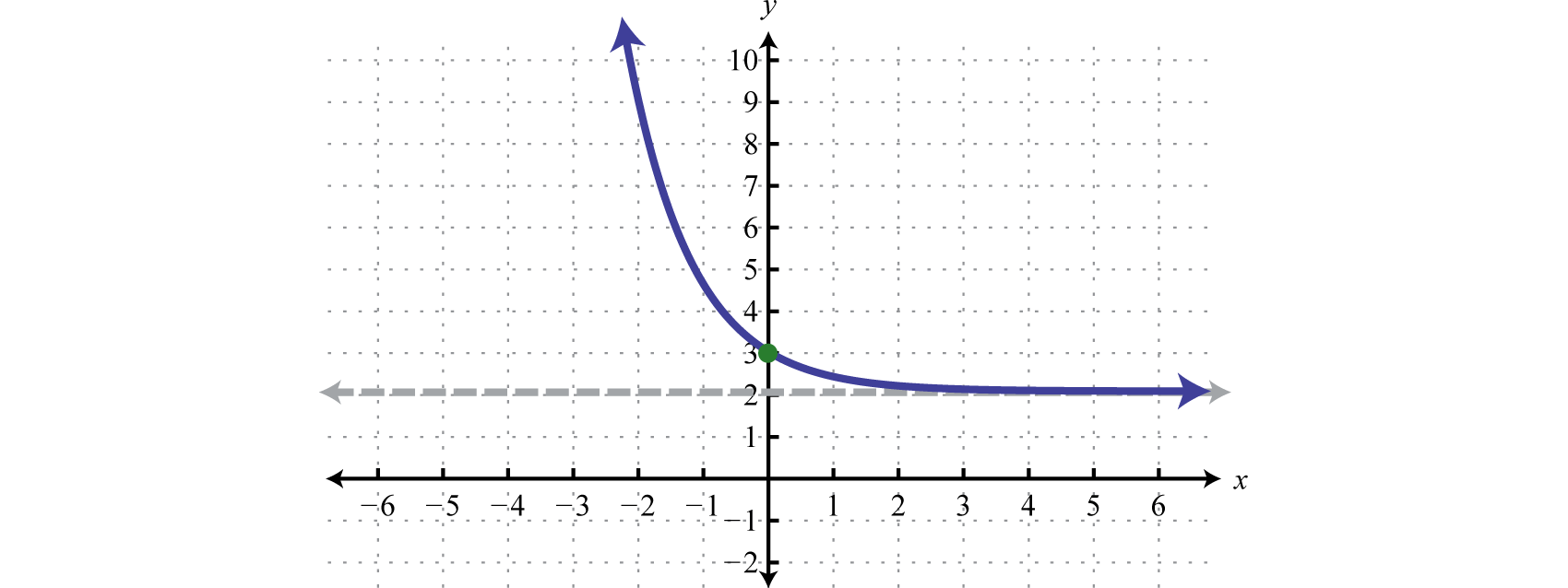
Describe the end behavior of the graph.
a)
x →∞, y→⁻∞ and x →⁻∞,y→⁻∞
b)
x →∞, y→∞ and x→⁻∞, y→∞
c)
x →∞, y→∞ and x→⁻∞, y→2
d)
x →∞,y→2 and x→⁻∞, y→∞
31.

Describe the end behavior of the function

a)

 x →∞, f(x)→⁻∞ and x →⁻∞,f(x)→⁻∞

b)

x →∞, f(x)→∞ and x→⁻∞, f(x)→∞

c)

x →∞, f(x)→∞ and x→⁻∞, f(x)→2

d)

 x →∞,f(x)→2 and x→⁻∞, f(x)→∞

32.

Is y = 5(1.04)x growth or decay?

a)

Growth

b)

Decay

33.
Is y = 4(.20)x growth or decay?
a)
Growth
b)
Decay
34.

What is the y-intercept of the function?

a)

(0, -3)

b)

(-3, 0)

c)

(1, 0)

d)

(0, 1)

35.

What is the range of the function?

a)

(0, ∞)\left(0,\ \infty\right)

b)

(−∞,0)\left(-\infty,0\right)

c)

all real numbers

36.

Describe the end behavior of the function shown: y=log2(x+1)

a)
b)
c)
37.

Describe domain of the function shown: y=log2(x+1)

a)

(-∞,∞)

b)

(-1,∞)

c)

(-1,3)

d)

(∞, -1)

38.

Describe range of the function shown: y=log2(x+1)

a)

(-∞,∞)

b)

(-1,∞)

c)

(-1,3)

d)

(∞, -1)

39.
find the asymptote: y = log10 (x+3)
a)
x=-3
b)
x=3
c)
y=-3
d)
y=3
40.
Logarithmic functions are the inverse of...
a)
Linear Functions
b)
Exponential Functions 
c)
Quadratic Functions 
d)
Polynomial Functions 
41.

Expand:  log⁡b mn\log_b\ \frac{m}{n} 

a)

 log⁡bm −log⁡bn\log_bm\ -\log_bn 

b)

 log⁡bm + log⁡b n\log_bm\ +\ \log_b\ n 

c)

 mlog⁡bnm\log_bn 

d)

 nlog⁡bnn\log_bn 

42.

Expand:  log⁡923\log_9\sqrt{23} 

a)

 12log⁡923\frac{1}{2}\log_923 

b)

 log⁡9(12)−log⁡923\log_9\left(\frac{1}{2}\right)-\log_923 

c)

 log⁡92+log⁡93\log_9\sqrt{2}+\log_9\sqrt{3} 

d)

 log⁡9 (12)+log⁡923\log_9\ \left(\frac{1}{2}\right)+\log_923 

43.

 ln⁡(2x2yz4)\ln\left(\frac{2x^2y}{z^4}\right) 

a)

ln2+2lnx+lny+4lnz

b)

ln2+2lnx+lny-4lnz

c)

2ln(2xy)-4lnz

d)

2ln2x+lny-4lnz

44.
What is the first step in finding the equation of the inverse of a function?
a)
get x by itself
b)
switch x and y
c)
solve for y
d)
write the function in inverse function notation
45.
The inverse has been reflected over which line?
a)
y = x
b)
y =1
c)
y = 0
d)
y = x + 1
46.
Are these functions inverses of each other?
a)
Yes
b)
No
47.
a)
A
b)
B
c)
C
d)
D
48.
log9(10)-log9(x-3) =log9(72)
a)
81/16
b)
113/36
c)
No Solution
d)
92/15
49.

Solve for x.
log⁡8(x)+log⁡8(x+2)=1\log_8\left(x\right)+\log_8\left(x+2\right)=1  

a)

2, 13

b)

2, -4

c)

4

d)

2

50.

Solve for x.
log⁡3(x−4)−log⁡3(x)=1\log_3\left(x-4\right)-\log_3\left(x\right)=1  

a)

-2

b)

0

c)

1

d)

No solution

51.
Sovle for x:
5-3x - 1 = 25
a)
x = -1
b)
x = -4
c)
x = -3
d)
x = 1
52.
7n+10- 8 = 6
a)
-7.374
b)
-8.643
c)
-7.360
d)
-8.853
53.
log(x+6) = 1
a)
4
b)
4.222
c)
-5
d)
-9.550
54.

Write an exponential function that goes through points (2, 12) and (7, 384).

a)

 y=34⋅4xy=\frac{3}{4}\cdot4^x 

b)

 y=0.375⋅32xy=0.375\cdot32^x 

c)

 y=3⋅2xy=3\cdot2^x 

d)

 y=2⋅3xy=2\cdot3^x 

55.

Write an exponential function that goes through points (0, 4) and (2, 324).

a)

y=4(9)xy=4(9)^x

b)

y=9(4)xy=9(4)^x

c)

y=2(4)xy=2(4)^x

d)

y=4(81)xy=4(81)^x

56.

What does the n stand for in this formula?

a)

Initial amount

b)

Final amount

c)

Rate

d)

Time

e)

The number of times compounded per year

57.
Change 6.75% to a decimal.
a)
67.5
b)
.675
c)
675
d)
.0675
58.

You invest $1600 at an annual interest rate of 4.6% compounded continuously. How much will you have in the account after 4 years.

a)

$1,923.23

b)

$10,138.07

c)

$6,701.28

d)

$800.26

59.

Chelsea put $7500 into an account paying 5% compounded continuously. She now has $10,643.01. How long has the money been in the account?

a)

7 years

b)

6 years

c)

5 years

d)

4 years

60.

At 4% annual interest compounded quarterly, how long will it take to double your money?

a)

0.4 yrs

b)

16.4 yrs

c)

17.4 yrs

d)

18.4 yrs

61.

Solve the system:

2x + y + z = -5

3y + z = 13

z = 4

a)

not enough information

b)

(-1, 3, 4)

c)

(-6 , 3, 4)

d)

(1, 3, 4)

62.
a)
A
b)
B
c)
C
d)
D
63.

Find the solution(s) to the system.

a)

(0,-3)(-1,-2)

b)

(0,-3)

c)

(-2,0)(2,0)

d)

No solution