wayground logo

Free Printable Worksheets

Font size

S
M
L
XL
Worksheets

Topic 6 Review (8CC [enVision])

Total questions: 118

Worksheet time: 30hrs 30mins

Name
Class
Date
1.
What Transformation is visible?
a)
Translation
b)
Rotation
c)
Reflection
d)
Dilation
2.
What Transformation is visible?
a)
Reflection
b)
Translation
c)
Dilation
d)
Rotation
3.
What Transformation is visible?
a)
Translation
b)
Rotation
c)
Dilation
d)
Reflection
4.
What Transformation is visible?
a)
Dilation
b)
Translation
c)
Reflection
d)
Rotation
5.
What Transformation is visible?
a)
Reflection
b)
Rotation
c)
Dilation
d)
Translation
6.
What Transformation is visible?
a)
Dilation
b)
Rotation
c)
Reflection
d)
Translation
7.
What Transformation is visible?
a)
Reflection
b)
Translation
c)
Rotation
d)
Dilation
8.
What Transformation is visible?
a)
Translation
b)
Reflection
c)
Rotation
d)
Dilation
9.
What Transformation is visible?
a)
Rotation
b)
Dilation
c)
Reflection
d)
Translation
10.
What Transformation is visible?
a)
Dilation
b)
Refection
c)
Translation
d)
Rotation
11.
What Transformation is visible?
a)
Translation
b)
Relfection
c)
Dilation
d)
Rotation
12.
What Transformation is visible?
a)
Dilation
b)
Translation
c)
Reflection
d)
Rotation
13.
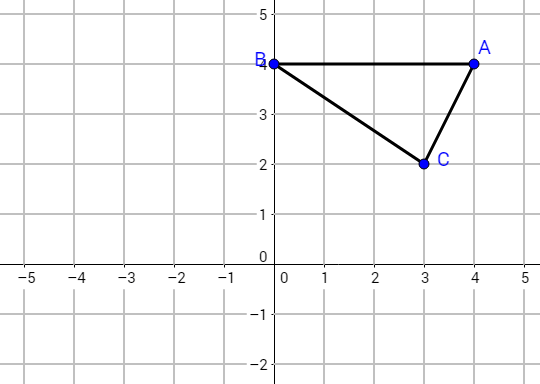
Triangle ABC is going to be translated. How is ABC being translated if the rule (x,y) --> (x+3, y-2) is used?
a)
3 up and 2 left
b)
3 right and 2 down
c)
3 left and 2 up
d)
3 right and 2 up 
14.
Which answer represents a reflection across the x-axis, using the algebraic rule (x,y) --> (x, -y)?
a)
d
b)
c
c)
b
d)
a
15.
Identify the transformation from ABC to A'B'C'.
a)
90o clockwise rotation
b)
90o counter clockwise rotation
c)
Reflection across the y-axis
d)
Reflection across the x-axis
16.
a transformation that changes the size of a figure, but not the shape
a)
translation
b)
rotation
c)
reflection
d)
dilation
17.
Identify the transformation from ABCD to A'B'C'D'.
a)
Translation
b)
Reflection across the x-axis
c)
Reflection across the y-axis
d)
90o counter clockwise rotation
18.
When you translate
(x-2 , y + 6) the figure will move _____.
a)
2 units right and 6 units right
b)
2 units left and 6 units down
c)
2 units left and 6 units up
d)
2 units left 6 units right
19.
What does a translation do to an image?
a)
Turns it 90* clockwise
b)
Mirrors it
c)
Shrinks it
d)
Slides it
20.
Which rule would result in a reflection in the x-axis?
a)
(x, y) → (2x, 2y)
b)
x, y) → (x + 4, y + 4)
c)
(x, y) → (y, -x)
d)
(x, y) → (x, -y)
21.
What type of transformation is quadrilateral PQRS?
a)
Translation 4 units right
b)
Rotation around the origin
c)
Reflection over the x-axis
d)
Reflection over the y-axis
22.
When you translate,
(x - 4, y + 3) the figure will move _____.
a)
4 units left and 3 units right
b)
4 units left and 3 units up
c)
4 units down and 3 units up
d)
4 units down and 3 units down
23.
How is triangle ABC being translated to triangle A'B'C'?
a)
(x, y) --> (x - 8, y + 3 )
b)
(x, y) -->(x - 4, y - 9) 
c)
(x, y) --> (x + 8, y - 3) 
d)
(x, y) --> (x+ 4, y - 9) 
24.
What transformation is happening to the red triangle to get to the blue triangle?
a)
Translation
b)
Rotation
c)
Reflection
d)
Dilation
25.
Determine where T' would be if you translated T three units to the right and six units up.
a)
(5, 1)
b)
(2, -5)
c)
(-1, 1)
d)
(8, -2)
26.
Determine where X' would be if you translated X three units to the left and nine units down.
a)
(-4, 4)
b)
(-10, 2)
c)
(-4, -5)
d)
(-1, 5)
27.
A slide is also called a _________.
a)
Translation
b)
Reflection
c)
Rotation
d)
Transformation
28.
A turn is also called a ___________.
a)
Translation
b)
Reflection
c)
Rotation
d)
Transformation
29.
Name the transformation.
a)
Translation
b)
Reflection
c)
Rotation
30.
When you translate, (x-4,y) will move _____.
a)
4 units right
b)
4 units left
c)
4 units up
d)
4 units down
31.
Write a rule for the translation.
a)
 (x -1, y  + 2)
b)
 (x -2, y  + 1)
c)
 (x +2, y  - 1)
d)
(x +1, y  -  2)
32.
Identify the transformation.
a)
Reflection across y-axis
b)
90 Rotation counter clockwise
c)
Translation 5 units left, 1 unit up.
d)
Translation 5 units right, 1 unit down
33.
The image shows what type of transformation
a)
Rotation
b)
Translation
c)
Reflection
34.
What is this picture an example of? 
a)
An angle
b)
A cat vertex 
c)
Rotation 
35.
Rotation or Reflection
a)
Rotation
b)
Reflection
c)
translation
36.
Is the picture being reflected in the y-axis or x-axis?
a)
y-axis
b)
x-axis
37.
Identify the transformation from C to D.
a)
90o Clockwise Rotation
b)
180o Rotation
c)
270o Clockwise Rotation
d)
360o Rotation
38.
Identify the transformation.
a)
Reflection across y axis
b)
Reflection across x-axis
c)
180 Rotation
d)
Translation 2 units down
39.
Triangle ABC will be dilated by a scale factor of 1/2.  What will be the coordinates of C'?
a)
(-1, -2.5)
b)
(12, 6)
c)
(3, -1.5)
d)
(0, 1.5)
40.
Enlargement or reduction?  Find the scale factor!
a)
It's a reduction; the scale factor is 2.
b)
It's an enlargement; the scale factor is 2.
c)
It's an enlargement; the scale factor is 1/2.
d)
It's a reduction; the scale factor is 1/2.
41.
State the line of reflection.
a)
Reflection across y-axis
b)
Reflection across x-axis
c)
Reflection across x = 1
d)
Reflection across y = 1
42.
If the dotted figure is the image, the original figure was reflected over the ...
a)
x-axis
b)
y-axis
43.
If the dotted figure is the image, the original figure was reflected over the ...
a)
x-axis
b)
y-axis
44.
If the scale factor is greater than 1, the dilation is...
a)
an enlargement
b)
a rotation
c)
a translation
d)
a reduction
45.
If the scale factor is less than 1, the dilation is...
a)
an enlargement
b)
a translation
c)
a rotation
d)
a reduction
46.

What type of transformation is this?

a)

Rotation

b)

Reflection

c)

Translation

d)

Enlargement

47.

What type of transformation is this?

a)

Rotation

b)

Reflection

c)

Translation

d)

Enlargement

48.

Determine how to translate triangle ABC to triangle A'B'C'.

a)

(x+2, y-5)

b)

(x-2, y+9)

c)

(x-2, y-9)

49.
When you translate, (x-4,y) will move _____.
a)
4 units right
b)
4 units left
c)
4 units up
d)
4 units down
50.
When you translate, (x,y+6) will move _____.
a)
6 units right
b)
6 units left
c)
6 units up
d)
6 units down
51.

A dilation produces a similar figure

a)

True

b)

False

52.

When the scale factor of a dilation is less than one, the dilation is a...

a)

Reduction

b)

Enlargement

53.

If an image is dilated by a scale factor below, the dilation is a...

k = 103k\ =\ \frac{10}{3}  

a)

Reduction

b)

Enlargement

54.
Choose the correct scale factor:
a)
2
b)
3
c)
1/3
d)
1/2
55.

Dilate Point C by a scale factor of 3:

a)

(12,0)

b)

(12,12)

c)

(1, 2/3)

d)

(9, 6)

56.

Does the image show a Dilation and what is the scale factor?

a)

Yes; k = 2

b)

Yes; k = 1/2

c)

No, it's a translation.

d)

No, it's a reflection.

57.
Dilate the figure by a scale factor of 3 with the origin as the center of dilation. What are the coordinates of the image?
A(3,3) B(6,6) C(9,3)
a)
A'(9,9) B'(18,18) C'(27,9)
b)
A'(6,6) B'(9,9) C'(12,6)
c)
A'(0,0) B'(3,3) C'(6,0)
d)
A'(1,1) B'(2,2) C'(3,1)
58.

If a line segment has a length of 12 units and after a dilation the image length is 4 units, what was the scale factor?

a)

3

b)

1/3

c)

8

d)

16

59.
The __________ is the ratio of a length of the new figure to the corresponding length on the original figure.
a)
reduction
b)
enlargement
c)
scale factor
d)
center of dilation
60.
If a dilation produces a congruent figure, then the scale factor was equal to _____.
a)
1/2
b)
2
c)
10
d)
1
61.

What is the scale factor?

a)

k = 2

b)

k = 1/2

c)

k = 4

d)

k = 1/4

62.

Which function was used to produce the image?

a)

f(x, y) = (1/7x, 1/7y)

b)

f(x, y) = (7x, 7y)

c)

f(x, y) = (4x, 4y)

d)

f(x, y) = (8x, 8y)

63.
What scale factor was used to produce the image?
a)
2
b)
-2
c)
1/2
d)
1
64.
The red triangle has been dilated by a scale factor of 1/4 about the origin, which triangle is it's new image? 
a)
green triangle 
b)
red triangle 
c)
black triangle
d)
none of these 
65.
Matching sides are called
a)
Corresponding Sides
b)
Corresponding Angles
c)
The Same
d)
Congruent Sides
66.
Matching angles are called
a)
Corresponding Sides
b)
Corresponding Angles
c)
The Same
d)
Congruent Angles
67.
What is congruency?  
a)
Same size and shape 
b)
Same size
c)
segment 
d)
congruent 
68.
∆ABC≅∆XYZ
which is true?
a)
AB≅XY
b)
AB≅YX
c)
AB≅XZ
d)
BC≅CB
69.

If ∆LMK ≅ ∆LMT, then

∠K ≅ ____

a)

MT

b)

∠T

c)

∠M

d)

∠L

70.
PICK THE CORRECT CONGRUENCE STATEMENT
a)
∆TUV ≅ ∆EUV
b)
∆VUT ≅ ∆UVE
c)
∆TUV ≅ ∆UEV
d)
∆UTV ≅ ∆EUV
71.
All corresponding angles in congruent figures are congruent.  
a)
True
b)
False
72.
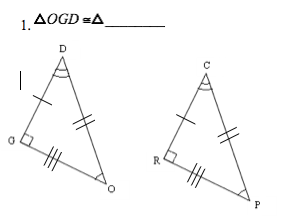
Complete the congruence statement.
a)
CRP
b)
PCR
c)
RPC
d)
PRC
73.
How can you tell which Angles are congruent from ∆DEF ≅ ∆ZXY?
a)
I can not tell without a diagram.
b)
I can not tell without measurements given.
c)
I looked at the letters in corresponding positions.
d)
The letters closer to the beginning of the alphabet match and the letters closer to the end of the alphabet match.
74.

Determine the relationship of the figures.

a)

Congruent

b)

Not Congruent

c)

Similar

75.

Polygon ABGH ≅ polygon CDEF. What is the m<G?

a)

90o

b)

75o

c)

105o

d)

62o

76.

Which statement is always true about two congruent polygons?

a)

Corresponding sides are always congruent.

b)

Corresponding angles are always right angles.

c)

Corresponding sides are always parallel.

d)

Corresponding sides are proportional.

77.

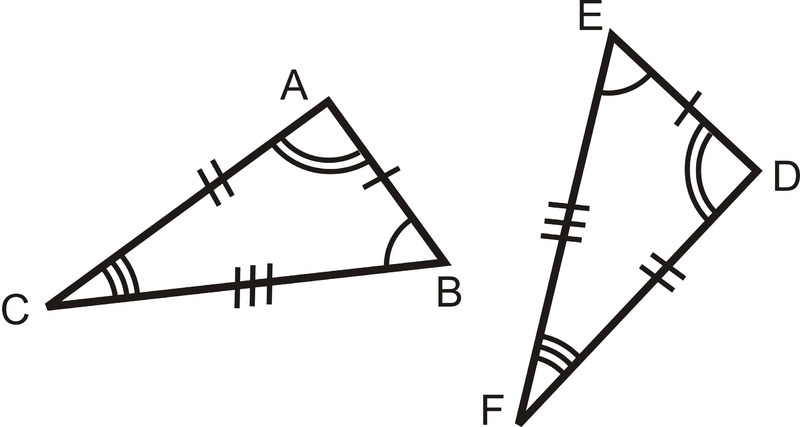
Determine whether the two figures are congruent.

a)

Yes, corresponding sides are congruent.

b)

Yes, corresponding angles are congruent.

c)

Yes, corresponding sides and corresponding angles are congruent.

d)

No, the two figure are not congruent.

78.

Determine the relationship of the figures.

a)

Congruent

b)

Not Congruent

c)

Similar

79.

Determine the relationship of the figures.

a)

Congruent

b)

Not Congruent

c)

Similar

80.

Determine the relationship of the figures.

a)

Congruent

b)

Not Congruent

c)

Similar

81.

Determine the relationship of the figures.

a)

Congruent

b)

Not Congruent

c)

Similar

82.
If ΔABC ≅ ΔXYZ, which statement is always true?
a)
AB = YZ
b)
∠C ≅ ∠Z
c)
∠B ≅ ∠C
d)
AC = XY
83.
Remember order matters. Which of the following is true?
a)
∆JLK ≅ ∆XWJ
b)
∆LJK ≅ ∆JWX
c)
∆JKL ≅ ∆JXW
d)
∆LKJ ≅ ∆JXW
84.

Given ΔEFIΔHGI\Delta EFI\cong\Delta HGI  

Complete the following: <F<F\cong ______  

a)

H

b)

I

c)

G

d)

not congruent to another angle

85.

Based on this diagram, which statement is not true?

a)

<B<F<B\cong<F

b)

CDGH\overline{CD}\cong\overline{GH}

c)

<E<A<E\cong<A

d)

BCFE\overline{BC}\cong\overline{FE}

86.

ΔXYZΔRST\Delta XYZ\cong\Delta RST  
Find the value of x.

a)

17.5

b)

25

c)

30

d)

15.5

87.

ΔXYZΔRST\Delta XYZ\cong\Delta RST  

Find the value of y (lowercase).

a)

2

b)

7

c)

15

d)

30

88.

ABCDEFGHABCD\cong EFGH  

Find the value of x

a)

4

b)

6

c)

8

d)

10

89.

What statement is needed to prove that the polygons are congruent?

a)

JQQL\overline{JQ}\cong\overline{QL}  

b)

KLNP\overline{KL}\cong\overline{NP}  

c)

<L<L<L\cong<L  

d)

<N<K<N\cong<K  

90.

Find m<Tm<T  


a)

41°41\degree  

b)

65°65\degree  

c)

74°74\degree  

d)

82°82\degree  

91.

Which two figures are similar?

a)

B and E

b)

B and D

c)

A and D

92.

If the figures shown are congruent, what is the measure of angle y?

a)

49.5

b)

99

c)

63

d)

148.5

93.

Which statement is true?

a)

A and B are congruent

b)

C and D are congruent

c)

A and B are similar

d)

C and D are similar

94.

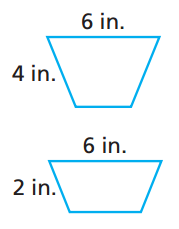
Are these figures congruent or similar?

a)

congruent

b)

similar

95.

Congruent figures have the same shape and size.

a)

True

b)

False

96.

These two figures are similar. What is the measure of x?

a)

12

b)

3

c)

9

97.
All angles in similar figures are congruent.  
a)
True
b)
False
98.
Are the following similar? Why or why not?
a)
Yes
b)
No, the corresponding angles are not equal.
c)
No, the ratios of the corresponding sides are not equal.
99.
Are the following similar? Why or why not?
a)
Yes. All pairs of corresponding angles are congruent.
b)
No, the corresponding angles are not equal.
c)
No, the ratios of the corresponding sides are not equal.
100.
Translations are always _______
a)
Congruent
b)
Bigger
c)
Smaller
d)
Rotated
101.

Congruent shapes have the same...

a)

Size

b)

Color

c)

Shape

d)

Rotation

102.
Sides in similar figures must be proportional.  
a)
True
b)
False 
103.

Which of the following is the description of the rigid motions which map ΔEFG to Δ​MNO?

a)

A translation 4 units to the left and 5 units​ down, followed by a reflection across the​ y-axis

b)

A translation 4 units to the left and 5 units​ down, followed by a reflection across the​ x-axis

c)

A translation 5 units to the left and 4 units​ down, followed by a reflection across the​ y-axis

d)

A translation 5 units to the left and 4 units​ down, followed by a reflection across the​ x-axis

104.

Describe a sequence of transformations that maps ΔDEF to ΔD′E′F′.

a)

A reflection across the​ x-axis followed by a translation 4 units left and 5 units up

b)

A reflection across the​ y-axis followed by a translation 1 unit left and 1 unit down

c)

A 90° rotation followed by a translation 1 unit left and 1 unit down

d)

A translation 5 units left and 1 unit down

105.

Describe a sequence of transformations that maps quadrilateral ABCD to quadrilateral A′B′C′D'.

a)

A rotation of 180° about the origin followed by a translation 3 units left and 7 units up.

b)

A reflection across the​ line x = -2 and a translation 2 units left.

c)

A rotation of 180° about the origin followed by a translation 2 units right and 7 units up.

d)

A translation 5 units left and 1 unit down

106.

Describe a sequence of transformations that maps quadrilateral ABCD to quadrilateral A′B′C′D'.

a)

A rotation of 180° about the origin followed by a translation 3 units left and 7 units up.

b)

A reflection across the​ line x = -2 and a translation 2 units left.

c)

A rotation of 180° about the origin followed by a translation 2 units right and 7 units up.

d)

A translation 5 units left and 1 unit down

107.

Describe a sequence of transformations that maps ΔXYZ to ΔX′Y′Z′.

a)

A reflection across the​ x-axis followed by a translation 8 units left and 1 unit up

b)

A reflection across the​ y-axis followed by a translation 3 units right and 6 units down

c)

A translation 7 units left and 6 units down

d)

A 90° rotation followed by a translation 3 units left and 6 units down

108.

A small store is rearranging its furniture. Describe the sequences of transformations the employees can use to rearrange the furniture.

a)

They can use​ translations, rotations,​ and/or reflections. There are no limits to the way the furniture can be arranged.

b)

They can only use rotations. A piece of furniture cannot be translated or reflected in the real world.

c)

They can only use translations. A piece of furniture cannot be rotated or reflected in the real world.

d)

They can use translations​ and/or rotations.​ However, they cannot use reflections. A piece of furniture cannot be reflected in the real world.

109.

Describe the sequence of rigid motions that maps figure ABCD to HIJK.

a)

A reflection across the​ x-axis followed by a translation of 4 units to the left and 2 units down

b)

A reflection across the​ x-axis followed by a translation of 5 units to the left and 3 units down

c)

A reflection across the​ y-axis followed by a translation of 4 units to the left and 2 units down

d)

A reflection across the​ y-axis followed by a translation of 3 units to the left and 4 units down

110.

What sequence of transformations maps ΔQRS to Δ​ABC?

a)

A reflection across the​ x-axis, followed by a rotation of 90° about the​ origin, and then a translation 3 units down

b)

A reflection across the​ x-axis, followed by a rotation of 90° about the​ origin, and then a translation 3 units right

c)

A rotation of 90° about the​ origin, followed by a translation 3 units​ right, and then a reflection across the​ y-axis

d)

A rotation of 90° about the​ origin, followed by a translation 3 units​ left, and then a reflection across the​ y-axis

111.
Describe a sequence of transformations that maps figure A onto figure B.
a)
A translation 4 units right followed by a reflection across the x-axis
b)
A reflection across the x-axis followed by a reflection across the y-axis
c)
A reflection across the y-axis followed by a translation 6 units down
d)
A 90° counter-clockwise rotation about the Origin followed by a reflection across the y-axis
112.
Describe a sequence of transformations that maps 
Triangle ABC onto Triangle A"B"C".
a)
A 180° rotation about the Origin followed by a reflection across the y-axis
b)
A reflection across the y-axis followed by a reflection across the x-axis and another reflection across the y-axis
c)
A translation 8 units right and 6 units down followed by a reflection across the y-axis
d)
A reflection across the x-axis followed by a translation 2 units to the left
113.

What is the angle of rotation about the origin that maps ΔPQR to Δ​P'Q'R'?

a)

90o

b)

-90o

c)

180o

d)

270o

114.

Is Δ​X'Y'Z' a rotation of Δ​XYZ? Explain.

a)

No. While the​ size, shape, and orientation are the​ same, the transformation used was a translation.

b)

Yes. The​ size, shape, and orientation are the same. Rays connecting the origin with corresponding points show an angle of rotation of 90° counterclockwise about the origin.

c)

No. While the​ size, shape, and orientation are the​ same, the transformation used was a reflection.

d)

No. The​ size, shape, and orientation of each triangle are not all the same.

115.

Which words below describe the​ mapping?

a)

ΔA′B′C′ is the image of ΔABC after a reflection across the line x = -2.

b)

ΔA′B′C′ is the image of ΔABC after a reflection across the​ x-axis.

c)

ΔA′B′C′ is the image of ΔABC after a reflection across the​ y-axis.

d)

ΔA′B′C′ is the image of ΔABC translated 2 units horizontally.

116.

Quadrilateral WXYZ is translated to quadrilateral W′X′Y′Z′. Write a rule that describes the translation.

a)

(x,y)→​(x−10​,y+8​)

b)

(x,y)→​(x+10​,y−8​)

c)

(x,y)→​(x−8​,y+10​)

d)

(x,y)→​(x+8​,y−10​)

117.

A rain gutter along the edge of a roof has the shape of a rectangular prism. It is 7 inches high and 18 feet long. It has a volume of 7,560 cubic inches. How wide is the​ gutter?

a)

1080

b)

60

c)

5

d)

4

118.
Describe a sequence of transformations that does NOT map Triangle PQR onto Triangle P'Q'R'.
a)
A reflection across the x-axis followed by a reflection across the y-axis
b)
A reflection across the y-axis followed by a reflection across the x-axis
c)
A 180° rotation about the origin followed by a translation 1 unit down
d)
A translation 3 units down followed by a reflection across the y-axis