wayground logo

Free Printable Worksheets

Font size

S
M
L
XL
Worksheets

Tech Final Exam 2023-1

Total questions: 100

Worksheet time: 3hrs 50mins

Name
Class
Date
1.

Which of the following is an example of a hidden line?

a)

________ __ __ __________

b)

__ ___ ___ ___ __ __ __ __

c)

________________________

d)

_____________ __ __________

2.
How many views are usually shown in an orthographic projection?
a)
3 views
b)
6 views
c)
9 views
d)
11 views
3.
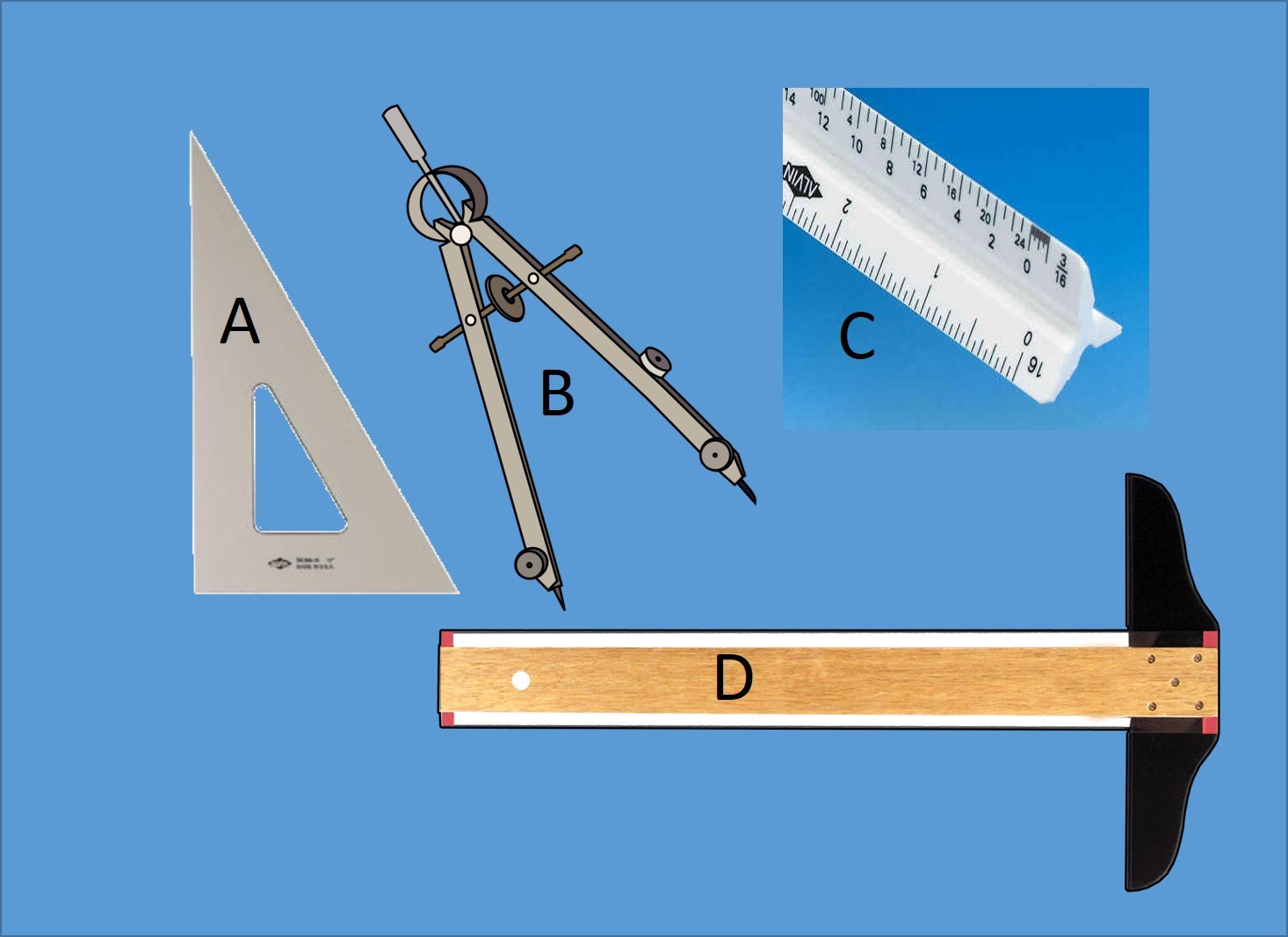
What is this Drafting Tool?
a)
30-60-90 Triangle
b)
45 Triangle
c)
Plastic Slope
d)
Right Triangle
4.
What is this Drafting Tool?
a)
30-60-90 Triangle
b)
45 Triangle
c)
Plastic Slope
d)
Right Triangle
5.
What is this Drafting Tool?
a)
Ruler
b)
Tri-Ruler
c)
Scale
d)
Straight Edge
6.
Which tool is used for creating horizontal lines?
a)
A
b)
B
c)
C
d)
D
7.
Which two tools are used for creating straight lines?
a)
A & B
b)
B & D
c)
C & A
d)
D & A
8.
a)
Break Line
b)
Center Line
c)
Dimension Line
d)
Hidden Line
9.

The __________and the___________are both used to measure objects in feet and inches?

a)

architect scale, engineer's scale

b)

ruler, metric scale

c)

engineer's scale, metric scale

d)

architect scale, potractor

10.

Select the correct orthographic view for A?

a)

1

b)

2

c)

10

d)

6

11.
Which drafting tool is a guide for drawing horizontal lines?
a)
T-square
b)
Compass
c)
Protractor
d)
Triangle
12.

The difference between a sketch and technical drawing is...

a)

The use of tools

b)

No difference

c)

A sketch has a 3D perspective

d)

The use of a pencil

13.

If you really enjoy Computer-Aided Technical Drawing, a career where you take technical specifications and create technical drawings is called...

a)

Drafting

b)

Architect

c)

Engineer

d)

Technical Illustrator

14.

Which tool allows vertical lines to be easily drawn?

a)

Triangles

b)

Protractor

c)

Compass

d)

Scale

15.

What symbol is this?

a)

radius

b)

ghost busters

c)

semi-circle

d)

diameter

16.

This is a vertical line.

a)

True

b)

False

17.

What kind of drawing is this?

a)

an oblique

b)

an orthographic

c)

a cavalier

d)

a cartoon

18.

This is a _______________ dimension.

a)

diameter

b)

radius

c)

linear

d)

aligned

19.

We don't use sketches anymore.

a)

True

b)

False

20.

Which ANGLE of PROJECTION do we us in the United States?

a)

1st Angle

b)

2nd Angle

c)

3rd Angle

d)

4th Angle

21.

This line is vertical:

a)

True

b)

False

22.

Tossing or throwing items such as pencils, erasers, and paper is_____________________

a)

OK as long as you are away from other students.

b)

never permitted in the classroom

23.

Any accidents or injuries occurring in the classroom

a)

should be reported to the instructor immediately

b)

requires that an accident report be filed

c)

may seem minor but could become serious if left untreated

d)

all of the above

24.

Don’t horseplay in the drafting classroom. Horseplay ________________ . ( choose the best answer )

a)

causes accidents

b)

wastes time

c)

keeps others from working

d)

makes too much noise

25.

When lifting something from the floor, use the muscles in your ______________

a)

arms

b)

back

c)

legs

d)

shoulders

26.

When the fire alarm sounds, what does it mean?

a)

run

b)

sit still

c)

exit the building immediately

d)

walk down the hall looking for help

27.

During an evacuation, students should exit: orderly, rapidly, & _______________

a)

loudly

b)

crying

c)

quietly

d)

stay in the room

28.

Super glue will not glue skin together?

a)

true

b)

false

29.

If you accidently glue your skin together you should_____________?

a)

Panic and jerk it a part

b)

Stay calm and jerk it a part

c)

Get a saw and cut it apart

d)

Stay calm and let the teacher know

30.

Balsa wood saws will only cut wood and will not cut you.

a)

True

b)

False

31.

Saws and knives can be used as toys?

a)

True

b)

False

32.

A(n) _____________line can be drawn either as a series of one long and two short dashes, or with equal length dashes, depending on its use.

a)

Phantom

b)

hidden

c)

short break

d)

object

33.

Super glue is safe to eat?

a)

True

b)

False

34.
Someone who wants to know how and why things work.  They also design and build things.
a)
scientist
b)
ME!
c)
Engineer
35.
A plan produced to show the workings of an object before it is built or made
a)
solution
b)
design
c)
prototype
d)
iterative process
36.
A plan produced to show the workings of an object before it is built or made
a)
solution
b)
design
c)
prototype
d)
iterative process
37.
Something designed of built to solve a problem.
a)
solution
b)
design
c)
prototype
d)
iterative process
38.
The following are all types of engineers:  civil, mechanical, electrical, chemical, nuclear, petroleum
a)
True
b)
False
39.
One of the three important questions engineers ask themselves is:  "When is lunch?"
a)
True
b)
False
40.
The Golden Gate Bridge is an example of something that was engineered.
a)
True
b)
False
41.
This type of engineer studies electricity and designs electrical systems.
a)
Electrical engineer
b)
Mechanical engineer
c)
Software engineer
d)
Aerospace engineer
42.
This type of engineer works in the manufacturing industry and designs tools, engines, and machines.
a)
Electrical engineer
b)
Mechanical engineer
c)
Software engineer
d)
Aerospace engineer
43.

__________ lines are used to describe edges and surfaces of an object which cannot be seen in the selected view.

a)

Viewing

b)

Phantom

c)

Hidden

d)

Construction

44.
This type of engineer designs planes and spacecrafts.
a)
Electrical engineer
b)
Mechanical engineer
c)
Software engineer
d)
Aerospace engineer
45.
Engineers are people who design and build things to solve _____
a)
riddles
b)
puzzles
c)
crosswords
d)
problems
46.
When they're trying to solve a problem, engineers follow a series of _____
a)
steps
b)
problems
c)
solutions
d)
tests
47.
When solving problems, the series of steps that engineers follow is called _____
a)
the engineering method
b)
the engineering process
c)
the engineering problem
d)
the scientific method
48.
Before you can solve a problem, the first thing you have to do is _____
a)
define the problem
b)
design your solution
c)
build a protoype
d)
test your solution
49.

Dimensions may contain all of the following types of lines except?

a)

leader

b)

object lines

c)

dimension lines

d)

extension lines

50.
Once you've figured out what problem you want to tackle, you need to _____
a)
do your research
b)
design your solution
c)
build a prototype
d)
test your solution
51.
After your research is done, this is where you _____
a)
define the problem
b)
develop a possible solution
c)
build a prototype
d)
test your solution
52.
Gustave Eiffel, who designed the famous Eiffel Tower in France, was _____
a)
a civil engineer
b)
a software engineer
c)
an aerospace engineer
d)
a chemical engineer
53.
A simple model that lets you test out your design is called _____
a)
protoplasm
b)
an archetype
c)
a prototype
d)
a proton
54.
To see if it works like they want it to, engineers need to _____
a)
do their research
b)
design their solution
c)
define their problem
d)
test their solution
55.
A lot of time and brainpower goes into the very last step: _____
a)
evaluating your solutions
b)
design your solution
c)
build a prototype
d)
test your solution
56.

___________ are drawn perpendicular to extension lines in order to indicate the actual length of a dimension.

a)

Dimension lines

b)

Object lines

c)

Leader lines

d)

Center lines

57.
The engineering process begins
a)
when you brainstorm new ideas 
b)
creating an advertisment
c)
identifying the need or solution to a problem
58.
Which word best describes a constraint?
a)
option
b)
opportunity
c)
restriction
59.
A prototype is a model that
a)
functions like the final solution would
b)
is made of the same materials as the final product
c)
is made after the final product is made
60.
When finding the solution to an engineering problem, there is/are usually 
a)
only one possible correct solution
b)
a very limited number of possible correct solutions
c)
many possible correct solutions
61.
Julie presented an idea for recycling empty milk cartons to her principal. If she followed the engineering design process, what was the first step in developing her idea?
a)
communicating the results of her research
b)
creating a prototype
c)
identifying the specific problem
62.

_____________ lines are thick, continuous lines which describe the visible shape of an object.

a)

Construction

b)

Section

c)

Object

d)

Short break

63.
What is the first step in engineering?
a)
define the problem
b)
build a prototype
c)
identify criteria
d)
share results
64.
Which word best defines constraint?
a)
restriction or limit
b)
opportunity
c)
option
d)
success
65.
A prototype is a model that 
a)
looks exactly like the final product but doesn't work
b)
is constructed with the same materials as the final one
c)
functions in exactly the same way as the final one
66.
When finding a solution to the design problem there is/are usually
a)
only one possible solution
b)
a very limited number of solutions
c)
many possible solutions
67.
A team of engineers is asked to design a scooter for less then $20.   They decide that they will only use recycled materials. What is the constraint?
a)
designed to appeal to children
b)
made out of recycled materials
c)
cost less than $20
68.
Maya presented an idea for recycling empty water bottles to her principal.  What would be the first step in developing her idea?
a)
communicating the results of her research
b)
developing a prototype
c)
identifying the specific problem she wanted to solve
69.
Which view is the front face of the object?
a)
Top right
b)
Top left
c)
Bottom right
d)
Bottom left
70.
An orthographic drawing is the best representation of what?
a)
Proper size and proportions of the faces of an object.
b)
Proper proportions of an object.
c)
Proper front face of an object, but not depth.
d)
Front, top and left side of an object.
71.
On an orthographic sketch, which side shows the Width and the Depth?
a)
Top
b)
Front
c)
Side
d)
None
72.
A short-dashed line that represents a feature not seen in a view is known as?
a)
Object Line
b)
Hidden Line
c)
Construction Line
d)
Center Line
73.
A line that is short and long dashes that represents a circle or hole is known as which?
a)
Object Line
b)
Hidden Line
c)
Construction Line
d)
Center Line
74.
What type of line is this?
a)
Object
b)
Construction
c)
Centerline
75.
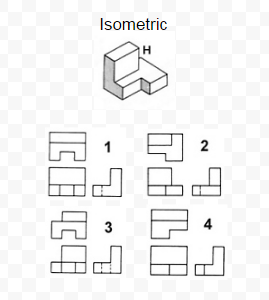
Which orthographic projection represents the correct views for the isometric sketch?
a)
1
b)
2
c)
3
d)
4
76.

A continuous thick line is shown in the image what is its application ?

a)

Object line or Outline

b)

Hidden Line

c)

Hatching Line

d)

Dimension Line

77.

What is a line with short dashes as shown used for?

a)

Dimension Line

b)

Center Lines

c)

Hidden Detail

d)

Object or Outline in a drawing

78.

Construction lines are very lightly drawn lines to build up the sketch or drawing . True or False

a)

True

b)

False

79.

The image shown is an example of what?

a)

Drawing Label

b)

Information Tag

c)

Title Block

80.

Examine the image shown and identity which type of line is labeled with the letter R ?

a)

Hidden Detail Line

b)

Dimension Line

c)

Object Line

d)

Center Line

81.

Examine the image and identify which type of line is highlighted by the letter E ?

a)

Dimension Line

b)

Object Line

c)

Hidden Line

d)

Chain Line

82.

Examine the image and identify which type of line is highlighted by the letter E ?

a)

Dimension Line

b)

Object Line

c)

Hidden Line

d)

Chain Line

83.

Examine the image and identify which type of line is letter T pointing to ?

a)

Dimension Line

b)

Object Line

c)

Center Line

d)

Hidden Line

84.
A drawing tool used to draw all horizontal lines and to support the other pieces of equipment used to draw angles lines.
a)
Set Squares
b)
T-Square
c)
30/60 Set Squares
d)
Compass
85.
A drawing tool with set angles.
a)
Triangles
b)
Compass
c)
T-Square
d)
Rulers
86.

What is a technical drawing?

a)

A sketch

b)

A detailed drawing with measurements

c)

A brainstorming sketch

d)

A drawing with labels

87.

This drawing is an example of:

a)

An orthographic drawing

b)

An isometric drawing

c)

A perspective drawing

d)

An oblique drawing

88.

Orthographic Drawings include how many drawings?

a)

1

b)

2

c)

3

d)

4

89.

Orthographic Drawings usually include which views? Select all that apply

a)

Front

b)

Top

c)

Side

d)

Back

e)

Bottom

90.

Orthographic Drawings usually include which views? Select all that apply

a)

Front

b)

Top

c)

Side

d)

Back

e)

Bottom

91.

If an object is drawn twice as large as it exists in real life, then the scale of the drawing is?

a)

1:1

b)

1:2

c)

!/2:1

d)

1:3

e)

2:1

92.

Technical drawings must:

a)

include dimensions

b)

include labels

c)

be drawn on special paper

d)

all of the answers are correct

93.

What are the most common dimensions? Select all that apply

a)

Length

b)

Width

c)

Height

d)

Thickness

e)

Perimeter

94.
What is the measurement
a)
3   1/2
b)
3   2/3
c)
3  3/8
d)
3 7/16
95.
What is the measurement
a)
3/4
b)
7/16
c)
1/2
d)
3/8
96.
What is the measurement
a)
2/16
b)
7/16
c)
7/8
d)
9/16
97.
What is the measurement
a)
2/16
b)
7/16
c)
7/8
d)
9/16
98.
What is the measurement
a)
1/2
b)
17/16
c)
15/16
d)
3/4
99.
What is the measurement
a)
5  3/8
b)
4  3/8
c)
5  3/4
d)
5  7/16
100.

Which ruler indicates the measurement 2-1/2 inches?

a)
b)
c)
d)