
 Worksheets
CSEC Physics - 05 Radioactivity
Total questions: 53
Worksheet time: 2hrs 46mins
What is radioactivity?
the integration of atomic matter
the spontaneous integration of matter
the spontaneous disintegration ('decay') of unstable atomic nuclei
the spontaneous disintegration ('decay') of unstable gasses

How is the alpha particle symbolized?
42⍺
24He
0-1 β
γ

a nucleus with a High-frequency electromagnetic wave is called a(n) ____.
alpha particle
electroscope
beta particle
gamma ray

A helium nucleus with two protons and two neutrons is called a(n) ____.
alpha particle
electroscope
beta particle
gamma ray

How is the gamma wave symbolized?
42⍺
24He
0-1 β
γ
The relative mass of a gamma ray is
γ=18401
γ=0
γ=1
γ=4

The relative mass of an alpha particle is
α=18401
α=0
α=1
α=4
The relative mass of a beta particle is
β=18401
β=0
β=1
β=4

What is the relative charge of an alpha particle
0
-1
+1
+2
What is the relative charge of a beta particle
0
-1
+1
+2
What is the relative charge of a gamma wave
0
-1
+1
+2

How fast is an alpha particle?
2×10⁷ms−1
3×10⁸ms−1
2×10⁸ms−1
almost the speed of light
How fast is a beta particle?
2×10⁷ms−1
3×10⁸ms−1
2×10⁸ms−1
almost the speed of light
How fast is a gamma particle?
2×10⁷ms−1
3×10⁸ms−1
2×10⁸ms−1
almost the speed of light

What is the Ionisation of an alpha particle in air?
strongly ionising on
collision with neutral air
molecules
very strongly ionising with neutral air
molecules
weakly ionising on
collision with neutral air
molecules
very weakly ionising
when the wave energy
is absorbed by air
molecules
What is the Ionisation of a beta particle in air?
strongly ionising on
collision with neutral air
molecules
very strongly ionising with neutral air
molecules
weakly ionising on
collision with neutral air
molecules
very weakly ionising
when the wave energy
is absorbed by air
molecules
What is the Ionisation of a gamma wave in air?
strongly ionising on
collision with neutral air
molecules
very strongly ionising with neutral air
molecules
weakly ionising on
collision with neutral air
molecules
very weakly ionising
when the wave energy
is absorbed by air
molecules
Alpha particles can be absorbed by...
several m of concrete
(4 cm of lead absorbs
90%)
a few m of air or about
3-5 mm of aluminium
a few m of lead 3-5 m
a thin sheet of paper or
about 5 cm of air
Beta particles can be absorbed by...
several m of concrete
(4 cm of lead absorbs
90%)
a few m of air or about
3-5 mm of aluminium
a few m of lead 3-5 m
a thin sheet of paper or
about 5 cm of air
Gamma waves can be detected by
GM tube and accessories
The smell in the air
The green light in the air
Gamma waves can be absorbed by...
several m of concrete
(4 cm of lead absorbs
90%)
a few m of air or about
3-5 mm of aluminium
a few m of lead 3-5 m
a thin sheet of paper or
about 5 cm of air
Beta particles can be detected by
GM tube and accessories
The smell in the air
The green light in the air
Gamma rays have
no mass
a huge mass
a small mass
an average mass
Radiation entering the GM tube produces a current which may be passed to what?
a vector
a fan
or a scalar
a photon meter
a loudspeaker
or a fan
a rate meter
a loudspeaker
or a scalar
a rate meter
a vector
or a scalar
Equations of radioactive decay for an alpha particle is
10 n
0−1 β or 0−1 e
11 p
γ
42 α or 42 He
Equations of radioactive decay for a beta particle is
10 n
0−1 β or 0−1 e
11 p
γ
42 α or 42 He
Equations of radioactive decay for a gamma wave is
10 n
0−1 β or 0−1 e
11 p
γ
42 α or 42 He
Equations of radioactive decay for a proton is
10 n
0−1 β or 0−1 e
11 p
γ
42 α or 42 He
Equations of radioactive decay for a neutron is
10 n
0−1 β or 0−1 e
11 p
γ
42 α or 42 He
When an isotope emits an ⍶-particle it becomes
an element two places back in the Periodic Table.
614C → −10e +714N
91234Pa → 91234Pa +γ
88226Ra → 24He +86222Rn
92238U → 90234Th +24α +γ 3890Sr → 3990Y +−10β +γ
When an isotope emits a β -particle it becomes an element one place forward in the Periodic Table. The mass number is unchanged.
614C → −10e +714N
91234Pa → 91234Pa +γ
88226Ra → 24He +86222Rn
92238U → 90234Th +24α +γ 3890Sr → 3990Y +−10β +γ
When an isotope emits a γ -photon its atomic number
and mass number remain unchanged.
614C → −10e +714N
91234Pa → 91234Pa +γ
88226Ra → 24He +86222Rn
92238U → 90234Th +24α +γ 3890Sr → 3990Y +−10β +γ
Some nuclei may remain in an excited state (more energetic state)
after emitting an α or β -particle. A γ -photon is then emitted,
returning the nucleus to its more stable, ground state.
614C → −10e +714N
91234Pa → 91234Pa +γ
88226Ra → 24He +86222Rn
92238U → 90234Th +24α +γ 3890Sr → 3990Y +−10β +γ
The half-life of a radioisotope is ...
the age of the mass half way to its expiration
when it is half way heated
when it is half way cooled
the time taken for the mass of a given sample of it to decay to half of its value.
The half life of a radioactive material is not affected by by conditions external to the nucleus. This includes:
q) boiling
b) freezing
c) melting
d) coolin
q) weight
b) mass
c) whether or not the isotope is new
d) or used
q) temperature
b) pressure
c) whether or not the isotope is in its pure state d) or chemically combined
with some other element in a compound.
q) colour
b) thickness
c) whether or not the isotope is transparent
d) or solid
CHOOSE ALL CORRECT OPTIONS -
Arrow method for calculations involving half-life
Particularly useful if a graph is to be plotted.
The 'Time' column always starts at 0 and increases by one half-life for each new row.
Each arrow represents a half-life transition and points to half the value it originates at.
The 'Activity' or 'Mass remaining' column decreases to half its value for every new row.
The total time of decay is the sum of the half-lives.
CHOOSE ALL CORRECT OPTIONS -
Table method for calculations involving half-life
Particularly useful if a graph is to be plotted.
The 'Time' column always starts at 0 and increases by one half-life for each new row.
Each arrow represents a half-life transition and points to half the value it originates at.
The 'Activity' or 'Mass remaining' column decreases to half its value for every new row.
The total time of decay is the sum of the half-lives.
In the nuclear equation below, calculate the mass number of the alpha particle. 23892U-->23490Th + 42He + 200
238
234
0
4
Solve this equation for beta decay.
614C = ___ + -10e
410Be
714N
210He
613C
An isotope that undergoes B- decay has
too few protons
too many protons
too few neutrons
Too many neutrons
Which Has the 1) highest penetrating power. Can penetrate our body. Even several cm thick of lead or several meters thick of concrete cannot stop all of it.
2) Lowest Can only penetrate 0.05 mm into the body and can be stopped by a piece of paper or clothing.
1) Alpha
2) Beta
1) Beta
2) Gamma
1) Gamma
2) Alpha
1) Beta
2) Alpha
The process of nuclear change in an atom of radioactive material is called...
nuclear decay
nuclear mass
isotopes
radon
Radioactive materials have unstable...
electrons
protons
nuclei
neutrons
In the equation, 146C --> 147N + 0-1B, the _______ decay of radioactive carbon-14 results in the creation of a new nitrogen-14 atom.
Gamma
Beta
Alpha
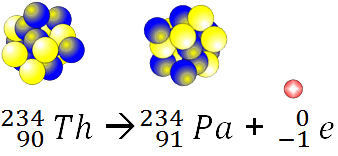
Gamma rays have
no mass
a huge mass
a small mass
an average mass

A
B
C
D
Alpha decay causes the mass number of the nucleus to decrease by ________ and the atomic number of the nucleus to decrease by _______.
four, two
two, four
one, two
two, three
Beta radiation is ____________________
an electron from an electron shell.
an electron from the nucleus.
two protons and two neutrons.
a high frequency electromagnetic wave.
What is the meaning of isotope?
Elements with same mass number but different proton number
Elements with same nucleon number but different proton number
Elements with different nucleon number and different proton number
Elements with different mass number but same proton number

