
 Worksheets
Cold War Practice Test
Total questions: 94
Worksheet time: 54mins

During the Cold War, what bill did the U.S. Congress pass to provide financial assistance to western European countries?
Truman Doctrine
Open Door Policy
Marshall Plan
Domino Theory

What policy implemented in the Cold War said the U.S. would give military aid to a country that needed to resist communism?
Marshall Plan
Truman Doctrine
Domino Theory
Open Door Policy
During the Cold War, what policy did the U.S. follow to stop the spread of communism?
Open Door Policy
Big Stick Policy
Containment Policy
Dollar Diplomacy
Which individual/group contributed to the Red Scare by accusing American citizens of being communist spies?
McCarthy/HUAC
NAACP/Farm Workers Union
Nativists/Muckrakers
Philanthropists/Entrepreneurs

In what year did the Russians launch the satellite Sputnik?
1941
1957
1969
1991

What happened as a result of the launch of Sputnik in 1957?
It started the space race between the USSR and U.S.
The U.S. government started NASA.
U.S. began to spend more money on math and science to maintain national security.
All of the above

During what Cold War event did the U.S. bypass a Soviet blockade in Germany without provoking a military conflict?
Berlin Airlift
Vietnam War
Watergate Scandal
Bataan Death March

During the Cuban Missile Crisis, what did President J.F. Kennedy do when he heard that the Soviet Union was constructing nuclear missile sites in Cuba.
He launched a nuclear missile at the Kremlin in Moscow.
He gave into the demands of the Soviet & Cuban government.
He ordered a naval blockade around Cuba to prevent Soviet ships from bringing the necessary materials.
He declared war on the Soviet Union & Cuba.
What theory caused the U.S. to enter the Vietnam War in order to stop the expansion of communism across Southeast Asia?
Marshall Plan
Domino Theory
Open Door Policy
Dollar Diplomacy

What amendment was passed to lower the voting age because it was unfair that 18-20 year olds could be drafted into the army but not vote?
17th amendment
21st amendment
22nd amendment
26th amendment
What words should you immediately associate with the Cold War?
Hitler & the Nazis
Economic recession
Containment of Communism
Corruption & Industrialization




.
The above statement is describing which organization?
Which of the following was a primary cause of the Cold War between the United States and the Soviet Union?
direct, armed conflict between the two nations
the founding of the United Nations
a deep reduction in military expenditures
a competition for political influence over other countries
Which of the following is most characteristic of the Cold War?
The growth of nuclear arsenals in the United States and the Soviet Union
The expansion of national borders by imperialistic European countries
The implementation of isolationist foreign policies in Great Britain and China
The rapid industrialization of many Southeast Asian countries
Which of these was a cause of the Korean War?
NATO air and naval forces blocked ships sailing to North Korea.
United Nations inattention allowed guerrillas to infiltrate South Korea.
North Korean forces, with Soviet approval, invaded South Korea.
Widespread anti-colonial riots forced the Korean government to begin the war.
During the Korean War, what prevented the southern part of the peninsula from falling permanently to the invading forces?
The threat of a Soviet naval blockade
The use of atomic weapons on northern cities
The assistance of the Chinese military
The involvement of UN forces under the command of the United States
What motivated the U.S. to get involved in the war in Vietnam?
The U.S. supports governments fighting against Communism (Containment)
The U.S. was only after natural resources in the area
The U.S. wanted to colonize Korea and Vietnam
The U.S. was helping the Japanese empire expand into Vietnam
Which of the following is usually a characteristic of a Communist economy?
Entrepreneurs sell shares in their companies to the government
The role of the government in the economy is restricted by law
Government agencies are in control of production planning
Investment is encouraged by the promise of large profits.
What are Proxy Wars?
Indirect conflicts between the 2 superpowers
Wars between Communist China and Russia
Wars between the US and Canada
Wars that US citizens greatly supported the involvement of US troops
In the Communist system who controls everything?
The Government
Businesses
The People
Nobody

An economic and political system in which a country's trade and industry are controlled by private owners for profit,
communism
socialism
fascism
capitalism

Which system has no social classes?
Communism
Fascism
Socialism
Capitalism

Which system allows you to own a business and make as much money as possible
Fascism
Socialism
Communism
Capitalism

In a Capitalist system the prices of a good are based on
whatever the owner wants
whatever the people decide
supply and demand
what is fair and just
Is it CAPITALISM or COMMUNISM:
Individuals and businesses own property and the means of production
Capitalism
Communism
Is it CAPITALISM or COMMUNISM:
Businesses follow their own self-interest by competing for the consumer’s money.
CAPITALISM
COMMUNISM
Is it CAPITALISM or COMMUNISM:
The community or the government should own property and the means of production. There should be no private ownership.
CAPITALISM
COMMUNISM
Is it CAPITALISM or COMMUNISM:
Progress results when a community cooperates for the good of all (equality).
CAPITALISM
COMMUNISM
Is it COMMUNISM or CAPITALISM:
A better system is for the government to distribute goods according to each person’s needs.
CAPITALISM
COMMUNISM
Is it CAPITALISM or COMMUNISM:
Every individual tries to make as much money as he can and should be free to start a business
CAPITALISM
COMMUNISM
The Vietcong were-
South Vietnam force
North Vietnam force
North Vietnamese forces in South Vietnam
Another name for Communists


The American people strongly supported U.S. involvement in the war
True
False

As a result of the Vietnam War, many Americans believe that U.S. forces should only be sent to world troublespots if U.S. security or vital interests are at stake.
True
False
Our Vietnam Vets were welcomed with open arms when they returned home
No
yes

In 1975, two years after the last American troops left Vietnam,:
South Vietnam defeated the Viet Cong
the United Nations drew up a treaty ending the war
South Vietnam surrendered to North Vietnam
POW's are
Partners of war
the children that were used as decoys
Prisoners of war
people who sided with communism
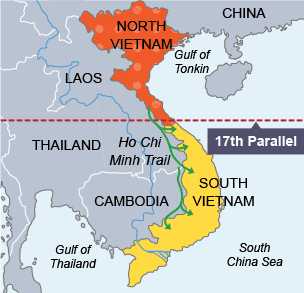
The Ho Chi Minh Trail was
a secret path which was used by the Viet Cong in Saigon.
a supply line for the Vietcong which ran through neutral countries.
the route that the Americans took when they left South Vietnam.
a supply line used by South Vietnam.
After the Vietnam War
South Vietnam stayed independent but communist.
both countries were reunited.
the Americans had to pay for most of the damage.
all of the above.
Which of the following was NOT used by the American military in Vietnam?
Aerial attacks (regular bombs)
Agent Orange
Napalm
Nuclear bombs
Where was the United States Navy allegedly attacked in 1964?
Gulf of Thailand
Gulf of Tonkin
Pearl Harbor
South China Sea
Which of the following was not a reason for the Vietnam War?
The Domino Theory
Containment
Gulf of Tonkin Incident
Vietnamization
In the ____________________, United States soldiers killed at least 450 women, children, and elderly men, shocking the American public.
My Lai Massacre
Attack on Sai Pan
Tet Offensive
Attack on Khe Sanh
The sustained bombing of North Vietnamese and Viet Cong troops, ordered by Johnson in 1965
Domino Theory
Operation Rolling Thunder
Gulf of Tonkin Resolution
Tet Offensive
US troop reduction in Vietnam; transfer of combat operations from American to South Vietnamese troops
Domino Theory
Kent State University
Tet Offensive
Vietnamization
Leading Vietnamese nationalist figure, supporting the Communist party
Ngo Dinh Diem
Ho Chi Minh
Viet Cong
Kent State University
1968, massive attack by the Viet Cong on major cities in South Vietnam; caused American public support of war to plummet
Operation Rolling Thunder
Gulf of Tonkin Resolution
Tet Offensive
Kent State University
Protests over military missions in Cambodia resulted in confrontation between protestors and police, with four students killed on May 4, 1970
Kent State University
Vietnamization
Domino Theory
Viet Cong

