
 Worksheets
7th ELA Finals Review
Total questions: 135
Worksheet time: 3hrs 6mins
What's the problem with the modifiers in this sentence?
Emma Sue was delighted when Mr. Nguyen returned her perfect calculus test with an ear-to-ear grin.
Mr. Nguyen was the who took the test.
It sounds like the calculus test as the grin.
What's the problem with the modifiers in this sentence?
Scrubbing the tile grout with bleach and an old toothbrush, the mildew stains began to fade.
We don't know who scrubbed the tile grout.
The mildew stains were scrubbing the tile grout.
A toothbrush was scrubbing the tile grout.
Which sentence is written MOST clearly and correctly?
Though only 16-years-old, the college accepted Martha's application.
Although Martha is only 16-years-old, the college accepted her application.
Correct or incorrect?
Regretting his remark, Kyle blushed uncontrollably.
Correct
Incorrect
Correct or incorrect?
Lying on the beach, thoughts of sun cancer entered my mind as I tried to relax.
Incorrect
Correct
Correct or incorrect?
The child on the bike, the blonde one, is my son.
Incorrect
Correct
Correct or incorrect?
Being very shy, strangers easily frighten my little sister, Maggie.
Incorrect
Correct
Correct or incorrect?
Standing near the runway, the sound of the jets was deafening.
Incorrect
Correct
Correct or incorrect?
They trudged along the bank of the river, hungry and exhausted.
Incorrect
Correct
Generally reliable and the narrator is NOT a character.
2nd person
1st person
3rd person
Narrator is a character but this POV is not always reliable.
1st person
2nd person
3rd person
The action of the story is told by the narrator who is not in the story.
3rd person
2nd person
1st person
The narrator talks you specifically and makes you feel like the text was written for you
3rd person
1st person
2nd person
What is the POV?
Brian could not bear to be on the roof of the skyscraper any longer. He wasn't usually afraid of heights, but the wind was so strong and Rufus kept messing with him.
3rd person
1st person
2nd person
What is the POV?
Chad tightened his grip on the rope. He could feel his fingers weakening. "Come on, Chad! Pull! We're losing ground!" shouted his teammate George. Chad gazed at the mud puddle toward which he and George were being dragged. Then he looked up at his opponents.
1st person
2nd person
3rd person
What is the POV?
Anthony was making a snowman in his front yard. He wanted to make the tallest snowman ever. "Making the tallest snowman ever is hard," he thought to himself.
3rd person
2nd person
1st person
What is the POV?
The stars were burning brightly in the night sky. The evening breeze felt cool on my skin. It was the last night of summer break and I was calm, oddly calm.
2nd person
1st person
3rd person
What is the POV?
"Go long, Howard," Mike said to me. Having not played much football before, it took me a couple seconds to process the words, but then I took off like a getaway car. I ran as fast as I could for about thirty yards and then I hooked left, turning around just in time to see the ball spiraling toward my head.
1st person
2nd person
3rd person
uses pronouns you, yours, yourself
1st person
2nd person
3rd person
True or False?
When identifying POV, you must pay close attention to the dialogue between characters.
true
false
A long time ago there was a king who wanted nothing but gold. He wished that everything he touched would turn into gold. Then, one day, a magical fairy granted his wish. So, anything he tried to eat turned into gold, thus he starved to death.
What is the theme of this story?
Don't steal.
Respect your elders.
Work together.
Don't be greedy.
Which of the following is NOT an example of a theme?
Treat others the way you want to be treated.
The little boy lied to his mother.
With hard work, you can accomplish anything.
You shouldn't judge a book by its cover.
In a spell of dry weather, when the Birds could find very little to drink, a thirsty Crow found a pitcher with a little water in it. But the pitcher was high and had a narrow neck, and no matter how he tried, the Crow could not reach the water. The poor thing felt as if he would die of thirst. Then an idea came to him. Picking up some small pebbles, he dropped them into the pitcher one by one. With each pebble the water rose a little higher until at last it was near enough so he could drink.
What is the theme?
Be honest.
Always share with others.
Be persistent.
Respect your family.
There once was an ugly duckling. The other ducks laughed at her, and she felt ashamed. Years later, she grew into a beautiful swan and far surpassed all of the other ducks that once shamed her.
What is the theme of this story?
Don't steal.
Being beautiful is the most important thing.
Swans are prettier than ducks.
Don't judge others. You don't know what they are capable of.
A lion was about to eat a mouse when the mouse pleaded, "Please, let me go, and someday I may help you." Laughing, the lion let the mouse go. Later, some hunters caught the lion in a trap. The mouse came along and chewed through the ropes and saved the lion's life.
What is the theme of this story?
Slow and steady wins the race.
Help others because what goes around comes around.
Always tell the truth.
It is okay to fail.
Jared's best friend is having a party Friday night, but he also has a baseball game that's been scheduled since the start of the season. This is going to be a tough decision. If he does not go to the game, he will let his team down.
What is the theme?
Being good at sports is the best way to get friends.
It's important to never give up.
It's important to be loyal and honor your commitments.
Being a good friend is the first priority.
Which of the following is an example of THEME?
Carry your laptops with two hands at all times.
Cereal is the healthiest breakfast food you can eat.
It's dangerous to drive in severe thunderstorms.
Life is short; make the most of it.
What is the main difference between THEME and MAIN IDEA.
Theme is a universal lesson and main idea is what a story is about.
Theme is what a story is about and main idea is the universal lesson it teaches.

What is the Author's Purpose of the text below:
Do you carpool to school? Do you take a bus? It should be a requirement for everyone to either share a ride or walk to school every day. If we are serious about saving the planet, we must take steps to conserve energy and reduce fossil fuel emissions.
Persuade
Inform
Entertain
Explain
Describe

What is the Author's Purpose of the text below:
Today, it is not uncommon to see women wearing high-heeled shoes. However, the first high-heeled shoes were actually made for men back in the 1500s. The heels helped soldiers keep their feet in the stirrups of their saddles as they rode into battle.
Persuade
Inform
Entertain
Explain
Describe

What is the Author's Purpose of the text below:
Caroline Bartlett Crane was born in 1858 in Hudson, Wisconsin. After working as a teacher, she became a journalist and an ordained minister. Crane was an activist who worked toward women's voting rights in the U.S. Her tireless efforts at improving sanitation in large cities-especially in the slums where the poorest residents lived-earned her the title "American's Housekeeper."
Persuade
Inform
Entertain
Explain
Describe

What is the Author's Purpose of the text below:
Driving west from Capital Park, turn left onto Maple Avenue. Continue for 3 blocks until you come to Trumbull Street, and then turn right. The library will be on your left.
Persuade
Inform
Entertain
Explain
Describe

What is the Author's Purpose of the text below:
Once upon a time in a magical kingdom, there lived a great hero. He was about to set out on a dragon's quest!
Persuade
Inform
Entertain
Explain
Describe

What is the Author's Purpose of the text below:
The rabbit's fur was as soft as velvet, and he seemed to enjoy having people pet him. He would snuggle in closer, lay his ears back, and pull in his feet.
Persuade
Inform
Entertain
Explain
Describe

What is the Author's Purpose of the text below:
Have you ever wished you could contact all of your friends at once? Wouldn't it be convenient to send a note to all your friends at the same time, rather than contacting each person individually? Download the FriendChat app today for your smartphone! In just minutes, you'll be able to send messages to all your friends simultaneously. For only $1.99, you can save yourself a lot of time!
Persuade
Inform
Entertain
Explain
Describe

What is the Author's Purpose of the text below:
Sarah knew time travel was impossible. Everything she'd learned in science told her it couldn't be done. But as she looked around the street, noting the horse-drawn carriages and the women dressed in long dresses and hats, she realized she was in the 19th century.
Persuade
Inform
Entertain
Explain
Describe

What is the Author's Purpose of the text below:
Building a bird house is a relatively simple task. Begin by cutting your wood to size, according to the pattern you've chosen. Before cutting, be sure to measure each pattern twice to ensure you are cutting the wood to the correct length.
Persuade
Inform
Entertain
Explain
Describe

Being a clown isn't all fun and games. Rodeo clowns expose themselves to great danger every time they perform. When cowboys dismount or are bucked off of bulls at riding competitions, rodeo clowns jump in front of the bulls and motion wildly to get their attention. In this way rodeo clowns provide an alternate target, and in doing so protect the rider. So you see, sometimes clowning around can be serious business
Because lambs are sometimes eaten by coyotes, ranchers may hunt or trap the coyotes. However, killing coyotes may upset nature's balance. Scientists have found a way to protect sheep without killing coyotes. Coyotes are fed lamb meat treated with a drug. When they eat the meat, they get sick. Later, coyotes won't even go near lambs. They'll hunt rabbits instead.
This story mainly tells.....
Coyotes prefer rabbits to lambs.
Killing coyotes upsets nature's balance.
Scientists are trying to protect sheep and coyotes.
Do you ever wonder how you taste things? You owe your sense of taste to your taste buds. We have 9,000 taste buds just on the tongue alone. There are also taste buds on the roof of your mouth. You even have taste buds on the back of your throat.
What does the author want you to learn about the passage?
Why we can taste only sweet things.
that we taste through our nose
Taste buds are found in different places.
What is the central idea of the passage?
What is this passage mostly about?
This author belives that:
This passage is mainly about?
What is the central idea?
What is the central idea?
"Life is a journey" is an example of what?
Simile
Hyperbole
Metaphor
Alliteration
"I nearly died laughing" is an example of what?
Assonance
Hyperbole
Alliteration
Metaphor
Which of the following is an example of onomatopoeia?
Break a leg
She was white as a ghost
Buzz Buzz
Peter Piper Picked a Peck of Pickled Peppers
Define hyperbole
An overused phrase
A comparison of two unlike things using like or as
A comparison of two unlike things without using like or as
An over exaggeration
What is the meaning of this simile? "My mom can be as fiery as a volcano when I don't do my chores on time."
Her hair is red
She gets really angry
She talks very loudly
She spits when she talks
"Look outside! Its raining cats and dogs!" is an example of what?
Simile
Onomatopoeia
Idiom
Personification
The repetition of sounds at the beginning of words is what?
Alliteration
Imagery
Simile
Metaphor
The vantage point from which a story is told is called what?
Tone
Mood
Memoir
Point of View
When you give human-like qualities to something that is not human
alliteration
simile
personification
metaphor
an expression that is not meant to be taken literally
idiom
allusion
alliteration
metaphor
The rain falls like the sun, rising upon the mountains
simile
idiom
hyperbole
metaphor
He clattered and clanged as he washed the dishes
red-herring
alliteration
idiom
personification
It really burned me up when you yelled at me
alliteration
personification
simile
idiom
The sunflowers nodded their yellow heads
metaphor
simile
personification
onomatopoeia
My life is a dream of wonders
idiom
personification
simile
metaphor
We had to wait forever!
simile
personification
hyperbole
metaphor

What kind of figurative Language is "There is no Frigate like a book."
Simile
Metaphor
Hyperbole
Personification
Fill in the blank:
-------, or a group of lines in the poem, are nicknamed the "paragraphs of poetry".
Sentences
Stanzas
Lines
Fill in the blank:
-------- is a type of rhyme that occurs at the end of a line.
Outside Rhyme
Inside Rhyme
End Rhyme
What is the difference between a simile and a metaphor?
A simile does NOT compare using "like" or "as" and a metaphor does compare using "like" or "as"
A simile and a metaphor BOTH use "like" or "as" to compare
A simile does compare using "like" or "as" and a metaphor does NOT compare using "like" or "as"
Kelsey was terrified of going into the cold, dark basement by herself.
I covered my ears when the loud dance music suddenly blared from the radio.
I stared up in awe and wonder at the beautiful, shining skyscraper.
Hilda's thick German accent made her difficult to understand sometimes.
Do you see coordinate or cumulative adjectives in this sentence: Turn left at the red brick building on the corner.
coordinate
cumulative
as a result, because, since, due to
propose, conclude, suggest, reason, solve
both, same, like, unlike, at the same time


Cause-Effect
Description
Problem-Solution
Sequence

Cause-Effect
Description
Problem-Solution
Chronological
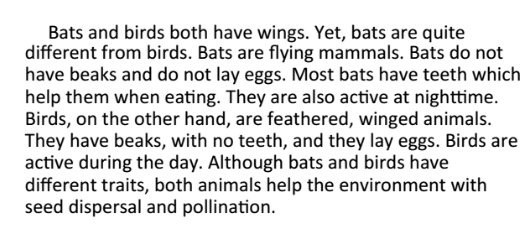
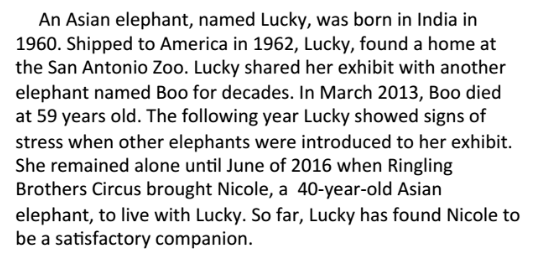


Cause-Effect
Description
Chronological
Sequence


It was one year to the day since Will had accepted the position of team captain for his school’s soccer team. He had wanted that honor since he had watched his older brother lead the team to a state finals victory three years earlier. Now that the privilege was his, Will found himself restive and unable to sit still. It was only the first game of the season, but Will envisioned great things, both for himself and for the rest of his team. After all, this day had been a long time in coming.
1. Based on the surrounding text, the word restive most likely means___________.
Tired
Pensive
Bored
Restless
It was one year to the day since Will had accepted the position of team captain for his school’s soccer team. He had wanted that honor since he had watched his older brother lead the team to a state finals victory three years earlier. Now that the privilege was his, Will found himself restive and unable to sit still. It was only the first game of the season, but Will envisioned great things, both for himself and for the rest of his team. After all, this day had been a long time in coming.
A word that means the same as envisioned is_______________________.
Prevented
Initiated
Imagined
Prayed for
The wind was blowing hard as the team took its final time out. The driving rains seemed to be coming sideways. Both teams were exhausted as they dragged themselves back to the field. With just four seconds left on the clock, there was nothing left to do but watch as the football was booted through the air and passed just through the goal post. The crowd roared; the home team had won.
The author’s purpose for this piece is to ________________.
Persuade
Entertain
Inform
Reflect upon an experience
The wind was blowing hard as the team took its final time out. The driving rains seemed to be coming sideways. Both teams were exhausted as they dragged themselves back to the field. With just four seconds left on the clock, there was nothing left to do but watch as the football was booted through the air and passed just through the goal post. The crowd roared; the home team had won.
Clues in the text tell what the author’s purpose was in writing it. This text contains mostly _____________________________.
Strong language, favoring one side of an issue
Facts and details
Suspenseful and exciting details
Thoughts and feelings
The plot of a story is _____________.
Where and when an event takes place
The main character’s feelings and thoughts
The events that take place as characters deal with the conflict
What happens when the conflict is resolved
The sentence Jose’ couldn’t choose between joining the football team or the hockey team. Is an example of a(n)______________________.
conflict resolution
Internal conflict
External conflict
Internal resolution
Dillain was an adventurous dog; perhaps it was the pit bull in him, maybe it was the boxer. Whatever lineage was responsible, nothing could stop him from going after that fox that mocked him from across the river. Of course, despite all the wonderful things that Dillain had grown to become—great friend, watchdog, protector—he had never become a strong swimmer.
Upon hearing the quick splashing and the slight whimper in his yelps, I quickly hopped up from the hammock and rushed into the frigid water to help my brave but foolish companion. This happens every year when Dillain and I head up the river toward Maine. But he loves the cool rush of the river, and I love him too much to deprive him of that.
From what point of view is this selection written?
First-person
Second person
Omniscient third person
Limited third person
Dillain was an adventurous dog; perhaps it was the pit bull in him, maybe it was the boxer. Whatever lineage was responsible, nothing could stop him from going after that fox that mocked him from across the river. Of course, despite all the wonderful things that Dillian had grown to become—great friend, watchdog, protector—he had never become a strong swimmer.
Upon hearing the quick splashing and the slight whimper in his yelps, I quickly hopped up from the hammock and rushed into the frigid water to help my brave but foolish companion. This happens every year when Dillian and I head up the river toward Maine. But he loves the cool rush of the river, and I love him too much to deprive him of that.
What clues tell you that Dillian is a static character?
Dillian is a great friend, watchdog, and protector.
This happens every year.
Dillian is a poor swimmer.
Dillian is an adventurous dog.
What point of view provides the reader with the thoughts and feelings of only one character?
Round character
Limited third person
Omniscient third person
Character motivation
Two characters, or a character and an outside force, in opposition are an example of ______.
External conflict
Character motivation
Internal conflict
Resolution
A round character is _______________________.
Someone with just one or two personality traits
The person narrating the story
Someone who does not change or develop throughout the story
A complex, fully developed character
Which of the following questions reveals clues to the reader about potential conflict in a story?
How many people are involved?
Where does the story take place?
What helps or doesn’t help a character make a decision?
Why is this important to the reader?
What is one step you should take if you come across an unfamiliar word as you read a story?
Stop reading and move on to another story.
Think of other words that start with the same letter.
See if you come across the meaning later on in the story
Make a wild guess.
Choose the word that best completes the following sentence.
None of the animals in the shelter_________ to anyone.
Belong
Are belonging
Belongs
Is belonging
Everybody in the classroom _________________ ice cream and soda now.
Is enjoying
Enjoy
Are enjoying
Enjoys
Choose the word that correctly completes the sentence.
Lemonade and grape soda _____________ on sale today.
Is
Was
Are
Am
The painter is putting _______________ brushes into the water to soak.
Its
his
Outs
Theirs
Read the following sentence. Identify the possessive pronoun.
My brother is an opera star. His voice is loud.
Brother
My
Is
His
The farmer took great pride in his vegetables. But he was not the only fan of his labors. A family of rabbits also appreciated the farmer’s gardening skills. One day, the farmer noticed that his carrot crop was shrinking! He rushed toward the rabbit he saw in his carrot plot, screaming, “What are you doing? Those are mine!”
“I only take just enough to feed my family,”replied rabbit.
“But these aren’t for my family, "responded the frustrated farmer. “I sell these to local produce markets so I can afford to maintain my farm!”
“Then it appears,” responded the rabbit, “we both need these carrots.”
What is the conflict between these two characters?
The farmer and the rabbit both want to live on the same farm.
The farmer’s wife is afraid of rabbits.
They both need the carrots for their welfare.
The rabbit’s family is larger than the farmer’s.
The farmer took great pride in his vegetables. But he was not the only fan of his labors. A family of rabbits also appreciated the farmer’s gardening skills. One day, the farmer noticed that his carrot crop was shrinking! He rushed toward the rabbit he saw in his carrot plot, screaming, “What are you doing? Those are mine!”
“I only take just enough to feed my family,”replied rabbit.
“But these aren’t for my family, "responded the frustrated farmer. “I sell these to local produce markets so I can afford to maintain my farm!”
“Then it appears,” responded the rabbit, “we both need these carrots.”
What is the suitable resolution for both parties in the conflict above?
The farmer moves to another town.
The farmer grows enough extra carrots for the rabbit’s family.
The farmer changes what crops he grows.
The farmer’s wife overcomes her fear of rabbits.

