wayground logo

Free Printable Worksheets

Font size

S
M
L
XL
Worksheets

Chemistry Final Review

Total questions: 97

Worksheet time: 1hrs 24mins

Name
Class
Date
1.
Any factor that can change in an experiment
a)
variable
b)
constant
c)
independent
d)
dependent
2.

Manipulated or intentionally changed by the scientist in an experiment

a)

Control Variable

b)

Dependent Variable

c)

Experimental Control

d)

Independent Variable

3.

How close the measurment is to the accepted value

a)

Precision

b)

Variable

c)

Accuracy

d)

Experimental control

4.

How close several measurements are to each other

a)

Accuracy

b)

Variable

c)

Precision

d)

Experimental Control

5.

A characteristic of matter that can only be observed when matter is changed into a new kind of matter.

a)

Chemical property

b)

Physical property

6.

This property can be observed and measured without changing the matter being studied

a)

Physical Property

b)

Chemical Property

7.

What is a cation?

a)

A negatively charged ion

b)

An atom with no charge

c)

A positively charged ion

d)

A stable atom on the periodic table

8.

What is an anion?

a)

A negatively charged particle

b)

An atom with no charge

c)

A positively charged ion

d)

A stable atom found on the periodic table

9.
An atom, or a group of atoms that has an electrical charge, either positive or negative.
a)
electron
b)
ion
c)
nucleus
d)
orbital
10.
Formed when positively charged metal ions attract negatively charged non-metal ions.
a)
ionic compounds
b)
molecular compounds
11.
Formed when a non-metal shares electrons with another non-metal.
a)
ionic compound
b)
molecular compound
12.
Conduct electricity when melted or dissolved in water.
a)
ionic compounds
b)
molecular compounds
13.
Which of the following forms an ionic compound?
a)
a metal and another metal
b)
a non-metal and another non-metal
c)
a metal and a non-metal
d)
a covalent bond
14.
NaCl is a(n) 
a)
ionic compound
b)
molecular compound
15.

ZnO is a(n)

a)
ionic compound
b)
molecular compound
16.
CH4 is a(n)
a)
ionic compound
b)
molecular compound
17.
silicon dioxide
a)
SO2
b)
NaO2
c)
SiO2
d)
SiO
18.

What property is describing an ionic compound?

a)

shares electrons

b)

high melting/boiling point

c)

weak bonds

d)

made up of nonmetals.

19.
CH3OH is a(n)
a)
ionic compound
b)
molecular compound
20.

What property is describing an Ionic compound?

a)

crystal lattice structure

b)

low melting point

c)

weak bonds

d)

made up of 2 nonmetals

21.

What property is describing an Ionic compound?

a)

poor conductors of heat and electrictity

b)

low melting point

c)

strong electrolytes

d)

made up of 2 nonmetals

22.

What property is describing an molecular compound?

a)

crystal lattice structure

b)

high melting point

c)

strong bonds

d)

poor conductors of heat and electricity

23.

What is matter?

a)

It is a problem we have to solve.

b)

It is anything that takes up space.

c)

It is something that is heavy and used for chemical researches in order to discover new things

d)

It is something that is light and can be used for experiments.

24.

#1 represents

a)

Infrared

b)

Gamma

c)

Radio Waves

d)

Microwaves

25.

#2 represents

a)

Infrared

b)

Ultra Violet (UV)

c)

Radio Waves

d)

Microwaves

26.

#3 represents

a)

Infrared

b)

Ultra Violet (UV)

c)

Radio Waves

d)

Microwaves

27.

#5 represents

a)

Green

b)

Violet

c)

Yellow

d)

Red

28.

#6 represents

a)

X-ray

b)

Ultra Violet (UV)

c)

Gamma

d)

Infrared

29.

#7 represents

a)

X-ray

b)

Ultra Violet (UV)

c)

Gamma

d)

Infrared

30.
Data/observations based on measurements, volume, mass, or another quantity
a)
Qualitative
b)
Inference
c)
Quantitative
d)
variables
31.
Date/observations that are descriptive in nature.
a)
Qualitative
b)
Quantitative
32.

During an experiment, the group that does not receive the variable or change is the:

a)

independent variable

b)

dependent variable

c)

control

d)

hypothesis

33.

What is a factor that can change in an experiment?

a)

Claim

b)

Variable

c)

Scientific Inquiry

d)

Hypothesis

34.
If plants are exposed to sunlight, then they will grow taller.
What part of the scientific method is this an example of?
a)
Procedure
b)
Hypothesis
c)
Question
d)
Results
35.

Variable that is always plotted on the "Y" axis

a)

Independent

b)

Dependent

36.

Variable that is always plotted on the "X" axis

a)

Independent

b)

Dependent

37.

"If...then..." statement which explains what may happen in an experiment

a)

Conclusion

b)

Researchable Question

c)

Hypothesis

38.

"How does the change in...... effect...." statement that summarizes the experimental objective.

a)

Conclusion

b)

Researchable Question

c)

Hypothesis

39.

Summarizes data results with evidence is known as

a)

Conclusion

b)

Graph

c)

Hypothesis

d)

Variable

40.
Wave with the longest wavelength
a)
microwave
b)
radio
c)
gamma
d)
visible light
41.

Which of the following has the most energy?

a)

Red

b)

Blue

c)

Green

d)

Violet

42.

Which of the following has the shortest wavelength?

a)

Gamma rays

b)

The color blue

c)

AM radio

d)

Infrared

43.
Which has the SHORTEST wavelength and, therefore, the highest frequency/most energy
a)
Radio waves
b)
Ultraviolet Rays
c)
Gamma Rays
d)
X-rays
44.
Which has the LONGEST wavelength and, therefore, the lowest frequency/energy
a)
Gamma Rays
b)
Radio Waves
c)
Visible Light
d)
Infrared rays
45.
The red numbers in the image below represent ________
a)
subscripts
b)
coefficients
c)
I don't know, and don't want to try
d)
None of the answers are correct
46.
The blue numbers in the image below represent ________
a)
I don't know, and don't want to try
b)
coefficients
c)
subscripts
d)
none of the answers are correct
47.
The substances at the beginning of a chemical equation are called the ____
a)
product
b)
yield
c)
chemical symbol
d)
reactants
48.

What is the right part of a chemical equation called...

H2 + O2 --> H2O

a)

Reactants

b)

Products

c)

Yields

d)

Chemical Equation

49.
What is the right ratio of chemicals for the BCE (Balanced Chemical Equation)?__Al + __O2--> __Al2O3
a)
4,1 --> 2
b)
4,3 --> 4
c)
3,4 --> 1
d)
4,3 --> 2
50.
What is the right ratio of chemicals for the BCE (Balanced Chemical Equation)?__H2 + __S --> __H2S
a)
1,1 --> 1
b)
2,2 --> 2
c)
1,2 --> 1
d)
1,2 --> 2
51.
What is the right ratio of chemicals for the BCE (Balanced Chemical Equation)?__CH4 + __O2 --> __CO2+ __H2O
a)
2,1 --> 2,1
b)
1,2 --> 1,1
c)
1,2 --> 1,2
d)
1,2 --> 2,1
52.
4Si   + S8   -->   2Si2S4
a)
Synthesis
b)
Decomposition
c)
Single Displacement
d)
Double Displacement
53.
C4H12 + O2 → CO2 + H2O
a)
Synthesis
b)
Combustion
c)
Single Replacement
d)
Double Replacement
54.
What type of chemical reaction is this?
Al(OH)3 → Al2O3  + H2O
a)
Decomposition
b)
Combustion
c)
Synthesis
d)
Single Replacement 
55.
3Ca + 2AlCl3 --> 3CaCl2 + 2Al
a)
Synthesis
b)
Decomposition
c)
Single Displacement
d)
Double Displacement
56.
2NO2 --> N2 + 2O2
a)
Synthesis
b)
Decomposition
c)
Single displacement
d)
Combustion
57.
3KOH + H3PO4 --> K3PO4 + 3H2O
a)
Synthesis 
b)
Decomposition
c)
Single displacement
d)
Double displacement
58.

The name of FeCl₂ is

a)

iron chloride

b)

iron (II) chloride

c)

iron (I) chloride

d)

iron dichloride

59.

What is the name for the compound CaCO3?

a)

Calcium carbon oxide

b)

Calcium (II) carbonate

c)

Calcium carbonate

d)

Carbon carbonate

60.

#8 represents

a)

X-rays

b)

Gamma

c)

Radio Waves

d)

Microwaves

61.
Silicon is a semiconductor and has properties of both metals and nonmetals. What type of element is Silicon? 
a)
Metal
b)
Nonmetal
c)
Metalloid
d)
Pretty
62.
In the modern periodic table elements are arranged by:
a)
atomic mass
b)
atomic number
c)
valence electrons
d)
number of isotopes
63.
The atomic number of an element tells the number of _____ in the nucleus of an atom of that element.
a)
protons
b)
neutrons
c)
electrons
d)
isotopes
64.
An element's identity is determined by the number of
a)
electrons.
b)
protons.
c)
neutrons.
d)
valence.
65.
What is the number of protons that the element in this image contain?
a)
14
b)
7
c)
15
d)
18
66.
What is the atomic mass of "F"
a)
9
b)

18.9984

c)
17
d)
19
67.
Which item on this element square represents the atomic number?
a)
13
b)
Al
c)
Aluminum
d)
26.981538
68.
Which item on this element square is the chemical symbol?
a)
Copper
b)
29
c)
Cu
d)
63.546
69.

an arrangement of the elements according to their atomic numbers so that elements with similar properties are in the same column and properties repeat from row to row

a)

Periodic Table of Elements

b)

Atomic Theory

c)

Isotopes

d)

Subatomic Particles

70.

a unique number for each element that equals the number of protons in an atom of that element

a)

element name

b)

element symbol

c)

atomic number

d)

atomic mass

71.

This is calculated by adding the number of protons and neutrons in the nucleus of the atom

a)

element name

b)

element symbol

c)

atomic number

d)

atomic mass

72.

What is the atomic number of Barium, Ba? (enlarge the periodic table)

a)

20

b)

38

c)

56

d)

88

73.

How many protons are in a sodium atom, Na? (tap to enlarge the periodic table)

a)

Sodium has 1 proton.

b)

Sodium has 3 protons.

c)

Sodium has 11 protons

74.

An element has the mass number 12 and atomic number 6. The number of neutrons in it is:

a)

6

b)

10

c)

4

d)

8

75.

If an atom has 10 electrons, how many protons does it have?

a)

0

b)

1

c)

10

d)

5

76.

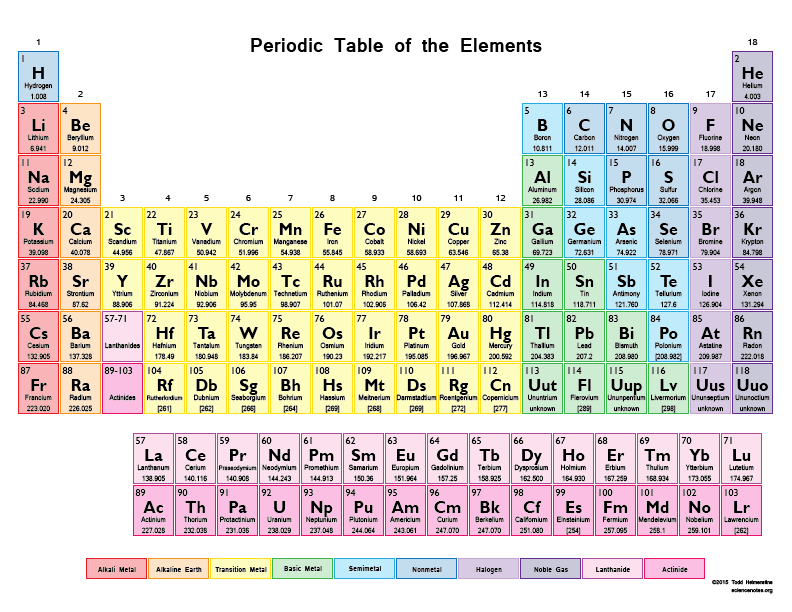
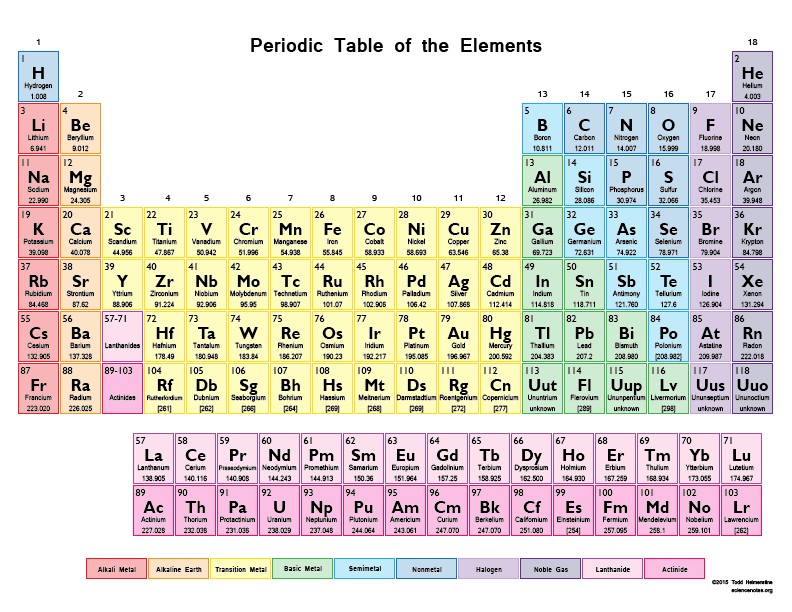
Which color on the image of the periodic table corresponds with the halogens.

a)

red

b)

black

c)

blue

d)

orange

77.
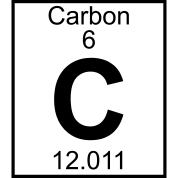
What does 12.011 represent?
a)
atomic mass
b)
atomic number
c)
element name
d)
chemical symbol 
78.

Which color on the image of the periodic table corresponds with the alkaline earth metals.

a)

yellow

b)

dark yellow

c)

blue/green

d)

teal

79.

Which color on the image of the periodic table corresponds with the metalloids.

a)

bright yellow

b)

gold

c)

teal

d)

light blue

80.

What is a metalloid?

a)

Elements that have properties that are a mixture of metal and non-metal properties

b)

Elements that are shiny

c)

Elements that want to be metals, but are non-metals

d)

Metalloids don't exist

81.

Which color on the image of the periodic table corresponds with the noble gases.

a)

red

b)

black

c)

blue

d)

orange

82.

Which color on the image of the periodic table corresponds with the transition metals.

a)

red

b)

black

c)

blue

d)

orange

83.

The horizontal rows in a periodic table are known as

a)

Groups

b)

Columns

c)

No name

d)

Periods

84.
What does the 6 represent?
a)
atomic mass
b)
atomic number
c)
element name
d)
chemical symbol 
85.
What is a reactant?
a)
a volatile chemical
b)
a dangerous substance
c)
the substances you start with in a chemical reaction
d)
the substances that are formed by a chemical reaction 
86.
What is a product?
a)
a fancy word for make-up
b)
a volatile chemical
c)
the substances you start with in a chemical reaction
d)
the substances that are formed by a chemical reaction
87.
a)
Alkali
b)
Alkaline Earth
c)
Halogens
d)
Noble Gases
88.
a)
Alkali
b)
Alkaline Earth
c)
Halogen
d)
Noble Gases
89.
a)
Alkali
b)
Alkaline
c)
Halogen
d)
Noble Gases
90.
a)
Alkali
b)
Alkaline
c)
Halogen
d)
Noble Gases
91.
a)

Transition Metals

b)

Inner Transition Metals

c)

Metals

d)

Metalloids

92.
What does 12.011 represent?
a)
atomic mass
b)
atomic number
c)
element name
d)
chemical symbol 
93.

The chemical symbol for this element is _________.

a)

Fe

b)

Iron

c)

26

d)

55.845

94.

The atomic mass for this element is __________.

a)

26

b)

Fe

c)

55.845

d)

iron

95.

The atomic number for this element is _________.

a)

26

b)

55.845

c)

Fe

d)

iron

96.

A substance that conducts electricity, is malleable, ductile, and has luster would be classified as a

a)

metalloid

b)

element

c)

metal

d)

nonmetal

97.

#4 represents

a)

Green

b)

Violet

c)

Yellow

d)

Red