
 Worksheets
Chemistry Unit 1 Review
Total questions: 20
Worksheet time: 22mins
Name
Class
Date
1.
What did Thomson discover?
a)
electron
b)
proton
c)
neutron
d)
electron cloud
2.
He claimed that matter was made of small, hard particles that he called “atomos.”
a)
Democritis
b)
Dalton
c)
Moseley
d)
Einstein
3.
The scientist responsible for "discovering" the nucleus is:
a)
Bohr
b)
Rutherford
c)
Schroedinger
d)
Einstein
4.
John Dalton stated:
a)
Atoms are tiny, invisible particles.
b)
Atoms of one element are all the same.
c)
Atoms of different elements are different.
d)
Compounds form by combining atoms.
e)
All of the statements listed.
5.
Light is emitted when electrons
a)
move from one atom to another.
b)
collide with one another, releasing energy.
c)
move from a lower energy level to a higher energy level.
d)
move from a higher energy level to a lower energy level.
6.

For a given element, the atomic number indicates the number of _____
a)
protons in the nucleus
b)
neutron in the nucleus
c)
electrons in the atom
d)
nucleons in the atom
7.

What is the Element's atomic number?
a)
Fe
b)
26
c)
55.847
d)
Iron
8.
An atom has an atomic number of 15 and a mass number of 31. How many protons are there in the atom?
a)
15
b)
31
c)
16
d)
47
9.
An atom has 5 protons and 7 neutrons. What is the mass number of the atom?
a)
5
b)
7
c)
2
d)
12
10.
An atom has an atomic number of 19 and a mass number of 29. How many neutrons are in the atom?
a)
30
b)
19
c)
10
d)
38
11.
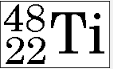
How many protons does this isotope of titanium have?
a)
48
b)
22
c)
26
d)
70
12.
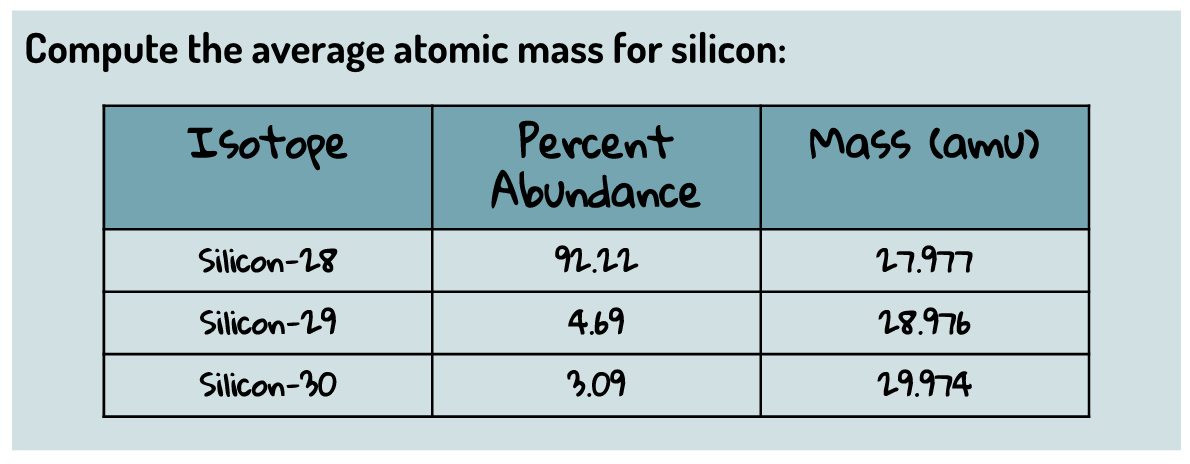
Compute the average atomic mass for silicon:
a)
27.977
b)
28.09
c)
28.976
d)
The average mass cannot be determined from provided information.
13.
A neutral atom of Carbon-13 has ________ electrons and _________ neutrons
a)
13, 13
b)
6, 7
c)
7, 7
d)
6, 6
14.
What atom matches this electron configuration?
1s22s22p63s23p64s23d10
1s22s22p63s23p64s23d10
a)
Zinc
b)
Copper
c)
Nickel
d)
Germanium
15.
What atom matches this electron configuration?
1s22s22p63s2
1s22s22p63s2
a)
Neon
b)
Magnesium
c)
Aluminum
d)
Potassium
16.
Which electron configuration belongs to Chlorine (Cl)?
a)
1s2 2s2 2p6 3s2 3p5
b)
1s2 2s2 2p6 3s2 3p6
c)
1s2 2s2 2p6 3s2 3p7
17.
What is the noble gas configuration for Sulfur?
a)
[Ar] 3p4
b)
[He] 3s2 3p4
c)
[Ne] 3s2 3p4
d)
[Na] 3s2 3p4
18.
What atom matches this electron configuration?
[Xe] 6s24f145d9
a)
Mercury
b)
Gold
c)
Platinum
d)
Thallium
19.
The Periodic Table of the Elements is useful for revealing patterns and trends in the elements. Which statement accurately describes a pattern in the size of atomic radii in the Periodic Table of the Elements?
a)
Atomic radii decrease from left to right across a period and decrease from top to bottom in a group.
b)
Atomic radii increase from left to right across a period and increase from top to bottom in a group.
c)
Atomic radii decrease from left to right across a period and increase from top to bottom in a group.
d)
Atomic radii increase from left to right across a period and decrease from top to bottom in a group.
20.

The symbols W, X, Y, and Z represent four elements shown on the outline of a periodic table.
Which element has the highest electronegativity?
Which element has the highest electronegativity?
a)
W
b)
X
c)
Y
d)
Z
100 %

