wayground logo

Free Printable Worksheets

Font size

S
M
L
XL
Worksheets

Kingdoms Final Exam Review OL

Total questions: 45

Worksheet time: 47mins

Name
Class
Date
1.

The first word in a scientific name is the

a)

species

b)

phylum

c)

genus

d)

class

2.

The taxonomic level that would include the MOST number of species

a)

class

b)

kingdom

c)

phylum

d)

genus

3.

What characteristics are used to divide organisms into kingdoms?

a)

number of cells, nucleus, obtaining energy

b)

number of legs, mammal, reptile

c)

obtaining energy, habitat, nucleus

d)

number of cells, eggs or live birth, aquatic or terrestial

4.

Which of the following is the CORRECT form of a scientific name?

a)

canis lupus

b)

Canis Lupus

c)

Canis lupus

d)

canis lupus

5.

A FAMILY of organisms would be grouped into a LARGER taxonomic level of a

a)

phylum

b)

class

c)

genus

d)

order

6.

A FAMILY of organisms would be divided into a SMALLER taxonomic level of a

a)

phylum

b)

genus

c)

class

d)

order

7.

Which taxonomic level would include the LEAST number of organisms?

a)

species

b)

genus

c)

order

d)

phylum

8.
What are the 8 levels of classification of living things from most general to most specific?
a)
domain, kingdom, phylum, class, order, family, genus, species
b)
domain, kingdom, phylum, class, order, family, genius, species
c)
domain, kingdom, phamily, class, order, family, genus, species
d)
domain, king, phillip, class, order, family, genus, species
9.
Who is the closest relative to the birds?
a)
crocodiles
b)
sharks
c)
fish
d)
amphibians
10.
Who is the closest relative to the sharks?
a)
crocodiles
b)
sharks
c)
ray-finned fish
d)
amphibians
11.
An important difference between viruses and living cells is that viruses:
a)
contain more nuclei than cells
b)
need an energy source but cells do not
c)
cannot reproduce outside of cells
d)
cannot mutate but cells can
12.
What is an organism called when it is able to produce its own food using light energy?
a)
Heterotroph
b)
Autotroph
c)
Eukaryote
d)
Prokaryote
13.
This kingdom is eukaryotic, uni and multicellular, heterotrophic, and has a cell wall made of chitin.
a)
Plant
b)
Fungi
c)
Animal
d)
Eubacteria
14.
This kingdom is multicellular, autotrophic, and has a cell wall made of cellulose.
a)
Fungi
b)
Plant
c)
Animals
d)
Eubacteria
15.
What bird is the closest relative to bird K?
a)
D
b)
J
c)
H
d)
B
16.
Which types of organisms have a nucleus
a)
Eukaryote
b)
Prokaryote
c)
Both
17.
Which type of organism has DNA, ribosomes, but no nucleus?
a)
Eukaryote
b)
Prokaryote
c)
Both
18.
Choose the characteristics that animals must possess in the Animal Kingdom.
a)
multicellular
b)
eukaryotic and multicellular
c)
eukaryotic, multicellular, heterotroph
d)
eukaryotic, multicellular, autotroph
19.
All vertebrates have
a)
4 legs
b)
wings
c)
lungs
d)
a backbone
20.
Plants that produce seeds in cones are known as _____, while flower producing plants are known as _____.
a)
Angiosperms; Gymnosperms
b)
Nonvascular plants; Vascular plants
c)
Vascular plants; Nonvascular plants
d)
Gymnosperms; Angiosperms
21.

Angiosperms are the most successful terrestrial plants. Which of these features is unique to them and helps account for their success?

a)

Dominant gametophytes

b)

Fruits enclosing seeds

c)

Embryos enclosed within seed coats

d)

Sperm cells without flagella

22.
What kind of plant is pictured?
a)
angiosperm
b)
gymnosperm
c)
monocot
d)
dicot
23.
Seedless vascular plants, like ferns, reproduce with the use of ____.
a)
Seeds
b)
Spores
c)
Eggs
d)
Sperm
24.

What are the two groups that all plants can FIRST be divided into?

a)

Nonvascular or Vascular

b)

Seeds or Seedless

c)

Gymnosperms or Angiosperms

d)

Monocots or Dicots

25.

Which adaptation helps land plants to transport materials?

a)

Roots

b)

Vacuole

c)

Vascular Tissue

d)

Cell Walls

26.

Bacteria play very important roles in the ecosystem, but they are especially important in the nitrogen cycle.


Which of the following best describes the role(s) bacteria play in the nitrogen cycle?

a)

Different species of bacteria carry out nitrogen fixation, denitrification, and decomposition.

b)

Bacteria are parasites to many species of animals that depend on nitrogen for their survival.

c)

Several species of bacteria are producers that provide nitrogen-rich food for small animals.

d)

All bacteria produce nitrogen gas in their unique form of cellular respiration.

27.

Which of the following best describes the stigma?

a)

The narrow “neck” of the carpel

b)

The part of the stamen that makes pollen

c)

The base of the carpel that contains the seeds

d)

The part of the carpel designed to catch pollen

28.
To what domain does Kingdom Fungi belong?
a)
Eukarya
b)
Archaea
c)
Bacteria
29.
Which of the following is NOT a characteristic of Kingdom Fungi?
a)
Autotrophic
b)
Cell walls of chitin
c)
Eukaryotic
d)
Saprotrophic
30.
Fungi are made up of filaments known as _________, which allow the fungus to digest substances and absorb nutrients.
a)
Hyphae
b)
Spores
c)
Roots
d)
Fruiting Bodies
31.

Cilia are

a)

false feet that give protista movement

b)

tiny hairs that give protista movement

c)

tails that give the protista movement

32.

An example of a protista that has false feet (pseudopods) are

a)

paramedium

b)

euglena

c)

diatoms

d)

amoeba

33.
All protists are __________________________.
a)
Prokaryotic
b)
Eukaryotic
c)
Unicellular
d)
Multicellular
34.
There are three main categories of protists:  animal like, plantlike, and _________  like ?
a)
bacteria 
b)
fungus
c)
virus
d)
slime
35.
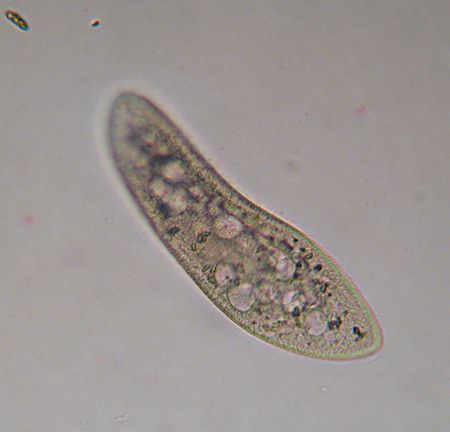
The image shows a paramecium. What structure is utilized by the paramecium for movement?
a)
Cilia
b)
Flagella
c)
Pseudopods
d)
Pili
36.
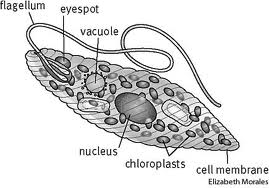
What is the function of the flagella, as seen in the diagram of a euglena?
a)
Movement
b)
Detects light
c)
Removes excess water
d)
Photosynthesis
37.
What do viruses need to reproduce?
a)
they need genetic material
b)
They need a host cell
c)
They need  bacteria
d)
They need insulin
38.
When a virus invades a living cell, its _______
takes over the cell's functions.
a)
outer coat
b)
genetic material
c)
core
d)
cytoplasm
39.
What do viruses have in common with living cells? They both...
a)
store genetic information
b)
have chloroplasts
c)
use glucose for cellular respiration
d)
have endoplasmic reticulum
40.
Reasons that viruses are considered to be nonliving is because
a)
They are not cellular
b)
They cannot reproduce on their own
c)
They cannot make proteins
d)
all of the above
41.
Which of the following occurs after a virus attaches to a host cell in the viral reproduction process?
a)
The host cell dies
b)
The virus dies
c)
The virus inserts its genetic information into the host cell
d)
copies of the virus are immediately released from the host
42.
One reason that viruses are considered to be nonliving is that they are not made of ______.
a)
protein
b)
viruses
c)
bacteria
d)
cells
43.

What can we do to reduce the rate of development of antibiotic resistant strains of bacteria

a)

Always finish a course of antibiotics

b)

Only take antibiotics when they are really needed

c)

Take antibiotics whenever it is possible

d)

Reduce the amount of antibiotics given to animals in the farming industry

44.

Any particle or organism that can cause a disease is called a

a)

bacteria

b)

virus

c)

pathogen

d)

prokaryote

45.

What do all bacteria need?

a)

oxygen

b)

food

c)

carbon dioxide

d)

a host