
 Worksheets
Honors Algebra II Final Exam Review
Total questions: 142
Worksheet time: 7hrs 18mins
Multiply 16x2x2−4⋅x+232x
x2(x−2)
4
2xx−2
x(x+4)

Samantha's hair was known to grow very rapidly. It began at a length of 6 in and grew at a rate of 14% a week.
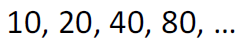
125, 25, 5, ....
Write the explicit rule:
f(x) = 3x3 + 2x2 - 6x + 7
(3x - 4x3 + 6x4 + 1) / (x + 3)
2x3 - 11x2 + 12x + 9 = 0
Solve:
log (x - 1) - log (x - 2) = log 5
7
4/9
9/4
1/7
Solve
log2(x + 5) = 3
3
4
5
6
Solve
log2(x + 2) + log2x = 3
-4, 2
-2, 4
2
1
Solve
23n = 4
2
3
2/3
4
Solve
144-6x = 11
(round to the nearest tenth)
5
0.5
0.1
1
Solve 8 = 25x+7
x = ⅘
x = ¼
x = -⅘
x = -¼
Expand log2(3y2)
log2(3) + log2(y)
2log2(3) + 2log2(y)
log2(3) + 2log2(y)
log2(y23)

Solve for the constant of variation, k. (Use / for the fraction bar)
z varies jointly as x and y. x=3, when y=-8 and z=6.
(a)
The price P of an aluminum tube is varies jointly to its radius r and the length l. If a 12-foot pipe with 5-inch radius costs 5250 pesos, how much will be the cost of a 9-foot pipe with a 6-inch radius? (Write your final answer without comma in the form: (a) pesos)
If x varies inversely as the square root of y, and x = 9 when y = 121, find x when y = 81.
7
11
13
17
The current in a simple electrical circuit is inversely proportional to the resistance. If the current is 80 amps when the resistance is 50 ohms, find the current when the resistance is 22 ohms.
90 amps
100 amps
105 amps
120 amps
Write the given statement in a mathematical equation.
Interest (I) varies jointly as the principal (P) amount deposited, and the rate (r) and time (t) of the deposit.
I = kPrt
P = kIrt
T = kPIt
r = kPIt


Multiply the Rational Expression
A.
B.
C.
D.

Divide the Rational Expression. When you divide fractions you multiply by the reciprocal.
A
B
C
D

Divide
1/6
x+10/ 6x+60
x+8/ 6x+60
(x+10)(x+8)/ 6x+60
The number of bacteria on a piece of food on the floor doubles after 10 seconds. The piece of food starts with 45 bacteria on it.
Determine the number of seconds, to the nearest second, will pass until there are 475 cells of bacteria on the piece of food.
(a)
A certain car loses half of its value every 5 years.
How many years will the computer be worth 12.5% of its initial value?
3 years
5 years
10 years
15 years
A certain car loses half of its value every 5 years.
If the value of the car after 8 years is $12,450, what was the initial value of the car?
$24,900
$19,920
$37,741
$4,107
Solve for p
SA =hp + 2B
hSA−2B=p
hSA−2B=p
2BSA−h=p
SA−2B−h=p
3y = 2g(x+h) solve for x
x = 2g3y+h
x = 2g3y−h
x = 2g3y+h
x = 2g3y−h
Find the inverse of f(x)=x2+5
f−1(x)=x−25
f−1(x)=±5+x
f−1(x)=±x−5
f−1(x)=±x−5

What is the linear function that an inverse graph will reflect across?
y = x
y = 0
(the x-axis)
x = 0
(the y-axis)
y = 1


Find the inverse of f(x)=2(x+2)2−10
f−1(x)=−2±2x+10
f−1(x)=−2±22x+20
f−1(x)=−2±22x+20
f−1(x)=−2±2x+10
Find the inverse of j(x)=x2+8x+5
j−1(x)=−4±x+11
j−1(x)=−4±x+43
j−1(x)=4±x+11
j−1(x)=4±x+43

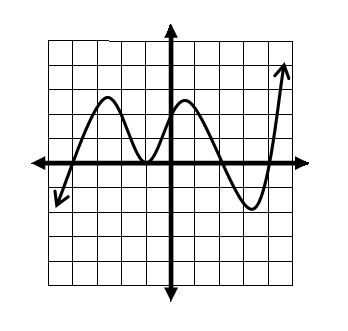
Identify the degree of the polynomial and the sign of the leading coefficient
Degree - Even
Degree - Odd
Degree - Even
Degree - Odd

Identify the degree of the polynomial and the sign of the leading coefficient
Degree - Even
Degree - Odd
Degree - Even
Degree - Odd
y = -x3 + 6x2 + 7x
as x-> ∞ f(x) -> -∞
as x-> ∞ f(x) -> ∞
as x-> ∞ f(x) -> ∞
as x-> ∞ f(x) -> -∞
What is the degree of the following polynomial?
4
6
7
2
What is the degree of the following polynomial?
9
10
11
12
y = (x + 2)(x - 7)3
Zeros: – 5(multiplicity of 3), 9(multiplicity of 2), – 2, 4.
What is the change in the graphs from f(x) to g(x)?
Right nine and down seven
Left nine and down seven
Left nine and up seven
Right nine and up seven
What is the graph of the function; f(x)=log9(x−5)+3?


A BOBO graph has a Horizontal Asymptote at:
It does not have an HA
y = 0
y = 2
y = 1
An EATS DC graph has a Horizontal Asymptote at
It does not have one
It depends on the coefficients
y = 1
y = 0
A BOTN graph as a Horizontal Asymptote at
y = 0
y = 1
y = 2
It does not have an HA

This rational function is a:
BOBO
BOTN
EATS DC
Linear
What is the vertical asymptote for the equation f(x)=x+8(x−1)(2x+5)
x = 8
x = 1
x = 1 and x = -5/2
x = -8
What are the x-intercepts for the function f(x)=x−9(x−2)(x+6)
x = 9
x = 2, x = 9
x = 2 and x = -6
x = -2 and x = 6
What is the horizontal asymptote for the equation f(x)=x2−6x+9x2+2x−7
y = 0
y = 1
y = 97
There is no horizontal asymptote.
What is the slant asymptote for the equation f(x)=x+3x2−5x+7
x=y+8
y = 8
y=x−8
y=x+7
Where is the removable discontinuity for the equation f(x)=(x−2)(x+4)x−2
(2, 1/6)
(-2, 1/2)
(4, 1/2)
There is no removable discontinuity.

Identify the Slant Asymptote for this function.
y = 5x - 7
y = 5x + 13
y = 5x + 3
y = 5x + 7
Which of the following functions does NOT have a removable discontinuity?
f(x)=x−4x2+10x+16
f(x)=x2+10x+9x−10
Both of these have a hole
Neither of these has a hole
The following equation: f(x)=x−2x2−5x−6 Has a removable discontinuity when...
x=4
x=1
x=2
x=-2
It does not has one.
Exponential Functions have a
Horizontal Asymptote
Linear Asymptote
Vertical Asymptote
Diagonal Asymptote
Rewrite the equation log3181=−4
31−4=81
−431=81
log−481=31

What is the asymptote of y = 2x - 3
y = 0
y = -3
x = 0
x = -3
The asymptote of y = 2x+5 will shift...
up five to y = 5
down five to y = -5
will not shift and remain y = 0
The asymptote of y = 2x + 4 will shift...
up four to y = 4
down four to y = -4
not shift at all and remain y = 0


Simplify:
2x−35x−3x+14x2
no solution
(2x−3)(3x+1)−8x3+27x2+5x
(2x−3)(3x+1)−8x3+3x2+5x
(2x−3)(3x+1)7x2+17x
Simplify:
2x+36−x−18
(x−1)(2x+3)−10x+18
(x−1)(2x+3)−10x−30
(x−1)(2x+3)22x+18
(x−1)(2x+3)22x+30
2x4 + 54x
2x(x + 3)(x2 - 3x + 9)
2(x + 2)(x2 - 2x + 4)
2x(x3 + 27)
2x(x - 3)(x2 + 3x + 9)
Simplify.
24a4b212a2b8
2a2b61
2a2b6
2a2b6
a22b6
ln(z42x2y)
ln2+2lnx+lny+4lnz
ln2+2lnx+lny-4lnz
2ln(2xy)-4lnz
2ln2x+lny-4lnz
Expand: log923
21log923
log9(21)−log923
log92+log93
log9 (21)+log923
Rewrite 1.6(x+2) = 14.1
log1.614.1 = x+2
log1.6(x+2) = 14.1
log14.1(x+2) = 1.6
log(x+2)1.6 = 14.1
Rewrite logx95 = 2.3
x2.3 = 95
952.3 = x
2.395 = x
x95 = 2.3
Without a calculator, determine which of the following ISN"T possible. Check all that apply.
log2 (x - 4) when x = 4
log3 (x+3) when x = 0
-2log5 (x-1) when x = 0
1/2 log (x+4) when x = -2
(51)(x−2)=125(2x−5)
What would be the BEST first step in solving the equation?
Divide by 125
Use expansion to "bring the exponents down"
Set the exponents equal to each other
Rewrite the bases as powers of 5

Solve for x
3
4
9
27

2.6
.88
1.14
.57

.77
3.83
2.83
1.83

Describe the transformations from the parent function y=log6x to y = - log 6 (x - 1) - 5
Reflection about the x-axis; shift left one and up five
Reflection about the x-axis; shift left one and down five
Reflection about the y-axis; shift right one and down five
Reflection about the x-axis; shift right one and down five

What type of roots does the polynomial have?
Three real
One real, and two imaginary
Two real, and one imaginary
Three imaginary
Which of the following would be the correct factored form with roots 2, 5i, and 6?
(x-6)(x-2)(x+5i)(x-5i)
(x+6)(x+2)(x+5i)
(x-6)(x-2)(x-5i)
(x+6)(x+2)(x-5i)
Does this function have any vertical asymptotes? If so, what are their equations? y=(x−4)(x+3)(x−4)(x+7)
No vertical asymptotes.
One vertical asymptote: x = 4
Two vertical asymptotes: x = -3 and x = -7
Three vertical asymptotes: x = -3, x = 4, and x = -7
Find the vertical asymptote.
x=-5
x=1/2
x=-1/2
x=-3
x=2
f(x)=(x−3)(x−5)(x+7)(x−3)(x+1)
Select all of the true statements.
A hole occurs where x=3
vertical asymptote at x=3
vertical asymptote at x=5
A hole occurs where x=5
h(x)=3x(x+3)(x−6)(x+7)x(x−3)(x−6)(x+3)
Identify the x-value of the hole(s).
x=0
x=-3
x=6
x=-7
x=3
Simplify
400+4x25x2
1256x2
x3−16400x
625x2+x3
Peter can mow the lawn in 40 minutes and John can mow the lawn in 60 minutes. How long will it take for them to mow the lawn together?
48 minutes
50 minutes
24 minutes
12 minutes

Describe the transformation.
Reflect over x-axis, left 3, up 3
Reflect over x-axis, right 3, up 3
Reflect over y-axis, left 3, up 3
Reflect over x-axis, right 3, down 3

Find the coordinates of the hole.
(-3, -3)
(-3, 3)
(3, -3)
(3, 3)

What is the domain?
All real numbers
All real numbers except 4
All real numbers except 2
All real numbers except 2 and -2
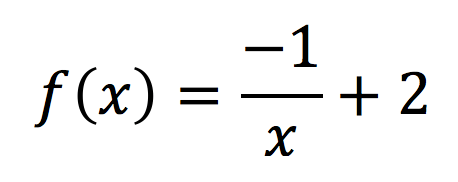
Describe the transformations of the function.
Shift up by 2 units
Reflected over the x-axis
Shift down by 2 units
Reflected over the y-axis
Shift up by 2 units
Reflected over the y-axis
Shift left by 2 units
Reflected over the x-axis
Dan can wash the tables in 20 minutes while David can wash them in 12 minutes. What equation would you use to find the time it would take both boys to wash the tables if they work together?
20x−12x=1
20x+12x=1
20x−12x=1

What is the equation of the graph?


(4a3 - 8a - 4a2) + (7a3 - 7 - 6a)
(4n4 - 8n + 4) - (8n2 + 4n4 + 1)

16x2 − 5x + 2. The area of the play area, the smaller rectangle, is 10x2 + 3x − 1. Write an expression to represent the area of the sidewalk.

A
B
C
D

A
B
C
D
Is k = -3 a zero of the function?

Cam divided (x4 + 3x2 - 4x - 2) by factor of (x-2) using synthetic division. His work is shown above. Which best describes his mistake?
Cam wrote the remainder incorrectly.
Cam did not use a zero place holder for the x3 term.
Cam added instead of subtracting the rows.
Cam should have used -2 as his division since the factor was x-2.
What is the LCD for x2+x+35= x1 ?
x2
x(x+3)
x+3
2x(x+3)
Which of the following equations makes the most sense for the following situation: Jerry works twice as fast as Kenny. If Jerry works for 2 hours and is then joined by Kenny...and they work an additional 3 hours...how fast could they each do the job alone?
x5+2x3=1
2x5+x3=1
3x+52x=1
x5+x−23=1

The time it takes for a canoe to go 4 miles upstream and back 4 miles downstream is 5 hours. The current in the lake is 2 mile per hour. Find the average speed (rate) of the canoe in still water.
x+24+x−24=5
2+x4+2−x4=5
x+24=x−25
2+x4=2−x5
Solve. (3x - 5)1/4 + 3 = 4
4/3
2
-2
-4/3
(x + 2)1/2 - 5 = -2

Solve.
x = -7, x = -2
x = 7, x = 2
x = - 7/4
no solution

Which function matches the graph?
A
f(x) = ∛(x + 3) + 2
B
f(x) = − ∛(x - 3) + 2
C
f(x) = ∛(x - 3) + 2
D
f(x) = ∛(x - 2) + 3

Which function matches the graph?
A
f(x) = √(x - 1) + 3
B
f(x) = − √(x + 1) + 3
C
f(x) = √(-x + 1) + 3
D
f(x) = − √(x + 3) − 1

What transformations have occurred to get from the parent function f(x) to the transformed function g(x)?
reflection over the x-axis,vertical shrink by a factor of -5
reflection over the x-axis,vertical shrink by a factor of 1/5
reflection over the x-axis,vertical stretch by a factor of 5
reflection over the y-axis,vertical stretch by a factor of 5


Write the exponential regression equation for the data.
Y=8.16(2.7)x
Y=81.6(2.7)x
Y=8.16(.27)x
Y=8.16(27)x

Given the sequence:
125, 25, 5, ....
Write the rule an using the geometric sequence formula:
an = (125)(1/5)(n-1)
an = 625(1/5)(n-1)
an = 625(5)(n-1)
an = 125 + 5n
which sequence has a common ratio of -2?
4, 8, 16, 32
4, -8, 16, -32
32, 16, 8, 4
-32, 16, -8, 4

Is the table linear, exponential, Quadratic, or not a function at all?
Linear
Exponential
Quadratic
Not a function

Is the Equation Linear, Exponential, Quadratic, or not a function at all?
Linear
Exponential
Quadratic
Not a function


