
 Worksheets
Properties of Matter- Mid Unit Test
Total questions: 60
Worksheet time: 46mins
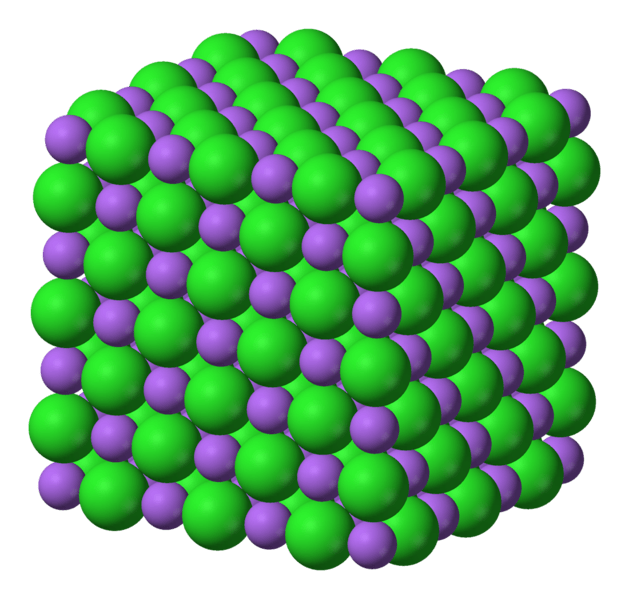
Which state of matter does this picture show?
Solid
Liquid
Gas
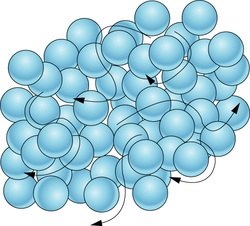
What state of matter does this picture show?
Solid
Liquid
Gas
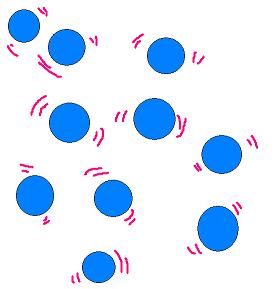
Which state of matter does this picture show?
Solid
Liquid
Gas
As temperature increases, what happens to particles?
They speed up
They slow down
As temperature decreases, what happens to particles?
They speed up
They slow down
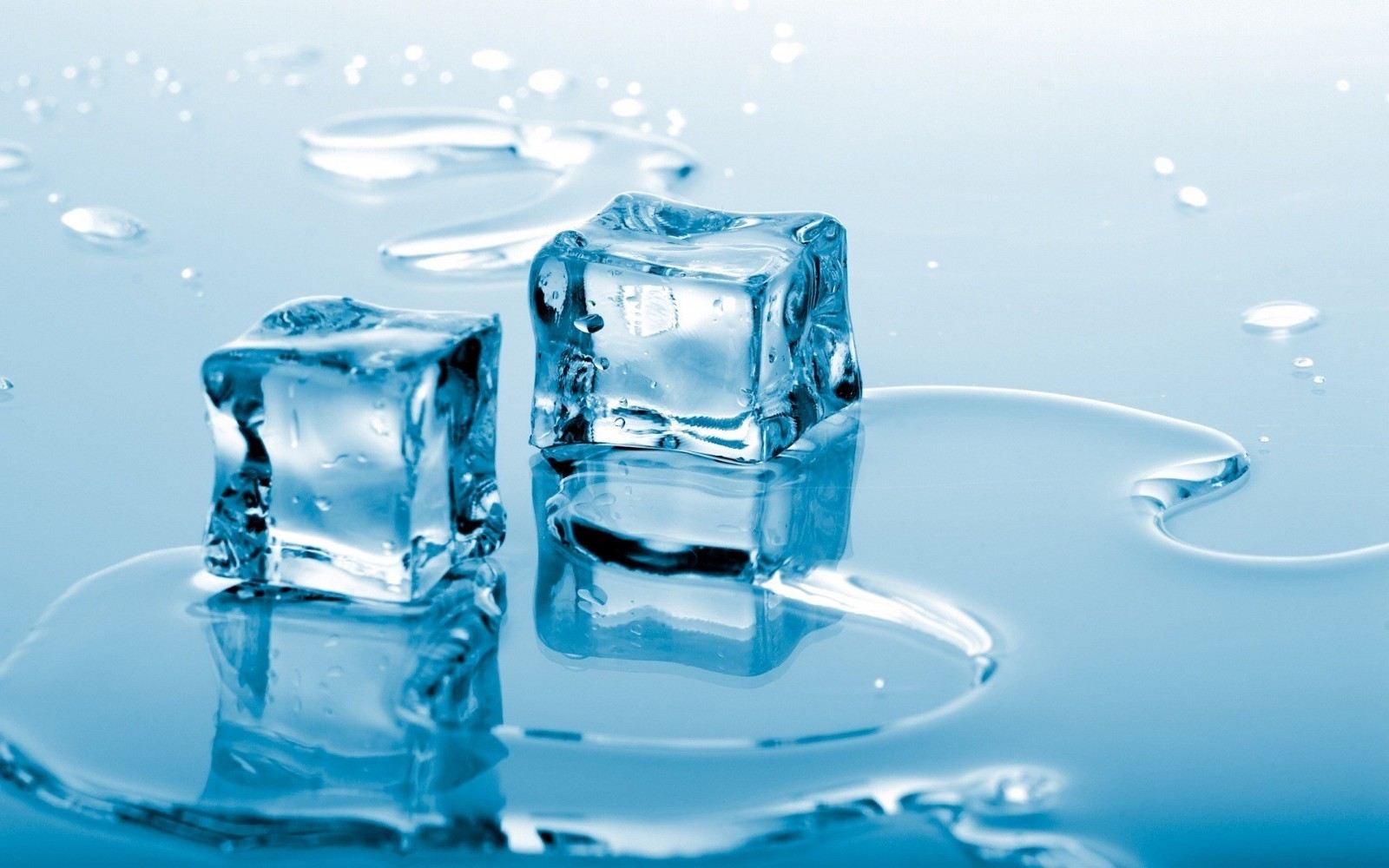
What is happening in this picture of ice melting?
Molecules are speeding up
Molecules are slowing down

What is happening in this picture of water boiling?
Molecules are speeding up
Molecules are slowing down
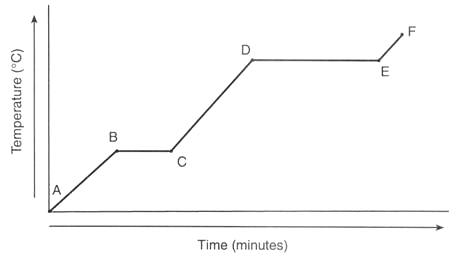
What state/phase is the object likely from points A to B?
Solid
Liquid
Gas
Plasma
What is happening to the particles in the substance between points D and E?
Melting
Freezing
Vaporizing
Sublimating

Is the substance gaining or losing energy?
Gaining
Losing

Use the graph below to answer this question. What state of matter would the substance be at point F?
solid
liquid
gas

Use the graph below to answer this question. Which point on the graph represents the boiling point?
B
C
D
E

Use the graph below to answer this question. At which point is the substance a solid?
A
C
E
F
Chemical or Physical:
A characteristic of matter that can be observed with your 5 senses is a ____________ property.
Chemical
Physical
Chemical or Physical:
A characteristic of matter that can only be observed when matter is changed into a new kind of matter.
Chemical
Physical
Chemical or Physical:
The words "blue", "large", and "soft" all describe __________ properties.
Chemical
Physical
The ability of matter to change when heated is a _____________.
Chemical
Physical
Chemical or Physical:
Rusting or tarnishing describes matter undergoing a __________ change with gases in the air.
Chemical
Physical
Chemical or Physical:
Color, shape, texture, and luster are all examples of _______________ properties of matter.
Chemical
Physical
Chemical or Physical:
Mass, volume, or density of an object is a _______________ property of that object.
Chemical
Physical
Chemical or Physical:
The ability to cook, burn, rust, tarnish, or explode is an example of a ___________ property.
Chemical
Physical
Chemical or Physical:
______________ properties include how a substance reacts with other substances.
Chemical
Physical
Chemical or Physical:
The ability to burn is a _______________ property of wood, but not a property of silver.
Chemical
Physical


What key words, when present in a question about chemical reactions, might indicate a chemical change is occuring? Check all that apply.
Bubbling
Fizzing
Dissolving
Evaporating
three hydrogen (H)
one sulfur (S)
four oxygen (O)

H2SO4

What are the reactants?
What are the products?

How many nitrogen atoms are there?
4
8
10
20

How many phosphorus atoms are there?
0
1
3
4
The positive particle in an atom.
proton
neutron
electron
electron cloud

How many protons does Nitrogen have?
7
8
14
14.01

Which of the labeled structures is a neutron?
a
b
c

What is the mass number of this element?
7
8
14
14.01
The negative particle in an atom.
proton
neutron
electron

Which of the labeled structures is an electron?
a
b
c
If an element has an atomic number of 11 and a mass number of 23, how many neutrons does it have?
11
12
23
34
The neutral particle in an atom.
proton
neutron
electron
Which of the following particles is NOT found in an atom's nucleus?
proton
neutron
electron
An element has 17 protons and 18 neutrons in the nucleus. What is the element's mass number?
17
18
1
35

What is the chemical symbol of this element?
79
Au
AU
gold

