wayground logo

Free Printable Worksheets

Font size

S
M
L
XL
Worksheets

Review; CP/S Final

Total questions: 97

Worksheet time: 1hrs 10mins

Name
Class
Date
1.

Name the compound Fe(NO3)2.

a)

Iron (II) Nitrate

b)

Iron (II) Nitrite

c)

Iron (III) Nitrate

d)

Iron (III) nitride

2.
Matter that has a definite shape and a definite volume is
a)
a liquid. 
b)
an element. 
c)
a solid.
d)
a gas.
3.
Which of the following is not a physical state of matter?
a)
solid 
b)
element
c)
gas 
d)
liquid
4.

What is the definition of matter?

a)

Anything that has mass and takes up space

b)

A substance that is liquid, solid, or gas

c)

Anything that is pure

d)

Anything that you can see or hold

5.
The law of conservation of mass states that mass cannot be
a)
burned
b)
changed in form
c)
created or destroyed
d)
heated or cooled
6.
The temperature at which a substance changes from a liquid to a solid is the
a)
freezing point
b)
saturation point
c)
boiling point
d)
condensation point
7.

What is the First Step of the scientific method

a)

Make a Hypothesis

b)

Make an Observation/Ask a question

c)

Create an Experiment

d)

Conduct and Experiment

8.

What do we call the part of the experiment that we change?

a)

Variable

b)

Constant

c)

Procedure

d)

Observation

9.

How many variables can be changed during an experiment?

a)

0

b)

1

c)

2

d)

3

10.

11. An experiment is being done to determine how light affects the growth of tomato plants. One plant is placed in full sunlight, the second in a shaded area, and the third in an unlit closet. What is the variable in the experiment?

a)

Type of plants

b)

Amount of water

c)

Length of the Experiment

d)

Amount of light

11.
This variable in an experiment is the one being deliberately changed by the scientist. 
a)
dependent variable
b)
independent variable
12.
There are two types of data. Which type of data involves numbers that are obtained by counting or measuring?
a)
quantitative
b)
qualitative
13.
A series of steps used by scientists to solve a problem or answer a question. 
a)
scientific method
b)
recipe
c)
metric system
14.
Two types of data scientists collect are...
a)
hypothesis and theory
b)
qualitative and quantitative
c)
metric and standard measurements
15.
Mia sets up an experiment to see how the mass of a ball affects the distance it rolls off a ramp.  Identify the INDEPENDENT VARIABLE:
a)
distance traveled by the ball
b)
mass of the ball
16.
If I study for my scientific methods quiz, then I will have a better test score. What is the DEPENDENT VARIABLE?
a)
Test score
b)
Studying
c)
Independent variable
17.
What is a hypothesis?
a)
A hypothesis is the right answer to an experiment.
b)
A hypothesis is the wrong answer to an experiment.
c)
A hypothesis is what you think will happen.
18.
Which is NOT a step in the scientific method?
a)
Make observation
b)
Form a theory
c)
Collect data
d)
Form a hypothesis
19.
Which of the following would be considered QUANTITATIVE data?
a)
Color
b)
Smell
c)
6.84 cm
d)
texture
20.

Numeric and measurable types of data such as height, age, scores, cost are called __________

a)

qualitative

b)

quantitative

21.

Categorical data such as eye color and birthplace is called __________

a)

qualitative

b)

quantitative

22.
On a graph, which axis shows the dependent variable?
a)
x-axis
b)
y-axis
c)
neither
d)
it changes
23.
On a graph, which axis shows the independent variable?
a)
x-axis
b)
y-axis
c)
neither
d)
it changes
24.
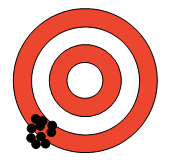
This bullseye demonstrates...
a)
High Accuracy & High Precision
b)
High Accuracy & Low Precision
c)
Low Accuracy & High Precision
d)
Low Accuracy & Low Precision
25.

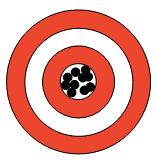
This bullseye demonstrates...

a)

High Accuracy & High Precision

b)

High Accuracy & Low Precision

c)

Low Accuracy & High Precision

d)

Low Accuracy & Low Precision

26.

Which is the more precise measurement?

a)

4 mL

b)

4.3 mL

c)

4.30 mL

d)

4.300 mL

27.

Subatomic particles with a negative charge

a)

Electrons

b)

Neutrons

c)

Protons

d)

Quarks

28.
Most of the mass in an atom is made up of _____________________?
a)
protons and electrons
b)
protons and neutrons
c)
neutrons and electrons
d)
electrons and quarks
29.
DIFFERENT kinds of atoms chemically combined to form a substance are
a)
Mixture
b)
Element
c)
Compound
d)
Substance
30.

Which subatomic particle determines the identity of an element?

a)

protons

b)

neutrons

c)

electrons

31.
What is the number of protons that the element in this image contain?
a)
14
b)
7
c)
15
d)
18
32.
Which has the LONGEST wavelength and, therefore, the lowest frequency/energy
a)
Gamma Rays
b)
Radio Waves
c)
Visible Light
d)
Infrared rays
33.
Select the correct order of waves on the EMS from the longest wavelength to the shortest wavelength
a)
Radio, Micro, Infra, Visible, Ultra, X-ray, Gamma
b)
Gamma, X-ray, Ultra, Vis, Infra, Micro, Radio
c)
Vis, Micro, Infra, Ultra, X-ray, Gamma, Radio
d)
Micro, Radio, Vis, Infra, Ultra, X-ray, Gamma
34.
Which section of the spectrum is the ONLY one we can see?
a)
X-rays
b)
Visible Light
c)
Gamma Rays
d)
Ultraviolet Rays
35.
Which of the following electromagnetic waves has the lowest energy?
a)
gamma ray
b)
infrared wave
c)
visible light wave
d)
microwave
36.
Which of the following has frequencies higher than ultraviolet rays?
a)
visible light
b)
infrared rays
c)
x-rays
37.
Which has the SHORTEST wavelength and, therefore, the highest frequency/most energy
a)
Radio waves
b)
Ultraviolet Rays
c)
Gamma Rays
d)
X-rays
38.
Which has the LONGEST wavelength and, therefore, the lowest frequency/energy
a)
Gamma Rays
b)
Radio Waves
c)
Visible Light
d)
Infrared rays
39.
What is the formula for manganese(III) oxide?
a)
MgO
b)
Mg2O3
c)
MnO
d)
Mn2O3
40.
From the following ionic compounds, choose the name-formula pair that is not correctly matched.
a)
sodium sulfide  Na2S
b)
ammonium nitrate 
NH4NO3
c)
sodium sulfate 
Na2SO3
d)
calcium oxide  CaO
41.
The formula of calcium phosphate is 
a)
CaPO4
b)
Ca2(PO4)3
c)
Ca3PO4
d)
Ca3(PO4)2
42.
How do the following two elements bond together?
Na1+  F1-         
a)
NaF
b)
NaF3
c)
Na3F
d)
Na1F2
43.
NH4 +1  and  C2O4 -2
a)
NH4C2O4
b)
(NH4)2C2O4
c)
NH4(C2O4)2
d)
correct answer is not given
44.
When adding a subscript to a polyatomic ion, you should...
a)
multiply any subscripts on the polyatomic ion by the subscript you are adding
b)
put parentheses around the polyatomic ion before adding a subscript
c)
write the new subscript next to any subscripts on the polyatomic ion
d)
put the polyatomic ion in square brackets before adding the subscript
45.

An ionic compound forms between a _______ and _______.

a)

metal and non-metal

b)

two metals

c)

two non-metals

46.

Name the ionic compound, CaCO3

a)

calcium carbide

b)

calcium carbon trioxide

c)

calcium carbon oxide

d)

calcium carbonate

47.
K20 - name?
a)
potassium dioxide
b)
potassium oxide
c)
potassium oxygen
d)
dipotassium dioxide
48.

What is the formula for diphosphorus pentoxide?

a)

P2O5

b)

PO5

c)

P5O2

d)

Po2O5

49.

What is the name for SiCl4?

a)

silicon tetrachloride

b)

silicon quadchloride

c)

monosilicon tetrachloride

d)

silicon chloride

50.
What is krypton?
a)
element
b)
compound
c)
mixture
51.

What reaction has the following general formula:

AB --> A + B

a)

Combination

b)

Decomposition

c)

Single Replacement

d)

Double Replacement

e)

Combustion

52.

What reaction has the following general formula:

A + CD --> C + AD

a)

Combination

b)

Decomposition

c)

Single Replacement

d)

Double Replacement

e)

Combustion

53.

What reaction has the following general formula:

AB + CD --> CB + AD

a)

Combination

b)

Decomposition

c)

Single Replacement

d)

Double Replacement

e)

Combustion

54.

What reaction has the following general formula:

A + B --> AB

a)

Combination

b)

Decomposition

c)

Single Replacement

d)

Double Replacement

e)

Combustion

55.

What reaction has the following general formula:
CxHy + O2 >CO2 + H2OC_xH_y\ +\ O_2\ ->CO_{2\ }+\ H_2O  

a)

Combination

b)

Decomposition

c)

Single Replacement

d)

Double Replacement

e)

Combustion

56.

What is the general reaction scheme for a combustion  reaction?

a)

A + B --> AB

b)

AB --> A + B

c)

A + CD --> C + AD

d)

AB + CD --> CB + AD

e)

CxHy+O2 > CO2+H2OC_xH_y+O_2\ ->\ CO_2+H_2O

57.

What type of reaction is the following:
3CuS +2Al > Al2S3+3Cu3CuS\ +2Al\ ->\ Al_2S_3+3Cu

a)

Combination

b)

Decomposition

c)

Single Replacement

d)

Double Replacement

e)

Combustion

58.
At the end of chemical reactions, what is the total mass of the reactants compared to the total mass of the products?
a)
the product is doubled
b)
the product is half the mass of the reactants
c)
the mass is the same
d)
the mass changes depending on the reaction
59.
The red numbers in the image below represent ________
a)
subscripts
b)
coefficients
c)
I don't know, and don't want to try
d)
None of the answers are correct
60.
The substances at the beginning of a chemical equation are called the ____
a)
product
b)
yield
c)
chemical symbol
d)
reactants
61.

What is the right part of a chemical equation called...

H2 + O2 --> H2O

a)

Reactants

b)

Products

c)

Yields

d)

Chemical Equation

62.

What is the arrow in a chemical equation...

H2 + O2 --> H2O

a)

Reactants

b)

Products

c)

Yields

d)

Chemical Equation

63.
What is the right ratio of chemicals for the BCE (Balanced Chemical Equation)?__H2 + __S --> __H2S
a)
1,1 --> 1
b)
2,2 --> 2
c)
1,2 --> 1
d)
1,2 --> 2
64.
What is the right ratio of chemicals for the BCE (Balanced Chemical Equation)?__H2SO3 + __KOH--> __H2O+ __K2SO3
a)
2,1 --> 2,1
b)
1,2 --> 1,1
c)
1,2 --> 1,2
d)
1,2 --> 2,1
65.
What is the right ratio of chemicals for the BCE (Balanced Chemical Equation)?__CH4 + __O2 --> __CO2+ __H2O
a)
2,1 --> 2,1
b)
1,2 --> 1,1
c)
1,2 --> 1,2
d)
1,2 --> 2,1
66.
What is the right ratio of chemicals for the BCE (Balanced Chemical Equation)?__AgNO3 + __H2S --> __Ag2S+ __HNO3
a)
2,1 --> 1,2
b)
1,2 --> 1,1
c)
1,2 --> 1,2
d)
1,2 --> 2,1
67.
Which of these is a property of metals?
a)
It's malleable
b)
It can't conduct electricity
c)
They are used in food
d)
It's very brittle
68.
Where are the non-metallic elements found in the periodic table?
a)
In the middle
b)
In the top rows
c)
On the left-hand side
d)
On the right-hand side
69.
I have an object that is dull, brittle, and an insulator, what is it?
a)
metalloid
b)
non-metal
c)
metal
d)
matter
70.
If you have a material that can conduct electricity well it is probably a...
a)
Metalloid
b)
Matter
c)
Non-metal
d)
Metal
71.
What physical properties are used to classify elements as metals, non-metals, or metalloids?
a)
Color, smell, physical state
b)
Reactivity, streak, hardness
c)
Ability to burn, mass, density
d)
Luster, conductivity, malleability
72.
Which of the following would help a student classify an unknown element as a metal, metalloid, or non-metal?
a)
Measure its conductivity
b)
Determine its density
c)
Find its melting point
d)
Observe its color
73.
Non-metals are good conductors of heat and electricity. 
a)
TRUE
b)
FALSE
74.
Metals are ductile, meaning they can be drawn into wire
a)
True
b)
False
c)
Never
75.
Luster is ___________
a)
A.  the way light is reflected off a surface.
b)
A.  how well a piece of matter conducts electricity. 
c)
A.  the capability of being drawn out into thin wires or threads.
d)
A.  the capability of being hammered out thin.
76.

Which of the following describes covalent bonds?

a)

Bonds form because of opposite charges

b)

electrons are shared to fill outer electron shells

c)

Electrons are transferred between atoms

d)

Covalent bonds are magical

77.
What molecule is this?
a)
CO
b)
CO2
c)
C2O
d)
C2O2
78.
How many electrons should Nitrogen have around its Lewis dot model?
a)
1
b)
3
c)
4
d)
5
79.
Ionic bonds form between metals and ____.
a)
metalloids
b)
metals
c)
nonmetals
80.
What is the formula of Sodium oxide?
a)
Na2O
b)
NaO2
c)
Na2O2
d)
Na2O
81.
An ionic bond is the attraction between:
a)
oppositely charged ions
b)
similarly charged ions
c)
neutral ions
d)
neutral atoms
82.

The octet rules states that most elements want to have _____ valence electrons.

a)

2

b)

4

c)

6

d)

8

83.
The atomic number tells you what?
a)
number of electrons
b)
number of protons
c)
number of neutrons
d)
both electrons and protons in an atom.
84.
Elements which are shiny, conduct electricity and heat are called
a)
metal
b)
nonmetal
c)
metalloid
d)
nonexistent
85.
Which is a halogen?
a)
Helium
b)
Chlorine
c)
Oxygen
d)
Neptune
86.
Which is an alkali metal?
a)
Magnesium
b)
Iron
c)
Sodium
d)
Europium
87.
If an atom had the same properties as fluorine (F), it would probably be located in
a)
period 1.
b)
period 2.
c)
group 2.
d)
group 17.
88.
Atoms with similar properties are most likely located...
a)
in the same period.
b)
in the same group.
c)
in different periods.
d)
to the right and left of each other.
89.
What is the element symbol for boron? 
a)
B
b)
Bo
c)
Bn
d)
W
90.
Each element is unique based on its number of protons, also known as the...
a)
atomic mass
b)
valence number
c)
atomic symbol
d)
atomic number
91.
The atomic number of this pictured element is
a)
28
b)
58.6934
c)
Ni
d)
Nickel
92.
what does the 6 represent?
a)
Atomic mass
b)
atomic number
c)
chemical symbol
d)
element name
93.
Group Name and Number for Neon
a)
Alkaline Earth Metals 2 or 2A
b)
Noble Gases 18 or 8A
c)
Halogens 17 or 7A
d)
Alkali Metals 1 or 1A
94.
A neutron has a charge of
a)
+2
b)
No charge
c)
-1
d)
+1
95.
What is the atomic mass of Neon?
a)
10
b)
30
c)
10.18
d)
20.18
96.
Which is a neutron?
a)
A
b)
B
c)
C
97.
What is the formula to solve for the neutron?
a)
Mass + Atomic Number= Neutrons
b)
Mass x Atomic Number = Neutrons
c)
Mass - Atomic Number = Neutrons
d)
Mass + Number of Protons = Neutron