Worksheets
Semester 2 Final Exam Review
Total questions: 182
Worksheet time: 4hrs 56mins
If you increase your work and decrease your time, you will have
more power
less power
same amount of power
power rating can not be determined
Person A and Person B are both using the same amount of work to lift something. Person A takes half as much time to do it. Who has greater power.
Person A
Person B
If you lift a box that is twice as heavy as your friend you are doing
the same amount of work.
two times more work than your friend.
half as much work as your friend.
Cannot be determined.
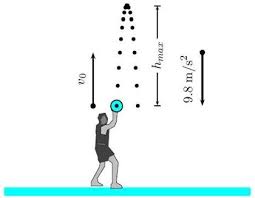
If a 0.5 kg ball is thrown up with 250 J of kinetic energy, how high will it go?
(HINT: At the ball's highest point it has stopped.) KE = 1/2mv2
g = 9.8 m/s2
51 m
25.5 m
12.76 m
31.6 m
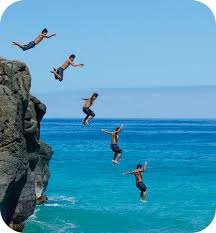
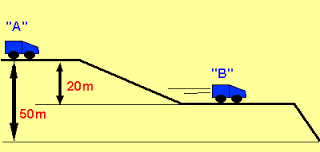
A cliff diver with a mass of 125 kg jumps off a 50m high cliff, how fast will he be traveling just before he hits the water? (His height at this point is 0m)
(HINT: Find PE first.) KE = 1/2mv2
g = 9.8 m/s2
61,250 m/s
980 m/s
31.3 m/s
247.5 m/s

A girl weighs 400 N. She runs up a flight of stairs of height 5 m in 4 seconds. Her power is:
320 W
400 W
500 W
2 000 W

Two equal mass marbles are at the top of a frictionless ramp. One marble falls to the ground off the back while the other rolls down the ramp. What is true about the marbles when they reach the ground?
The marble that rolled down the ramp is moving faster than the marble that fell.
The marble that fell down the back of the ramp is moving faster than the marble that rolled.
The marble that rolled down the ramp is not moving when it reaches the ground.
The two marbles are moving with the same speed.

Tarzan runs at 9 m/s and grabs a vertically hanging vine. He swings upwards. How high into the air does he swing? Ignore air resistance.
4.1 m
9.8 m
0.46 m
8.3 m
A 80.0-kg fireman slides down a 3.00-m pole by applying a frictional force of 400. N against the pole with his hands. If he slides from rest, how fast is he moving once he reaches the ground?
2.1 m/s
4.2 m/s
5.5 m/s
8.0 m/s

Find work done from 0 m to 3 m.
9 J
1 J
4.5 J
Cannot be determined
A 12 kg book is pushed from rest to a final velocity of 10 m/s. The book travels 6 m. How much force was the book pushed with?
600 N
100 N
200 N
1200 N
Find work done from 8 m to 10 m.
12 J
5 J
10.5 J
Cannot be determined


A wave of constant wavelength diffracts as it passes through an opening in a barrier. As the size of the opening is increased, the diffraction effects
decrease
increase
remain the same
What is the relationship between wavelength and diffraction.
direct, larger wavelength = more diffraction
direct, larger wavelength = less diffraction
inverse, larger wavelength = more diffraction
inverse, larger wavelength = less diffraction

The image of the two waves depicts
Constructive interference
Destructive interference

The two blue and purple waves will undergo _________________ when they meet.
Constructive interference
Destructive interference
What is the relationship between source separation and interference.
direct, larger separation = more interference
direct, larger separation = less interference
inverse, larger separation = more interference
inverse, larger separation = less interference
What is the relationship between frequency and interference.
direct, larger frequency = more interference
direct, larger frequency = less interference
inverse, larger frequency = more interference
inverse, larger frequency = less interference

In this image, the wave is passing into a ______ dense medium and the velocity is _________.
more dense; slowing down
less dense; slowing down
more dense; speeding up
less dense, speeding up
In this image, the transmitted wave has the _________ ____________ and _________ _________.
same wavelength and smaller frequency
smaller wavelength and same frequency
same wavelength and same frequency
smaller wavelength and larger frequency
When a wave pulse hits the end of the rope that is fixed (known as a fixed boundary), the pulse returns with no change of phase.
True
False
When a wave pulse hits the end of the rope that is free to move (known as a free boundary), the pulse returns with no change of phase.
True
False
When the transverse wave pulse is reflected, the amplitude of the reflected wave is _____ than the original because part of the wave energy is absorbed by the new medium.
smaller
larger

The frequency of a wave is 3.3 Hz. If the wavelength is 7.4 m, how fast is the wave moving?
2.24 m/s
24.4 m/s
0.45 m/s
0.24 m/s
The speed of sound depends on these two things:
The type of medium and the temperature of the medium
Speed of the medium and temperature of the medium
Temperature of the medium and sound of the medium
None of the above
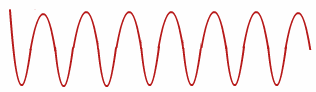
Which of these sound waves has the highest frequency?
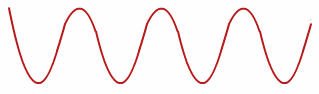
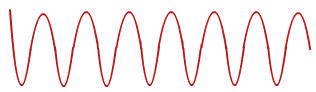

Which sound wave has the lowest pitch?

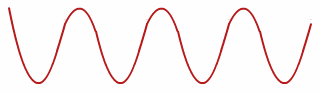
______________ sounds have a larger amplitude
quiet
loud
Sound waves that are higher than the range of human ear are known as ----
Infrasonic waves
Ultrasonic waves
A man stood 680 m from a cliff and shouted. How long after shouting does this person hear the echo back? Let the speed of sound in air be 340 m/s.
2s
1s
4s
6s
People often use the reflection of ultrasound to determine the depth of the sea. Assume the ship emits a sonar and picks up its reflection from the seabed after 1 second. Calculate the approximate depth of the seabed, knowing the speed of ultrasonic propagation in water is 1500 m/s.
1500m
750m
500m
1000m

Tuning fork ‘A’ has a frequency of 256 Hz.
A student strikes Tuning fork 'A' and Tuning fork 'B' with a mallet and they hear 4 beats every 2 seconds. What are the two possible frequencies for Tuning fork 'B'?
260 Hz and 252 Hz
258 Hz and 254 Hz
264 Hz and 248 Hz
256.5 Hz and 255.5 Hz
amount of sound energy that passes through a square meter of space in one second
intensity
pitch
reverberation
transmission
A number scale which indicates the loudness of sound (dB)
Sound
Noise
Frequency
Decibel
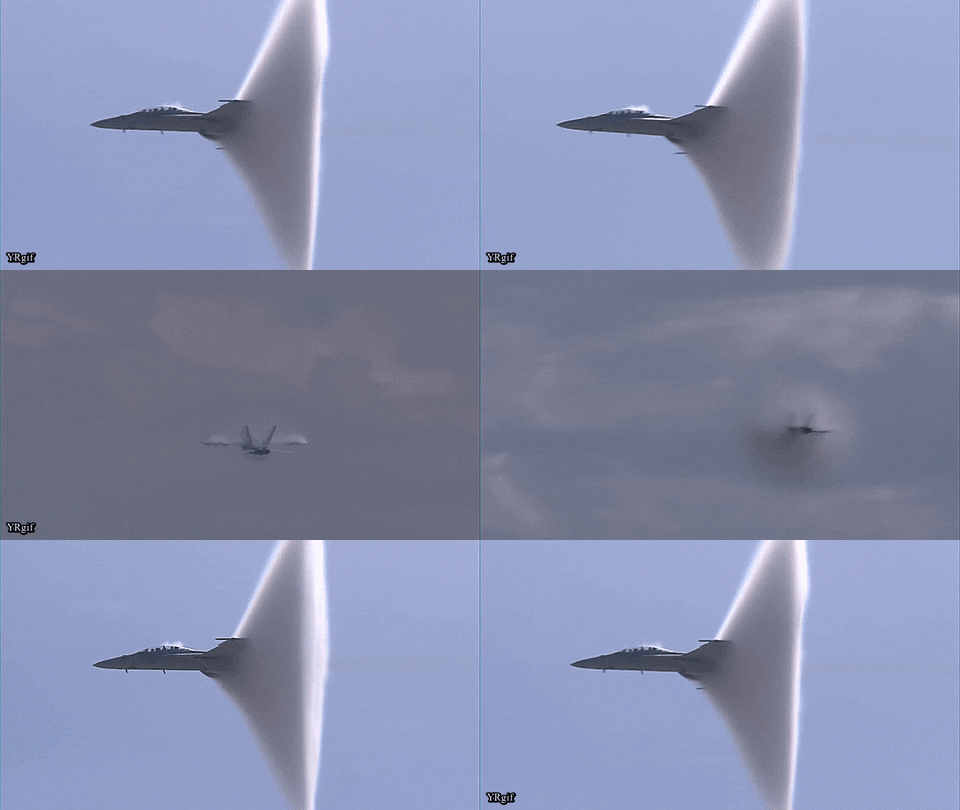
LOOK AT THE AIRPLANE WHAT TERM BELOW BEST DESCRIBES ITS MACH VELOCITY (SPEED).
Subsonic
Infrasonic
Supersonic
Ultrasonic
The sound of the approaching siren of ambulance seems to be
lower-pitched and softer
lower-pitched and louder
higher -pitched and become softer
higher - pitched and growing louder




Look at the diagram. At which positions will the overlapping waves have the most constructive interference?
Positions #1 & #5
Positions #2 & #3
Positions #3 & #4
Positions #4 & #5
Look at the diagram. At which positions will the overlapping waves have the most destructive interference?
Positions #1 & #5
Positions #2 & #3
Positions #3 & #4
Positions #4 & #5

The horn of a moving vehicle produces a sound of constant frequency. Two stationary observers, A and C, and the vehicle’s driver, B, positioned as represented in the diagram below, hear the sound of the horn. Compared to the frequency of the sound of the horn heard by driver B, the frequency heard by observer A is
lower and the frequency heard by observer C is lower
lower and the frequency heard by observer C is higher
higher and the frequency heard by observer C is lower
higher and the frequency heard by observer C is higher
Sound becomes audible to the human ear at an intensity of
I0 = 103 W/m2
I0 = 1012 W/m2
I0 = 10-3 W/m2
I0 = 10-12 W/m2
A 30 dB sound is ___________ than the quietest sound we can hear.
3 times greater
30 times greater
10 times greater
1000 times greater
A sound has a sound level of 60 dB. What would its sound level be if the intensity were increased by a factor of 1000?
63 db
90 db
100 db
180 db
A student stands 10 meters away from a sound source. The student walks toward the sound source to a 5 meter distance. Which is true?
The intensity is multiplied by 2
The intensity is multiplied by 4
The intensity is divided by 2
The intensity is divided by 4
The sound level of one violin is 55 dB. How many violins would need to be playing together to have a sound level of 85 dB?
30 violins
130 violins
100 violins
1000 violins
10,000 violins
A student stands 10 meters away from a sound source. The student walks away from the sound source to a 50 meter distance. Which is true?
The intensity is divided by 5
The intensity is multiplied by 5
The intensity is divided by 25
The intensity is multiplied by 25
What is the intensity of sound waves produced by a trumpet at a distance of 1.6 m when the power output of the trumpet is 0.30 W?
5.9 × 10⁻³ W/m2
1.5 × 10⁻² W/m2
9.4 × 10⁻³ W/m2
What is the 2nd overtone for an open tube whose first fundamental frequency is 272Hz.
1016 Hz
816 Hz
90.7 Hz
272 Hz
Stan Ding waives is playing his open tube. The frequency of the first overtone is 880 Hz. The speed of sound through the pipe is 350 m/sec. Find the length of the tube.
0.2 m
0.8 m
0.4 m
Determine the frequency of the fundamental for a closed tube whose 2nd overtone frequency is 1620 Hz.
1286 Hz
648 Hz
4 Hz
324 Hz

Determine the wavelength of the wave in this 85-cm long air column.
42.5 cm
85 cm
42 cm
none of them.
Determine the frequency of the wave in this 85-cm long air column. (V=343 m/s)
807 Hz
403 Hz
1614 Hz
What is the frequency of the second overtone for an open tube whose fundamental frequency is 272Hz.
1088 Hz
816 Hz
544 Hz
272 Hz
Stan Ding waives is playing his closed-tube pipe. The frequency of the sound is 880 Hz. The speed of sound through the pipe is 350 m/sec. Find the length of the pipe.
350 m
4 m
0.1 m
0.398 m
What color of the rainbow has the longest wavelength?
red
blue
green
violet
bending of light that happens when light travels through different mediums (substances)
reflection
refraction
diffusion
Gamma Rays are
High energy
Low energy
Medium energy
Just right

Why does this car appears red under a white light?
The car is absorbing the red light and reflecting the blue and green.
The car is reflecting only the red light while absorbing the blue and green.
The car is absorbing the red and green light while reflecting the blue.
The car is absorbing the red, blue and green, but our eyes can only see the red.

This drawing illustrates the ________________________ of a light wave.
refraction
reflection
diffraction
dispersion

In this diagram, which is the angle of incidence?
Angle A
Angle B
Angle C
Angle D

A concave mirror is shaped like the inner surface of a sphere. How do you think light rays will reflect off a concave mirror?
Reflected rays converge toward the center line of a concave mirror.
Reflected rays diverge away from the center line of a concave mirror.
Reflected rays reflect straight back at the angle that they came in.
Reflected rays are absorbed by a concave mirror.
Objects that generate their own light are called:
luminous objects.
illuminated objects.
shiny objects.
reflective objects.

A ray of light is incident towards a plane mirror at an angle of 30-degrees with the mirror surface. What will be the angle of reflection?
60o
30o
90o
45o


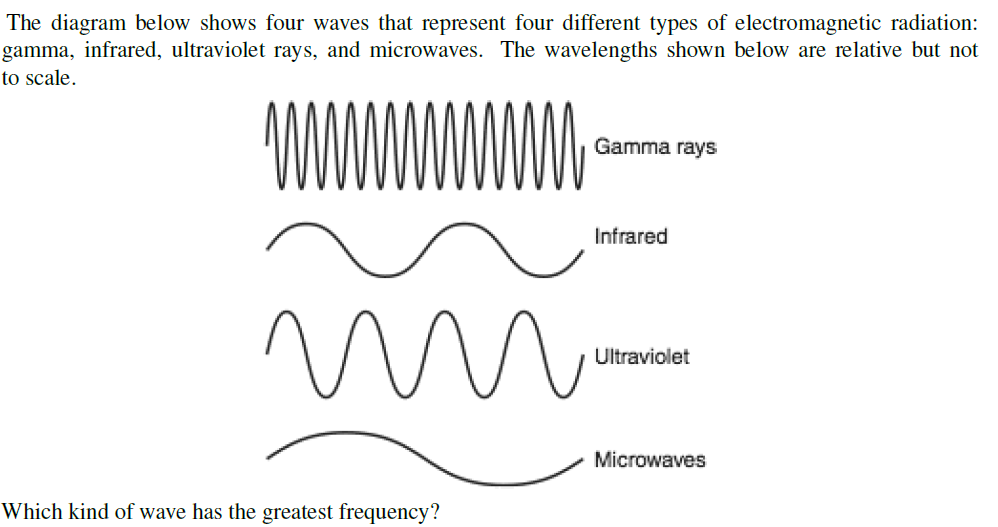


Solve this problems using the equation: C = λ x ν
If an AM radio station broadcasts at 9.95 x 10² kHz, what is the wavelength of this radiation? (Convert to Hz first).
6.59 x 10⁻²⁸ m
1.01 x 10⁻⁶ m
3.32 x 10⁻³ m
301 m
Solve this problems using the equation: C = λ x ν
A microwave oven emits radiation at a wavelength of 5.00 x 10⁻¹cm. What is the frequency of this radiation?
(Convert to m first).
6.67 x 10⁻⁷ Hz
2.00 Hz
1.50 x 10⁶ Hz
6.00 x 10¹⁰ Hz
Violet light has a wavelength of 4.10 x 10⁻¹² m. What is the frequency?
1.23 x 10 -3 Hz
7.31 x 10¹⁹ Hz
1.37 x 10¹² Hz
3.0 x 10⁸ Hz


flint glass n=1.70
barium glass n=1.60
crown glass n=1.523
water n=1.33
diamond n=2.45
flint glass n=1.70
barium glass n=1.60
crown glass n=1.523
water n=1.33
diamond n=2.45
diamond n=2.45
flint glass n=1.70
barium glass n=1.60
crown glass n=1.523
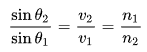
Light travels from air (n = 1.000) into an optical fiber. If the angles of incidence and refraction are 22oand 15º respectively. what is the index of refraction inside the fiber? Round off your values to 3 sig. figs.
1.45
1.44
0.69
0.70
There are certain angles of incidence for which the angle of refraction is close to 90°. What is this angle called?
Total internal angle
Critical angle
Reflection angle
Refracted angle
If a material has an index of refraction of 2.3, how fast will light travel through that material?
2.3 x 10⁸ m/s
6.9 x 10⁸ m/s
3.0 x 10⁸ m/s
1.3 x 10⁸ m/s

Light travels from air (n = 1.00) into a second material. The incident ray of light hits the surface at angle of 64o and the refracted ray enters the second material at an angle of 32o. What is the index of refraction of the second material? n1sin(Θ1) = n2sin(Θ2)
1.4
0.90
0.53
1.7
When a beam of light traveling in air enters a glass block, it undergoes a change in
speed only
wavelength only
frequency only
speed and wavelength
speed and frequency
A ray of light passes from air into carbon disulfide (n = 1.63) at an angle of 28.0° to the normal. What is the angle of refraction?
91°
16.7°
11.6°
53°

What happens to light during total internal reflection?
The light reflects back into the original medium at the same angle.
The light refracts closer to the normal line.
The light refracts farther away from the normal line.
The light reflects at the angle it would have refracted at.
When angle of incident (i) equals to critical angle (c) if light is traveled from a denser medium to a less dense medium,
total internal reflection occurs.
angle of refraction is equal to 90 degree.
light is refracted out
light travel in straight line
When will total internal reflection occur?
When light travels from a less dense to a more dense medium
When the angle of incidence is smaller than the critical angle
When the angle of incidence is greater than the critical angle
When the light cannot pass through a medium
For total internal reflection to occur, light must
travel from a more dense to a less dense medium
travel from a less dense to a more dense medium

What is the refractive index of a fibre optic pipe if the critical angle is 30 degree?
Outside is air.
2.0
1.7
2.4
Luminous flux is measure in
Illuminence
Lumens
luminous intensity
efficacy
What is the definition of luminous flux?
Light travels in a straight path and its direction can be changed by encountering a boundary
Objects that emit their own light
The rate at which a luminous source produces light energy
The rate at which light strikes a unit area of a surface
Which statement is correct?
The illuminance is directly proportional to the distance from the luminous source.
The illuminance is directly proportional to the square of the distance from the luminous source.
The illuminance is inversely proportional to the distance from the luminous source.
The lluminance is inversely proportional to the square of the distance from the luminous source.

A lamp is giving out 1200 lm in all direction is suspended 8 m above the working plane. Calculate the illumination at a point on the plane 6 m away from the foot of the lamp
764
7.64
0.764
76.4
A light bulb with a point source illuminance flux of 2250 lm is placed 80 cm in front of a screen. Determine the resulting illuminance on the screen.
2.79 x 10-2 lx
1.8 x 10-8 lx
1.8 x 104 lx
2.79 x 102 lx
What type of image is produced by a convex mirror?
enlarged and real
reduced and virtual
enlarged and virtual
reduced and real
A concave mirror has a 7 cm focal length. You place a 2.4 cm tall object 16 cm from the mirror. Determine the image height.
- 1.9 cm
- 3.5 cm
4 cm
7 cm
The focal length for a convex lens is _______________________.
always positive.
always negative.
dependent on the location of the object.
dependent on the location of the image.
An absolute value of magnification M is greater than 1, indicates that ______________________.
the image is diminished
the image is magnified
an image is not formed
the image has the same size as the object
Which of the following lenses are used to correct farsightedness?
Any transparent lenses
Concave lenses
Convex lenses
Normal glass


Type of mirror used in a convenience store to provide a wide angle view...
Plane
Convex
Concave

Type of mirror used by a dentist to get magnified view of a patient's teeth...
Plane
Convex
Concave

Type of mirror that can produce an inverted image...
Plane
Convex
Concave
An image that forms where light seems to come from a point but light rays don't actually meet is a
virtual image
real image
Inverted Image
clear image
The point in the middle way between a curved mirror and the center of curvature is the
principal point
focal point
center of curvature
principal axis
What is the distance of your image from you if you stand 1.5 m in front of a plane mirror?
1.5 m
2.0 m
3.0 m
4.5 m
An image that forms when light rays actually meet
virtual image
real image
diffuse reflection
regular reflection

This image is
real.
virtual.

The object distance is positive and the image distance is
positive.
negative.
upright.
inverted.

The image formed by this diverging mirror is
upright, smaller, real
inverted, larger, virtual
upright, smaller, virtual
inverted, smaller, real

The image formed by this converging mirror is
upright, same size, virtual
inverted, same size, real
inverted, larger, virtual
upright, smaller, real

The image formed by this converging mirror is
upright, same size, virtual.
inverted, same size, real.
upright, larger, virtual.
inverted, smaller, real.
no image is formed.
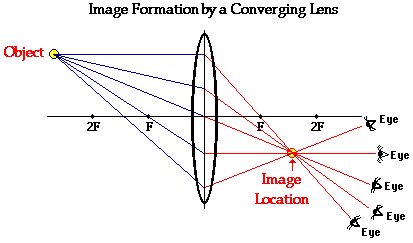

An object is placed 15.0 cm in front of a convex lens with a focal length of 10.0 cm. What is the image distance?
Satu objek diletakkan 15.0 cm di hadapan sebuah kanta cembung dengan panjang fokus 10.0 cm. Berapakah jarak imej?
6 cm
25 cm
30 cm
150 cm
An object 8.5 cm high is placed 28 cm from a converging lens. The focal length of the lens is 12 cm. Determine the height of the image.
*Hint: find di first
6.38 cm
8.5 cm
12cm
21 cm
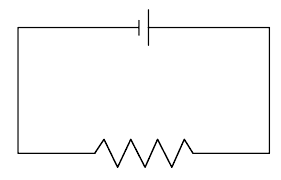
If the resistance in a constant voltage circuit is doubled, the power dissipated by that circuit will
increase by a factor of two.
increase by a factor of four.
decrease to one-half its original value.
decrease to one-fourth its original value.
If the voltage across a circuit of constant resistance is doubled, the power dissipated by that circuit will
be four times as large.
be two times as large.
decrease to one-half the original power.
decrease to one-fourth the original power.
A resistor operated at 140 V dc is rated at 1.40 kW.
(a) What is the normal operating current through the resistor?
(b) What is the resistance of the resistor?
(a) 10 A . (b) 14 Ω
(a) 14 A . (b) 14 Ω
(a) 10 A . (b) 10 Ω
(a) 0.010 A . (b) 14000 Ω
An instrument is rated at 240 W if it is connected across a 120-V dc power supply.
(a) What current does it draw under normal operation?
(b) What is its resistance?
(a) 0.20 A (b) 360 Ω
(a) 60 A (b) 2.0 Ω
(a) 2.0 A (b) 60 Ω
(a) 0.2 A (b) 60 Ω
A 200-W light bulb is connected across a 100-V dc power supply. What current will flow through this bulb?
0.90 A
0.36 A
0.60 A
2.0 A
A light bulb operating at a dc voltage of 100 V has a resistance of 200 Ω. How much power is dissipated in this bulb?
100 W
60 W
50 W
200 W

Solve for the total resistance of the circuit shown
50 V
1970 ohms
705 K ohms
20 Amps

Solve for total Current in the circuit shown
25 Amps
35 amps
25 milliamps
35 milliamps

Solve for the voltage drop at resistor 1
38 volts
60 Kvolts
50 volts
25 volts
With three 10 resistors connected in series with a 30 volt power supply, the total circuit current will equal ____.
300 amps
1 amp
150 amps
1 millamp

The voltage drop across R1 is ______________________________ V.
20
30
40
50
When a resistor in a series circuit is replaced by another resistor with an increased resistance value, the total circuit current will __________.
stay the same
decrease
increase
double in value