Worksheets
Science Final Review
Total questions: 46
Worksheet time: 1hrs 14mins
If an Ice cream melts will it be
Physical Change
Chemical change
Elemental change
states of matter changes
Hydrogen + Oxygen --> water
Identify the reactant(s).
Did a chemical reaction occur?
Identify ALL of the chemical changes
Boiling water
Burning a marshmallow
Fireworks going off
Cutting your hair
Dying your hair
Which best represents a balanced equation?
120 grams of carbon plus 20 grams of oxygen → 200 grams of carbon dioxide
120 grams of carbon plus 50 grams of oxygen → 200 grams of carbon dioxide
120 grams of carbon plus 80 grams of oxygen → 200 grams of carbon dioxide
When chemicals react in a closed container, which must be true?
The mass both before and after the reaction is the same.
The mass both before and after the reaction is variable.
The same number of compounds is present both before and after the reaction.
If 100 grams of vinegar and 5 grams of baking soda are poured in a container, a small amount of gas will be produced. What will the final mass of the products be if the gas is trapped in the container?
100 g
104 g
105 g
110 g
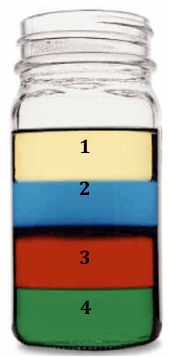

Which of the following represents the monomer of this image?


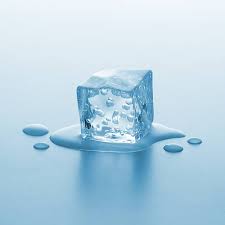
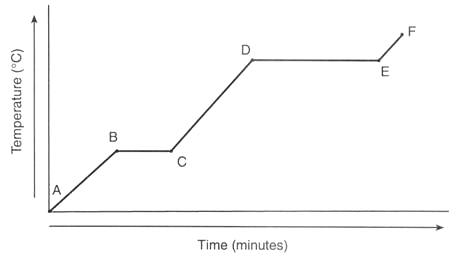
Are the particles moving faster or slower as time goes on?
Faster
Slower
What is happening to the particles in the substance between points D and E?
Melting
Freezing
Vaporizing
Sublimating

What state of matter is pictured?
Solid
Liquid
Gas
Plasma

What is the number of complete waves passing a fixed point in a given amount of time?
Amplitude
Intensity
Wavelength
Frequency

Which type of waves have the longest wavelength?
Visible light
Radio waves
X-rays
Gamma-Rays

Shorter wave lengths can carry more energy. Which of these probably carries the MOST energy:
Infrared light
Visible light
X-rays
UV light
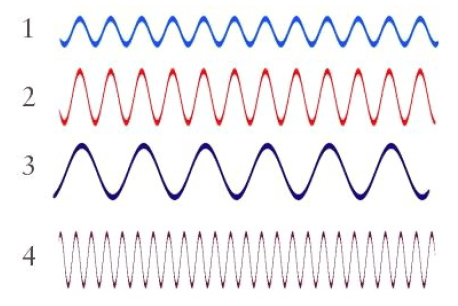

Which of the diagrams shows the least gravitational force?
I
II
III
IV
If two charges attract to each other, then which of the following is true?
Both charges must be positive.
Both charges must be negative
Both charges must be different.
Both charges must be equal in value.

A student claims that the magnetic fields are not the same across the magnet. Using the picture, what evidence best supports the claim?
The magnetic fields of the magnet are strongest at both poles.
The magnetic fields of the magnet are strongest at the north pole.
The magnetic fields of the magnet are strongest at the south pole.
The magnetic fields of the magnet are strongest at the middle
How do you increase the strength of an electromagnet?
add more magnets
larger core
increase the number of coils around the core
salt water

Which Apple has the greatest Gravitational Potential Energy?
Apple A
Apple B
Apple C
Apple D

The image shows
kinetic energy
elastic potential energy
chemical energy
sound energy

The _______________ is transformed into electrical energy inside the battery.
chemical energy
sound energy
kinetic energy
potential energy
Potential energy depends on ____________ & ______________.
mass, speed
mass, position
speed, position
mass, weight
Kinetic energy depends on _____________ & _____________.
mass, speed
mass, position
mass, weight
speed, distance
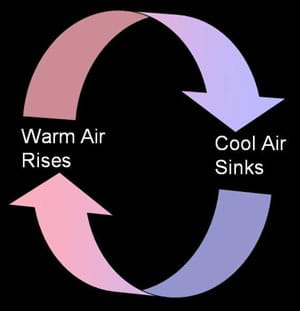
Near the ceiling of a room the air is warmer. The warm air rises because of
conduction
convection
radiation

In which section is the car undergoing positive acceleration?
a to b
b to c
c to d
d to e
f to g

Check all that apply.
constant speed
constant acceleration
zero acceleration
increasing velocity
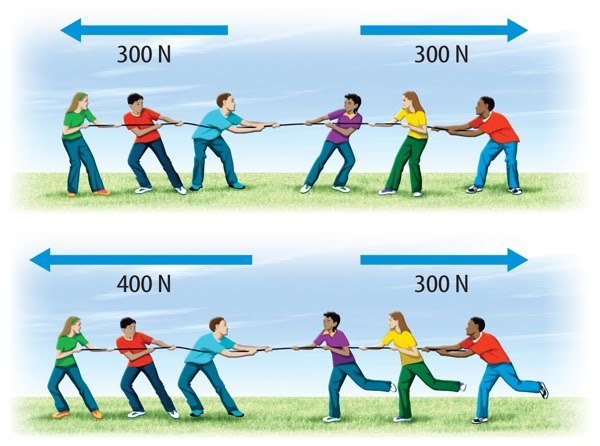
Which one is balanced?
top
bottom
both
Neither is balanced