
NEW
Font size
 Worksheets
Review of Physics
Total questions: 61
Worksheet time: 56mins
It's an example of vector quantity
Distance
Displacement
Energy
Mass
Which one of these options is NOT a vector quantity
Force
Displacement
Momentum
Energy

Vector F in the x-component is ....
F sin 30o
F cos 30o
F sin 60o
F tan 60o

Vector F in the y-component is ....
F sin 30o
F cos 30o
F cos 60o
F tan 30o
direction

Instantaneous rate of change of displacement is a definition of
Instantaneous velocity
Instantaneous acceleration
Instantaneous displacement
velocity

Describe this graph
constant acceleration
constant deceleration
object move to the left
constant velocity
How can we find distance traveled?
calculate area under v-t graph
calculate area under a-t graph
calculate area under s-t graph
A cheetah can accelerate from rest to a speed of 30.0 m/s in 7.00 s. What is its acceleration?
4.29 m/s3
4.29 m/s2
4.29 m/s1
4.29 m/s
If a ball is thrown downward at 30 m/s, what will its speed be at 4 s? (Assume no air resistance)
40 m/s
70 m/s
50 ms
10 m/s
An object free falls for 3.5 seconds. How far does it fall?
120.05 m
17.15 m
60.03 m
34.3 m

Which of the dot diagrams best describe the motion of a free-falling object that is dropped from rest?
Diagram A
Diagram B
Diagram C

At what point is vy= 0 m/s?
A
B
C
D
None of these points
At what point is vx= 0 m/s?
A
B
C
D
None of these points
In the absence of air resistance, the angle at which a thrown ball will go the farthest is?
90°
30°
60°
45°
If a ball thrown straight up into the air takes 4 seconds to reach the top (peak), how long will it take to travel from the peak back to the original position?
0s
1s
3s
4s
The path followed by a projectile is also known as its
trajectory
range
height
vertical displacement
A force is ____.
a push or pull that can cause movement
a magnet
when someone does not work
Work is _____.
using force to move an object
when a magnet attracts metals
not doing homework


A 50-kg crate is pushed with a horizontal acceleration of 20 m/s2. What net force is acting on the crate?
2.5 N
0.4 N
1000 N
30 N

A 20-N net force acts on an object with a mass of 2.0 kg. What is the object's acceleration?
10 m/s2
0.1 m/s2
40 m/s2
22 m/s2

A 10-kg crate is pushed across a frictionless surface with a force of 30 N. What is its acceleration?
300 m/s2
3 m/s2
20 m/s2
0.33 m/s2
(Using Fnet=ma), What net force is required to accelerate a car at a rate of 2 m/s2 if the car has a mass of 3,000 kg?
6,000 N
1,500 N
3,002 N
2,998 N
The acceleration of an object is proportional to...
the net force acting on it
its displacement
its velocity
its mass

Two objects experience an the amount of net force. However, object A is twice as massive as object B. How do their accelerations compare?
Object A and Object B will have the same acceleration
Object A will have a greater acceleration that Object B.
Object B will have a greater acceleration that Object A.
Neither object will accelerate.
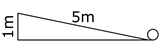
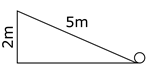
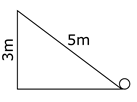
Which inclined plane requires the most effort to push the ball to the top?
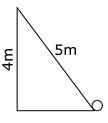
Energy is
how fast you do something.
the ability to do work.
confusing.
how fast you lift something.
If you use 30 J of energy to move an object, you have done ____ J of work.
3
10
30
0
You push a crate with a force of 100 N for 5 meters. How much work did you do?
500 J
100 J
50 J
5 J
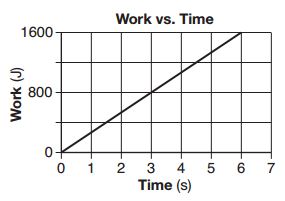
How much power was generated from 0-4 seconds?
1100 W
4 W
267 W
1600 W

How much work is done?
9 J
18 J
27 J
36 J

If it took 9 seconds for the object to move 6 meters, what's the power?
81 W
27 W
3 W
6 W
The unit for work (aka Newton-meter)
Watt
Power
Work
Joule
________________ is the rate at which work is done.
Power
Work
Time
Energy
The unit of power (aka Joule per second)
Joule
Minute
Watt
Pound
Energy that is stored and held in readiness
Kinetic
Mechanical
Work
Potential
Kinetic energy is the energy of ___________.
Distance
Motion
Work
Roman
What is the formula for work?
F = M(A)
KE = 1/2M (V)2
W = F(D)
Power = W/T

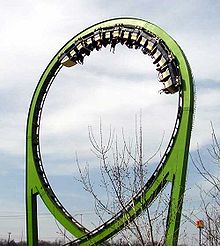
If there is no friction on this track, at which point would the coaster have the most kinetic energy?
A
B
C
D
How high up is a 3200-kg plane if it has 960000 J of potential energy?
10 m
30 m
307200000 m
300 m
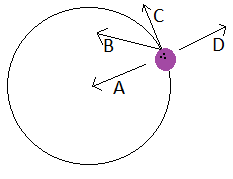
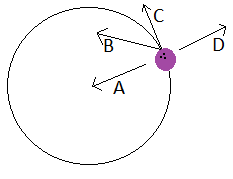
What would the force between them be if the distance between them were doubled?
What would the force between them be if one of the masses were doubled?

moving or tending to move toward a center...
centripetal force
centrifugal force
Tangent
Curvature

Which bucket has more inertia?
The bucket on the left because it has less mass
The bucket on the right because it has more mass
They have the same inertia
The bucket on the right because it has less mass

What is happening to the ice skater?
Decreased Angular velocity, decreased rotational inertia
Decreased Angular velocity, increased rotational inertia
Increased Angular velocity, increased rotational inertia
Increased Angular velocity, decreased rotational inertia
Find the angular momentum for a 5 kg solid cylinder with a 20 cm radius rotating at 3 rad/s.
3000 kg-m2/sec
0,3 kg-m2/sec
0,6 kg-m2/sec
1.2 kg-m2/sec

