wayground logo

Free Printable Worksheets

Font size

S
M
L
XL
Worksheets

Final Exam Semester 2 Biology

Total questions: 214

Worksheet time: 7hrs 34mins

Name
Class
Date
1.

The passing on of characteristics from parents to offspring

a)

Heredity

b)

trait

c)

gamete

d)

pollination

2.

Characteristics that are inherited

a)

gametes

b)

zygote

c)

traits

d)

hybrid

3.

The branch of biology that studies heredity

a)

law of independent assortment

b)

heredity

c)

genetics

d)

law of segregation

4.

male and female sex cells

a)

gametes

b)

alleles

c)

heterozygous

d)

traits

5.

transfer of pollen grains from a male reproductive organ to a female reproductive organ

a)

pollination

b)

fertilization

c)

heredity

d)

hybrid

6.

A fertilized egg cell

a)

zygote

b)

gamete

c)

hybrid

d)

genotype

7.

offspring of parents that have different forms of the trait

a)

hybrid

b)

homozygous

c)

heterozygous

d)

genotype

8.

observed trait when both are present

a)

dominant

b)

recessive

c)

hybrid

d)

heterozygous

9.

every individual has two alleles of each gene and when gametes are produced, each gamete receives one of these alleles

a)

law of segregation

b)

law of independent assortment

c)

law of the west

d)

constitutional law

10.

the way an organism looks or behaves

a)

genotype

b)

phenotype

c)

homozygous

d)

heterozygous

11.

The allele combination an organism contains

a)

genotype

b)

phenotype

c)

hybrid

d)

heterozygous

12.

An organism is ______ for a trait if its two alleles for the trait are the same

a)

homozygous

b)

heterozygous

c)

hybrid

d)

gamete

13.

An organism is ______ for a trait if its two alleles for the trait differ from each other

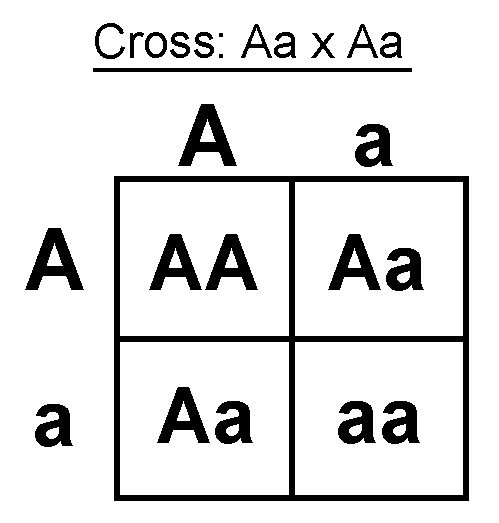
a)

heterozygous

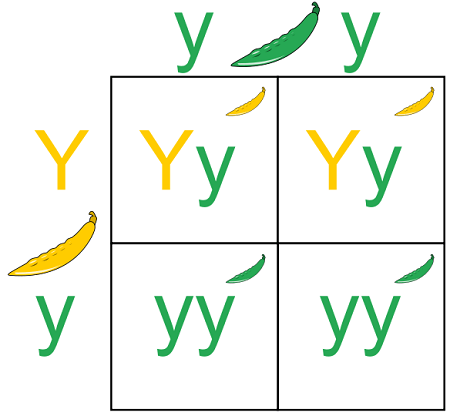
b)

homozygous

c)

hybrid

d)

dominant

14.

different traits are inherited independently of each other

a)

law of independent assortment

b)

law of segregation

c)

inheritance law

d)

law of gravity

15.

every individual has two alleles of each gene and when gametes are produced, each gamete receives one of these alleles

a)

law of independent assortment

b)

law of segregation

c)

law of gravity

d)

law of inertia

16.
The laws of probability predict what is likely to occur, not necessarily what will occur?
a)
True
b)
False
17.
A tool that can help you understand how the laws of probability apply to genetics is called a?
a)
Genetic cross
b)
Hybrid
c)
Punnett Square
d)
Combination
18.
A punnett square is a chart that does not show all the possible combinations of alleles?
a)
True
b)
False
19.
Two useful terms that geneticists use are?
a)
Phenotype and Kenotype
b)
Kenotype and Genotype
c)
Genotype and Phenotype
d)
Domininant and Kenotype
20.
An organisms Phenotype is its what?
a)
Genetic makeup
b)
Recessive Trait
c)
Dominant Trait
d)
Physical makeup
21.
An organisms genotype is its what?
a)
Genetic makeup
b)
Recessive Trait
c)
Dominant trait
d)
Physical trait
22.
An organism that has two identical alleles for a trait is said to be what?
a)
Hybrid
b)
Co-dominant
c)
Homozygous
d)
Heterozygous
23.
An organism that has two different alleles for a trait is?
a)
Hybrid
b)
Co-Dominant
c)
Homozygous
d)
Heterozygous
24.
In codominance the alleles are neither dominant or recessive?
a)
True
b)
False
25.
Whos discoveries set the foundation for the study of genetics?
a)
Oliver
b)
Taylor
c)
Mendel
d)
Newton
26.
Heredity is the passing of traits from _____________________ to _____________________
a)
predators to prey
b)
water to rain
c)
parents to offspring
d)
fungi to protists
27.
___________________________ is the study of how traits are passed on, or inherited.
a)
dominant traits
b)
ratio
c)
phenotype
d)
genetics
28.
If a child has red hair, they inherited a certain _______________ from their parents.
a)
ratio
b)
trait
c)
probability
d)
sex chromosome
29.
One trait that is ALWAYS present and causes the other traits to disappear is a ________________________
a)
recessive trait
b)
aggressive trait
c)
absent trait
d)
dominant trait
30.
Which of the following pairs is homozygous dominant?
a)
Hh
b)
pp
c)
HH
d)
aa
31.
Which of the following is heterozygous?
a)
Hh
b)
gg
c)
HH
d)
GG
32.
Which characteristic would a child not inherit from one or both of its parents?
a)
freckles
b)
hair style
c)
eye color
d)
dimples
33.
A ________________________ is used to predict the possible genotype from certain parents
a)
Mendel Grid
b)
Genetic Tic Tac Toe
c)
Punnett Square
d)
Pedigree Plot
34.
Gregor Mendel is often called ....
a)
The father of heredity.
b)
The father of genetics.
c)
The king of peas
d)
The father of punnett squares.
35.

Two parents have a heterozygous genotype for eye color. What is the chance of having a blue eye baby?

a)

0%

b)

25%

c)

50%

d)

75%

e)

100%

36.

If a homozygous recessive woman marries a heterozygous man. What is the chance of having a baby with dimples?

a)

0%

b)

25%

c)

50%

d)

75%

e)

100%

37.

A blue eyed woman marries a heterozygous man. What is the chance of having a blue eye baby?

a)

0%

b)

25%

c)

50%

d)

75%

e)

100%

38.

A heterozygous woman marries a heterozygous man. What are the chances of a blonde hair baby?

a)

0%

b)

25%

c)

50%

d)

75%

e)

100%

39.

If a Heterozygous woman marries a Heterozygous man. What is the chance of having a baby with dimples?

a)

0%

b)

25%

c)

50%

d)

75%

e)

100%

40.

Where are chromosomes found?

a)

vacuole

b)

cell membrane

c)

nucleus

d)

mitochondria

41.

Segments of DNA (Deoxyribonucleic acid) found in chromosomes that give instructions for producing a certain characteristic.

a)

heredity

b)

gene

c)

allele

d)

genotype

e)

phenotype

42.

The passing of physical characteristics, or traits, from parent to offspring.

a)

Genetics

b)

Dominant allele

c)

Heredity

d)

Recessive allele

43.

The different forms of a gene.

a)

Genes

b)

Allele

c)

Phenotype

d)

Pedigree

44.

An organism that has two different alleles for a trait.

a)

Genes

b)

Heterozygous

c)

Genotype

d)

Dominant allele

45.

Chromosomes are

a)

Found in the mitochondria

b)

Made of 20 pairs

c)

Long strands of DNA that contain many genes

d)

Bundles of DNA that contain only one gene each

46.

Every living thing has genetic information stored in the form of

a)

Ribosomes

b)

DNA

c)

Chloroplast

d)

Mitochondria

47.

Every living thing has genetic information stored in the form of

a)

Ribosomes

b)

DNA

c)

Chloroplast

d)

Mitochondria

48.

If two alleles are the same for a certain trait they are considered

a)

Homozygous

b)

Twins

c)

Heterozygous

d)

Common

49.

Physical traits that are expressed are known as ____________

a)

Mutation

b)

Personality

c)

Genotype

d)

Phenotype

50.

Sections of DNA that have instructions for a specific trait are called _______________

a)

Blueprints

b)

Genes

c)

Heterozygous

d)

Fragments

51.

Chromosomes are

a)

Found in the mitochondria

b)

Made of 20 pairs

c)

Long strands of DNA that contain many genes

d)

Bundles of DNA that contain only one gene each

52.

In science, mutations are

a)

The reason the X-Men exist

b)

Genetically engineered creatures that you fight in the Hunger Games

c)

A change in the DNA of an organism that produces new traits

d)

Always helpful for survival

53.

True or false: Mutations only harm chances of survival:

a)

True

b)

False

54.

Traits that are passed from parents to offspring are always

a)

Recessive

b)

Inherited

c)

Dominant

d)

Heterozygous

55.

The passage of genetic instructions from one generation to the next is known as

a)

Alleles

b)

Ancestry

c)

Heredity

d)

Variation

56.

The genetic difference between individuals in the same species is

a)

Interesting

b)

Harmful

c)

Variation

d)

Genetics

57.

If a gene is always expressed or always shown with a capital letter it is

a)

Bossy

b)

Recessive

c)

Yelling

d)

Dominant

58.

If a certain trait has two different alleles (one dominant and one recessive) it is called __________________

a)

Homozygous

b)

Confused

c)

Differentiated

d)

Heterozygous

59.

This variation of a gene can only be expressed if it is received from both parents

a)

Shy

b)

Heterozygous

c)

Variation

d)

Recessive

60.

Different versions of the same gene are called

a)

Jeans

b)

Editions

c)

Varieties

d)

Alleles

61.

The genetic difference between individuals in the same species is

a)

Interesting

b)

Harmful

c)

Variation

d)

Genetics

62.
Which of the following is homozygous recessive?
a)
rr
b)
AA
c)
TT
d)
Ff
63.
Which of the following is heterozygous
a)
FF
b)
tt
c)
Gg
d)
RR
64.
Which of the following is homozygous dominant?
a)
Jj
b)
Rr
c)
MM
d)
ee
65.
Which of the following is heterozygous
a)
Ww
b)
ii
c)
DD
d)
kk
66.
Mark is heterozygous. If B is for brown hair, and b is for blonde hair, what is Mark's phenotype?
a)
Brown Hair
b)
Blonde Hair
c)
Brown and Blonde Hair
d)
Black Hair
67.
T = tall an t = short
What is the phenotype for Tt?
a)
short
b)
tall
c)
medium sized
d)
neither tall or short
68.
TT,tt,PP,pp,SS,ss are examples of alleles that are?
a)
homozygous
b)
heterozygous
c)
different
d)
homologous 
69.
G = green, g = yellow
The genotype for a yellow plant is...
a)
GG
b)
Gg
c)
gg
d)
all of the choices result in yellow
70.
What mutation has occurred here? 
T-G-A-C-C-A
T-G-A-G-C-A
a)
Substitution
b)
Deletion
c)
Insertion
d)
Frameshift 
71.
Are all mutations bad?
a)
Yes
b)
No
72.
In a molecule of double-stranded DNA, the amount of Adenine present is always equal to the amount of
a)
cytosine
b)
guanine
c)
thymine
d)
uracil
73.
Any change in the sequence of DNA is...
a)
transgenic shift
b)
Single Genotype
c)
Monohybrid Trait
d)
Mutation
74.
Why are insertion and deletion (frameshift) mutations so harmful?
a)
They change all of the codons from the mutation on down the line, which changes the amino acid sequence
b)
They insert things that an organism doesn't need.
c)
They often delete things that organisms need.
d)
Insertion and deletions are not any more harmful than substitution mutations.
75.
Why is the order of amino acids so important?
a)
The order of amino acids dictates what shape the protein will fold into.
b)
It is not important. The protein folding chamber will force the protein to fold into the correct shape.
76.
DNA molecule segment is : TTACGCAAG
The mutated DNA segment is TTACGCAAC. This is an example of ___ mutation.
a)
Base Substitution
b)
Base Insertion
c)
Base Inversion
d)
Translocation
77.
DNA molecule segment is : TTACGCAAG
The mutated DNA segment is TTCGCAAG. This is an example of ___ mutation.
a)
Substitution
b)
Deletion
c)
Insertion
d)
Inversion
78.
DNA molecule segment is : TTACGCAAG
The mutated DNA segment is TTACGCAAC. This is an example of ___ mutation.
a)
Substitution
b)
Insertion
c)
Inversion
d)
Translocation
79.
Which RNA bases would pair with TACGAA in transcription
a)
AUGCUU
b)
ATGCTT
c)
GCATCC
d)
GCAUCC
80.
a change in one DNA triplet that may result in a new triplet that codes for a stop codon instead of an amino acid is known as
a)
missense
b)
nonsense
c)
frameshift
d)
silent
81.
A type of substitution in which no  amino acids change is called 
a)
Missense
b)
Nonsense
c)
Silent
d)
Deletion
82.
This type of substitution codes for a stop codon
a)
Missense
b)
Nonsense
c)
Silent
d)
Deletion
83.
In a point mutation, this would have the worst effect on the function of the protein 
a)
an insertion or deletion near the end of a gene
b)
an insertion or deletion at the beginning of the gene
c)
an insertion at the middle of the gene
d)
a base substitution
84.
Mutations are__________
a)
Harmful
b)
Harmful or beneficial
c)
Neutral
d)
Harmful, neutral, or beneficial
85.
Which of the following can increase the rate of mutation?
a)
UV Radiation
b)
Viruses
c)
toxic chemicals 
d)
All of the above
86.
A frameshift mutation would result from...
a)
a base deletion only
b)
a base substitution only
c)
either an insertion or deletion of a base
d)
a base insertion only
87.
A missense mutation results from...
a)
a base substiution that causes no change in amino acid
b)
a base substitution that causes a change in one amino acid
c)
a base change that codes for a stop 
d)
a base insertion or deletion
88.
Original: ATC CAT
Mutation: ATC GCAT
What mutation occurred?
a)
deletion
b)
insertion
c)
silent
d)
transverse
89.

Variations in DNA base sequences are called

a)

mutations.

b)

duplications.

c)

replication.

d)

none of the answers are correct

90.

A __ mutation occurs at a single point in the DNA sequence.

a)

chromosomal

b)

point

c)

frame shift

91.

If a gene in one cell is altered, the alteration ____ be passed on to every cell that develops from the original cell.

a)

can

b)

cannot

92.

Which of the following images is a INSERTION?

a)
b)
c)
93.

Which of the following images is a DELETION?

a)
b)
c)
94.

Which of the following images is a SUBSTITUTION?

a)
b)
c)
95.

These mutations can change the __ of genes on chromosomes and can even change the number of copies of some genes.

a)

size

b)

location

c)

type

96.

Which of the following statements is a DELETION?

a)

Produces an extra copy of all or part of a chromosome.

b)

Reverses the direction of parts of a chromosome.

c)

Involves the loss of all or part of a chromosome.

d)

Occurs when part of one chromosome breaks off and attaches to another.

97.

Which of the following statements is a TRANSLOCATION?

a)

Produces an extra copy of all or part of a chromosome.

b)

Reverses the direction of parts of a chromosome.

c)

Involves the loss of all or part of a chromosome.

d)

Occurs when part of one chromosome breaks off and attaches to another.

98.

Which of the following statements is a DUPLICATION?

a)

Produces an extra copy of all or part of a chromosome.

b)

Reverses the direction of parts of a chromosome.

c)

Involves the loss of all or part of a chromosome.

d)

Occurs when part of one chromosome breaks off and attaches to another.

99.

Which of the following statements is a INVERSION?

a)

Produces an extra copy of all or part of a chromosome.

b)

Reverses the direction of parts of a chromosome.

c)

Involves the loss of all or part of a chromosome.

d)

Occurs when part of one chromosome breaks off and attaches to another.

100.

Cellular machinery that replicates DNA inserts an incorrect base roughly once in every 10 ___ bases.

a)

billion

b)

million

c)

thousand

d)

quadrillion

101.

Mutagens are

a)

chemical agents in the environment.

b)

physical agents in the environment.

c)

both chemical and physical agents in the environment.

d)

none of the answer are correct.

102.

Organisms cannot evolve without mutagens.

a)

This is a True statement.

b)

This is a False statement.

103.

Some of the most harmful mutations are those that ...

(select ALL that apply)

a)

dramatically change protein structure.

b)

those that are repetitive in nature.

c)

those that change gene activity.

d)

those that are found in plants only.

104.

Sickle cell disease is caused by a ___ mutation.

a)

frameshift

b)

point

c)

polyploidy

d)

none of the answers are correct

105.

Some mutations can be to the benefit of the species.

a)

FALSE

b)

TRUE

106.

Polyploidy is a condition in which an organism has

a)

extra set of chromosomes.

b)

missing chromosomes.

107.
What are the building blocks of proteins called?
a)
DNA
b)
RNA
c)
Ribosomes
d)
Amino Acids
108.
Any change in the sequence of DNA is...
a)
transgenic shift
b)
Single Genotype
c)
Monohybrid Trait
d)
Mutation
109.
DNA molecule segment is : TTACGCAAG
The mutated DNA segment is TTCGCAAG. This is an example of ___ mutation.
a)
Substitution
b)
Deletion
c)
Insertion
d)
Inversion
110.
What is a Gene?
a)
A segment of RNA that encodes for a protein
b)
A chromosome
c)
A segment of DNA that encodes for a protein
d)
Your genome
111.
Normal-
GAG-CTC-GAC-AGA
Mutant
GAG CTC-CAC-AGA
a)
no mutation
b)
substitution
c)
insertion
d)
deletion
112.
Are all mutations bad?
a)
Yes
b)
No
113.
What are the three types of mutation? 
a)
Insertion, Deletion, Subsitution
b)
Deletion, Newstion, Subsitution 
c)
Newstion, Deletion, Insertion 
d)
Insertion, Newstion, Substitution 
114.
Which of the following best describes a DNA molecule?
a)
double helix
b)
contains ribose
c)
made of amino acids
d)
contains Uracil
115.
Why is DNA important?
a)
it is very small and very complicated
b)
it's in everything
c)
it serves as the blueprint for traits of all living things
d)
because we eat it every day for energy
116.
What do hurtful mutations do? 
a)
Decrease chances of survival 
b)
Increases changes of survival 
c)
Decreases likelihood of developing cancer
d)
Increases likelihood of developing cancer
117.
Which of the following is an example of a hurtful mutation? 
a)
Developing cancer
b)
Makes the organism faster
c)
Makes the organism a predator 
d)
Develops sharp claws
118.
What do helpful mutations do? 
a)
Increases chances of survival 
b)
Decreases changes of survival 
c)
Increases chances of developing cancer
d)
Decreases skills
119.

Who is Gregor Mendel

a)

an Austrian Monk from the mid 1800s who contributed to the study of Genetics

b)

The scientist who discovered the structure of DNA

c)

a British scientist who discovered penicillin

d)

The scientist who used X-Ray Crystallography to shed light on the structure of DNA

120.

What did Gregor Mendel study?

a)

Mold Spores

b)

Pea Plants

c)

Sun Flowers

d)

Rats

121.

Why did Gregor become a Monk?

a)

He thought the robe would look cool

b)

He wanted to rebel against his parents

c)

He was called by God

d)

For free college

122.

What was the theory of genetics before Mendel did his experiments.

a)

All traits were random

b)

All traits skipped a generation

c)

All traits were decided by God

d)

All traits were a mixing of the the parents traits

123.

What specifically about Pea Plants did Mendel Study?

a)

Color of Pea Flower

b)

Colors of individual Peas

c)

Texture of Peas

d)

All of these

124.

Why were pea plants perfect a study on Heredity?

a)

Pea plants are complex

b)

They were easy to study

c)

One gene controlled one trait. (i.e. it was simple)

d)

One gene was controlled by multiple traits

125.

What did Mendel notice?

a)

Most pea flowers were tall, and some were purple.

b)

Most of the pea flowers were white, but a few were purple.

c)

Most of the pea flowers were purple, but a few were white.

d)

Most pea flowers were short, and some were white.

126.

What was Mendel's first conclusion?

a)

Pea plants were inheriting a pair of genetic instructions from both parents.

b)

Pea plants were inheriting genetic instructions from their grandparents.

c)

Pea plants were inheriting genetic instructions only from their maternal parent.

d)

Pea plants were inheriting genetic instructions only from their paternal parent

127.

What was Mendel's Second conclusion?

a)

The allele (factor) for purple flowers was stronger, or more dominant, than the white allele (factor)

b)

The allele (factor) for purple flowers were the same strength, equal dominance, to the white allele (factor)

c)

The allele (factor) for purple flowers was weaker, or more recessive, than the white allele (factor)

d)

The allele (factor) for white flowers was stronger, or more dominant, than the purple allele (factor)

128.

What was Mendel's third conclusion?

a)

The dominant allele (factor) was being passed down less than the recessive allele (factor).

b)

The dominant allele (factor) of purple flowers was being passed down more than the recessive allele (factor) of white flowers.

c)

The recessive allele (factor) was being passed down more than the dominant allele (factors).

d)

Just because purple is the dominant allele (factor), doesn't mean it is being passed down more, it was just being expressed more.

129.

Mendel's Law of Segregation means?

a)

Every person has two alleles for each trait, they segregate from each other and the dominant is passed more often.

b)

Every person has two alleles for each trait, Where two traits are being passed, they do not effect each other.

c)

Every person has two alleles for each trait, they segregate from each other and are passed down at random.

d)

Every person has two alleles for each trait, they segregate from each other and the recessive is passed more often.

130.

What is Mendel's Law of Independent Assortment?

a)

If the recessive allele is passed for one trait, then it is more likely that the recessive allele will be passed for the other trait.

b)

The passing of allele of one trait does not affect the passing of allele of another trait.

c)

If the dominant allele is passed for one trait, then it is more likely that the dominant allele will be passed for the other trait.

d)

If the dominant allele is passed for one trait, then it is more likely that the recessive allele will be passed for the other trait.

131.

What was the reaction to Mendel's paper?

a)

All the scientists of his time were greatly appreciative of his work

b)

He was too far ahead of his time for other scientists to understand the implications of his work

c)

They all disagreed with him and stopped his research

d)

He never wrote a paper, he was just a monk, not a scientist.

132.

What was up with Mendel's Data?

a)

It was too perfect to be real scientific data.

b)

It was not sigficant and did not support his hypothesis

c)

His data was missing from his paper

d)

No one could understand the way he showed his data

133.
T - tall and t = short
In the punnett square below, what belongs in the missing square
a)
tt
b)
Tt
c)
Bb
d)
TT
134.
What you see, or the physical appearance.
a)
Genotype
b)
Phenotype
c)
Homozygous
d)
Heterozygous
135.
What is the probability of heterozygous offspring?
a)
25%
b)
50%
c)
0%
d)
100%
136.
What allele combination should go in the missing box?
a)
AA
b)
Aa
c)
aa
d)
none of these
137.
Each one of the boxes on the Punnett Square represents what probability of an offsprings' genotype?
a)
25%
b)
1%
c)
10%
d)
0%
138.
Which choice best represents the genotype of this cross?
a)
1 Yy: 2 yy: 0 YY
b)
2 Yy: 2 yy: 0 YY
c)
3 Yy: 1 yy: 0 YY
d)
1 Yy: 3 yy: 0 YY
139.
What is the phenotype of the offspring? (A-Brown hair; a-blond hair) 
a)
50 % Brown Hair and 50% Blond Hair 
b)
25 % Brown Hair and 75% Blond Hair 
c)
75 % Brown Hair and 25% Blond Hair 
d)
0% Brown Hair and 100% Blond Hair 
140.
Which of the following genotypes is homozygous dominant?
a)
A
b)
Aa
c)
AA
d)
aa
141.
Which of the following genotypes is heterozygous?
a)
Bb
b)
BB
c)
bb
d)
B
142.
Which of the following is homozygous recessive?
a)
Tt
b)
tt
c)
TT
d)
T
143.
Which of the following is an example of phenotype?
a)
bb
b)
blue eyes
144.
Which of the following genotypes are purebred?
a)
Pf
b)
Pp
c)
PP
d)
pP
145.
If you are purebred dominant for a trait, your genotype would be...
a)
Tt
b)
TT
c)
tt
d)
tall
146.
Which of these is homozygous recessive?
a)
Rr
b)
rR
c)
RR
d)
rr
147.

This trait is hidden whenever the dominant allele is present

a)

dominant allele

b)

codominance

c)

recessive allele

d)

Punnett Square

148.

A chart that shows all the possible combinations of alleles that can result from a genetic cross

a)

dominant allele

b)

codominance

c)

probability

d)

Punnett Square

149.

An organism's physical appearance or visible traits. (what it looks like)

a)

phenotype

b)

genotype

150.

An organism's genetic makeup, or allele combination. The letters we use to show the allele combination.

a)

phenotype

b)

genotype

151.

B = brown fur b = white fur

In the Punnett square, what is the probability for white fur?

a)

0%

b)

25%

c)

50%

d)

75%

152.

Mitosis is also referred to as...

a)

cellular multiplication

b)

cellular subtraction

c)

cellular addition

d)

cellular division

153.

Mitosis starts with one cell and ends with...

a)

one cell

b)

two cells

c)

three cells

d)

four cells

154.

What best explains the role of cellular division?

a)

to grow, develop, and repair tissue

b)

to eliminate unneeded cells

c)

to produce egg and sperm cells

d)

to eliminate waste from your body

155.
What is cell differentiation?
a)
Process by which cells produce more cells
b)
Process by which cells become specialized
c)
Process by which cells become unspecialized
d)
Process by which cells die
156.
What is one goal of cellular differentiation/specialization?
a)
To create specialized cells to help organism maintain homeostasis.
b)
To many cells.
c)
To make stem cells
d)
to make single celled organisms
157.
Stem cells are
a)
cells that grow uncontrollably
b)
undifferentiated and can be any type of cell
c)
never go through cell division
d)
only found in embryos
158.
what is the role of stem cells in the body 
a)
fight against infection 
b)
provide specialized roles in the body 
c)
used for fertility treatment 
d)
they produce new specialized cells in the body to replace old cells that are used up 
159.

Name the cellular process responsible for repair, growth, and development in living organisms.

a)

meiosis

b)

mitosis

c)

transcription

d)

translation

160.
Stem cell research is controversial because in involves?
a)
social issues
b)
ethical issues
c)
educational issues
d)
economical issues
161.
What is the difference between embryonic stem cells and adult stem cells?
a)
Embryonic stem cells can differentiate into more cell types than adult stem cells
b)
Adult stem cells are pluripotent, just like embryonic stem cells
c)
Adult stem cells can differentiate into more cell types than embryonic stem cells
d)
Adult stem cells grow bigger than embryonic stem cells
162.
Why are scientists interested in studying stem cells?
a)
They never die.
b)
They come from the brain stem. 
c)
They can be transplanted into monkeys.
d)
They can become any type of cell.
163.
What is the importance of apoptosis?
a)
To eliminate damaged or unnecessary cells
b)
To create specialized cells
c)
To produce two identical cells
d)
To cause uncontrolled cell growth
164.

DNA replication is important for mitosis because...

a)

it results in a variety of traits amongst the same type of cells

b)

it ensures more genetic material in the strongest cells

c)

it ensures both cells will have identical, correct genetic information

d)

it creates variety amongst cells

165.
Stem cells are
a)
cells that grow uncontrollably
b)
undifferentiated and can be any type of cell
c)
never go through cell division
d)
only found in embryos
166.
Stem cells can be obtained from
a)
embryos
b)
some adult tissues
c)
umbilical cord blood
d)
all of the above
167.
What does "pluripotent" mean?
a)
able to divide and make many different types of cells
b)
not able to divide
c)
can only divide and make one cell type 
d)
if it divides, it will make a cancerous tumor
168.
What process best explains how muscle cells and nerve cells can develop from the same fertilized egg?
a)
genetic engineering
b)
survival of the fittest
c)
differentiation
d)
selective breeding
169.
Which best explains why muscle cells are different from blood cells?
a)
Muscle cells are produced by the brain, but blood cells are produced by the heart. 
b)
Different genes are activated in muscle cells than in blood cells. 
c)
Muscles cells experience different environmental influences than blood cells. 
d)
A mutation occurs during the development of muscle cells but not in blood cells. 
170.
What is the difference between embryonic stem cells and adult stem cells?
a)
Embryonic stem cells can differentiate into more cell types than adult stem cells
b)
Adult stem cells are pluripotent, just like embryonic stem cells
c)
Adult stem cells can differentiate into more cell types than embryonic stem cells
d)
Adult stem cells grow bigger than embryonic stem cells
171.
This type of cell sends messages throughout the body in the form of electrical impulse.
a)
nerve cell
b)
sperm cell
c)
muscle cell
d)
skin cell
172.
This type of cell carries oxygen throughout the body.
a)
gamete
b)
platelet
c)
white blood cell
d)
red blood cell
173.
This type of cell fights infection.
a)
red blood cell
b)
platelet
c)
white blood cell
d)
antibacterial cell
174.
Which is true about embryonic stem cells?
a)
They no longer divide, their cell type is set and cannot change.
b)
They can develop into only one type of cell.
c)
They can become any cell type in the body.
d)
They are found in adults.
175.
How do stem cells know what type of cells to differentiate into?
a)
The nucleus has instructions to turn some genes on and some genes off.
b)
Signals from chemicals in the organism or from the environment determine which genes will be turned on and off.
c)
Genes turn on and off randomly.
d)
The cell has unique DNA that determines what the cell will become.
176.
Which type of cell is unspecialized?
a)
skin cell
b)
stem cell
c)
liver cell
d)
muscle cell
177.
This type of cell is found in males and is responsible for reproduction.
a)
sperm cell
b)
egg cell
c)
muscle cell
d)
nerve cell
178.
Which is true about Adult Stem Cells.
a)
They no longer do mitosis, their cell type is set and can not change
b)
They are limited to the type of  cell they can become.
c)
They can become any cell type in the body
d)
They are found in embryos
179.
what is the role of stem cells in the body 
a)
fight against infection 
b)
provide specialized roles in the body 
c)
used for fertility treatment 
d)
they produce new specialized cells in the body to replace old cells that are used up 
180.
A process where one cell forms two identical daughter cells is called...
a)
cell cycle
b)
cell division (mitosis)
c)
interphase
d)
cytokinesis
181.
The cell cycle is ______________.
a)
the process of cells circling throughout the body
b)
the process of splitting the organelles
c)
a process where one cell gets energy
d)
the sequence of stages of growth and division that a cell undergoes
182.
During interphase the cell ___________.
a)
divides into two cells
b)
divides its nucleus
c)
replicates its DNA
d)
replicates the organelles within the cell
183.
What does DNA stand for?
a)
DeNatured Acid
b)
DomiNant Acid
c)
DeoxyriboNucleic Acid
d)
DiriboNucleic Acid
184.
Replication is when __________.
a)
the cell makes a copy of its DNA in nucleus 
b)
the cell forms 2 identical cells
c)
the cell produces 2 sets of organelles
d)
the cell continues to complete the same function
185.
Where does replication occur within the cell?
a)
in the cytoplasm
b)
in the nucleus 
c)
in the ribosome
d)
in the chromatin
186.
After interphase is completed the cell moves into the next stage of the cell cycle called _________.
a)
anaphase
b)
cytokinesis
c)
metaphase
d)
mitosis
187.
Mitosis is made up of how many phases?
a)
4
b)
5
c)
6
d)
7
188.
The genetic material that has the instructions for how the cell is to be run is called the _________.
a)
nucleus
b)
chromatin
c)
chromatid
d)
carbohydrate
189.
What is one half or one rod of the condensed chromatin called?
a)
DNA
b)
chromatin
c)
chromatid
d)
chromosome
190.
What is the  two daughter strands of replicated chromatin that are condensed into two rod shaped structures and connected by a centromere called?
a)
DNA
b)
chromatin
c)
chromatid
d)
chromosome
191.
The following describes __________ during mitosis. The chromatin condenses and spindle fibers form at each side of the cell. The nuclear membrane breaks apart.
a)
prophase
b)
metaphase
c)
anaphase
d)
telophase
192.
The following describes ________  during mitosis. The chromosomes line up along the center of the cell and the spindle fibers attach to each chromosome at the centromere.
a)
prophase
b)
metaphase
c)
anaphase
d)
telophase
193.
The following describes _________ during mitosis. The spindle fiber splits the centromere and the chromatids move to opposite sides of the cell.
a)
prophase
b)
metaphase
c)
anaphase
d)
telophase
194.
What is the correct term for "the sequence of stages of growth and division that a cell undergoes"?
a)
cell
b)
cell cycle
c)
cell plate
d)
centriole
195.
What is the correct term for "the basic building block of all living organisms"?
a)
cell
b)
cell cycle
c)
cell plate
d)
centriole
196.
What is the correct term for "develops in the middle plane of a plant cell separating it into two daughter cells during cell division"?
a)
cell
b)
cell cycle
c)
cell plate
d)
centriole
197.
What is the correct term for "cylinder-shaped organelles found in animal cells which help to form spindle fibers during cell division"?
a)
centriole
b)
nucleus
c)
spindle fibers
d)
cytokinesis
198.
What is the correct term for "contains the genetic material (DNA) and serves as the control center of the cell"?
a)
centriole
b)
nucleus
c)
spindle fibers
d)
cytokinesis
199.
What is the correct term for "form during prophase of mitosis and attach to chromosomes at the centromere to pull them apart during cell division"?
a)
centriole
b)
nucleus
c)
spindle fibers
d)
cytokinesis
200.
a)

INCREASES GENETIC VARIATION

b)

TAKES PLACE IN PROPHASE I

c)

CROSSING OVER

d)

ALL ARE TRUE

201.

CROSSING OVER INCREASES

a)

LIFE SPAN

b)

GENETIC VARIATION

c)

THE NUMBER OF OFF-SPRING

d)

ALL ARE TRUE

202.

CROSSING OVER TAKES PLACE DURING

a)

PROPHASE II

b)

PROPHASE I

c)

INTERPHASE

d)

METAPHASE I

203.

__________-RE-ORDERS THE BASE SEQUENCE ;

EXAMPLE TO CREATE MORE GENETIC DIVERSITY

(ATA-CCG) TO (TTA-GGC)

a)

CROSSING OVER

b)

MITOSIS

c)

ASEXUAL REPRODUCTION

204.

DURING WHICH PHASE OF MEIOSIS DOES GENETIC VARIATION INCREASE

a)

PROPHASE II

b)

PROPHASE I

c)

ANAPHASE I

d)

ANAPHASE II

205.

WHAT TYPE OF CELLS STORE THE GENETIC INFORMATION THAT IS PASSED TO OFF-SPRING

a)

BODY CELLS

b)

MITOSIS

c)

EGG

d)

SPERM

e)

EGG AND SPERM

206.

MEIOSIS

a)

REDUCES THE NUMBER OF CHROMOSOMES BY ONE HALF

b)

PRODUCES UNIQUE SEX CELLS-1N

c)

ALLOWS TRAITS TO BE PASSED TO OFFSPRING

d)

ALL ARE TRUE

e)

INCREASE GENETIC VARIATION

207.

MITOSIS

a)

INCREASES GENETIC VARIATION

b)

ALLOWS TRAITS TO BE PASSED ON TO OFFSPRING

c)

PRODUCES 2 IDENTICAL DAUGHTER CELLS

d)

ALL ARE TRUE

208.

FERTILIZATION OCCURS WHEN

a)

THE SPERM UNITES WITH THE EGG

b)

THE SPERM UNDERGO MEIOSIS

c)

THE EGG UNDERGOES MEIOSIS

d)

THE EGG AND SPERM UNDERGOES MEIOSIS

209.

MEIOSIS PRODUCES 4 CELLS-THE CHROMOSOME NUMBER IS ...

a)

DIPLOID

b)

HAPLOID

210.

NORMAL HUMANS HAVE 46 CHROMOSOMES, HOW MANY WILL THE GERM CELLS HAVE AFTER MEIOSIS?

a)

46

b)

23

c)

12

d)

92

211.

MOVING MOLECULES AGAINST A CONCENTRATION GRADIENT IS

a)

PASSIVE TRANSPORT

b)

ACTIVE TRANSPORT

212.

WHICH OF THE FOLLOWING DO NOT OCCUR DURING THE MITOSIS STAGE OF THE CELL CYCLE

a)

SISTER CHROMATIDS SEPARATE LIKE IN ANAPHASE

b)

DNA IS REPLICATED LIKE IN THE S PHASE

c)

CHROMOSOMES LINE UP AT THE EQUATOR LIKE METAPHASE

d)

CHROMATIN CONDENSES INTO CHROMOSOMES

213.

CANCER CELLS ARE DIFFERENT BECAUSE THE DON'T ENTER THE G-0 PHASE AND THEY ARE LIKELY TO DO WHICH OF THE FOLLOWING

a)

FAIL TO COMPLETE S PHASE

b)

MUTATE DURING G1 PHASE

c)

REPEAT THE CELL CYCLE CONTINUOUSLY

d)

DIE AFTER COMPLETING MITOSIS

214.

Figure M-9 represents a type of cell division. Select each true statement.

a)

In diagram A or B: Cells 2&3,5&6 are Haploid

b)

In diagram A or B: Cells 2,3,4 & 5 are identical. This is mitosis.

c)

Homologous Chromsomes pair in the parent cell. This is Meiosis.