Worksheets
Year 9 Physics Revision
Total questions: 75
Worksheet time: 3580secs

When the switch is closed the buzzer will sound because -


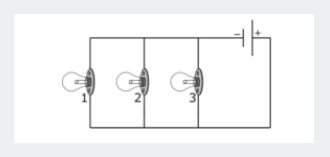

What is a circuit that only has ONE path for electricity to flow?
series circuit
closed circuit
parallel circuit
light bulb
Conventionally, current is described as flowing from the ................ terminal of a battery to the ................ terminal.
Negative.....negative
Negative....positive
Positive......negative
Positive....positive
In the circuit, the bulb lights up because there is ............... flowing in the closed circuit.
battery
current
resistance
voltage
In the circuit, the bulb lights up because there is ............... flowing in the closed circuit.
battery
current
resistance
voltage
Current can be measured using ............
ammeter
light bulb
resistor
voltmeter
Voltage can be measured using ............
ammeter
light bulb
resistor
voltmeter
An ammeter is connected in ...........
Parallel
Series
A voltmeter is connected in ...........
Parallel
Series

This is the symbol for
ammeter
light bulb
resistor
voltmeter

This is the symbol for
ammeter
light bulb
resistor
voltmeter
SI unit of resistance is
ampere
metre
ohm
volt

The table describes four different resistance wires.
They are all made from the same metal.
Which wire has the smallest resistance?
A
B
C
D
Which equation can be used to calculate the resistance R of a resistor?
V = I / R
I = V x R
R = V x I
V = I x R
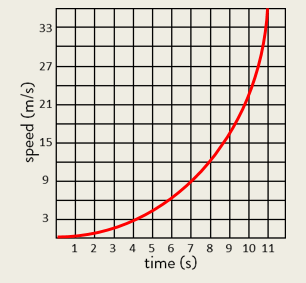
What is this graph showing?
Gradually slowing down
Gradually speeding up
Constant speed
Stopped

What is this graph showing?
At rest
Acceleration
Constant speed of 1 m/s
Gradually speeding up

What is this graph showing?
Constant speed
Gradually speeding up
Gradually slowing down
At rest
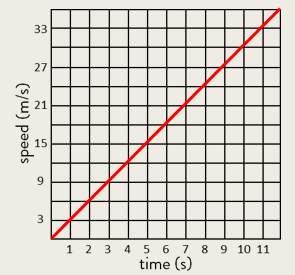
Accelerating gradually
Stopping
Slowing down constantly
Speeding up constantly

What is this graph showing?
Fast constant speed
Slow constant speed
At rest
Accelerating

What is this graph showing?
Two objects speeding up constantly
Two objects slowing down constantly
Two objects accelerating
Two objects at rest

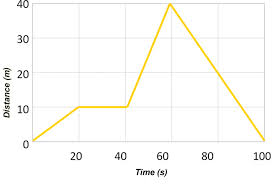
What is the graph showing?
Slowing down moving toward start
Speeding up moving toward start
Slowing down moving away from start
Speed up moving away from start

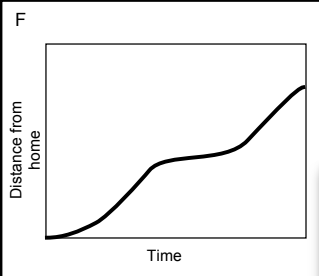
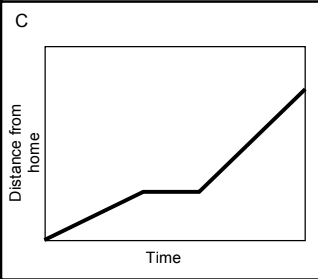
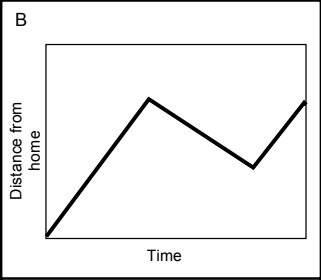
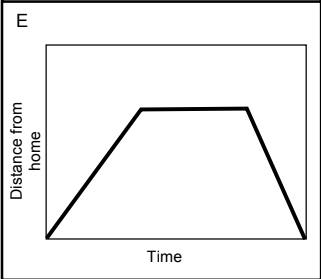



Which of the following is the correct equation for calculating SPEED?
s = d / t
s = d x t
s = t / d
s = d - t
How do you find the speed from a distance-time graph?
Find the area under the graph
Find the gradient of the line
Read the height of the graph
How do you find the distance travelled from a speed-time graph?
Find the gradient
Find the area under the graph
Read the height of the graph

How long is the train stopped for in total?
5 minutes
7.5 minutes
10 minutes
2.5 minutes
Calculate the acceleration of the train at 2.5 minutes
1 km/m2
3.33 km/m2
0.3 km/m2
7.5 km/m2
This variable is the one thing that changed on purpose...
Dependent Variable
Control
Independent Variable

Mr. Pransky wants to see how different surfaces affect how high a tennis ball can bounce. What is the independent variable?
the different surfaces
using the same ball
how high they bounce

A student wants to test the hypothesis of "If salt is added to water then the boiling point of water will decrease (go down)." What is the independent variable?
Whether salt is added or not
Boiling Point
Amount of water
What are the constant variables?
what we are changing or testing
what we are observing or measuring
what we keep the same to make the experiment fair
An object that orbits a planet is a
Orbiter
Satellite
Planetoid
Why do satellites orbit a planet?
The force of gravity pulling inwards is always perpendicular to the satellite's velocity
The centripetal force is always parallel to the satellite's velocity
The object travels at a very fast angular velocity
The equation for orbital speed is
2πd/T
ΨρφγΦ^2/(κ^3.πλ)
πr/T
2πr/T
The planet with the slowest orbital speed is
Neptune
Uranus
Saturn
Pluto
Planets follow ________ orbits
Circular
Oblong
Elliptical
Triangular
How much gravity an object has depends on its _________.
Weight
Speed
Momentum
Mass
When will gravity be the strongest?
The further away you are from an object
The closer you are to an object
The faster your relative speed is to an object
None of the above

Which of the following has the strongest gravitational pull?
A bowling ball
A car
The Earth
The Sun
What do we call the force of gravity on an object?
Weight
Mass
Speed
Acceleration
Weight is a force that depends on mass and:
friction
gravity
magnetism
energy
Compared to your weight and mass on Earth, if you were on the moon:
your weight and mass would be less.
your weight would be less but your mass would remain the same.
your weight would remain the same, but your mass would be less.
your weight would be greater, but your mass would remain the same.
What is the weight of your backpack in Newtons? The mass of your backpack is 10 kg. (assume: g = 9.8 m/s2)
10 N
9.8 N
98 N
980 N
The correct equation to solve for weight in Newtons is:
W = m/g
W = g/m
W = grams
W = mg

Calculate the weight in Newton's of the small stack of textbooks. (Mass = 3 kg; Assume on Earth g = 9.8 m/s2)
0.306 N
3 N
29.4 N
58.8 N
On Earth, the acceleration due to gravity is constant. Without air resistance, objects will fall to the ground at the same acceleration.
True
False
The acceleration due to gravity on Earth is .....
g = 1.6 m/s2
g = 3.8 m/s2
g = 9.8 m/s2
g = 24.6 m/s2